Book Review: The Shattered Skies by John Birmingham

Cover of the book The Shattered Skies by John Birmingham
The Shattered Skies
by John Birmingham
Del Rey, 2022

This review was first published by Booklist on January 1, 2022.

Commander Hardy, Admiral McClennan, Seph, Princess Alessia, and their crews struck a decisive blow against the Sturm, but the war is just beginning. Humanity in the Greater Volume has been decimated, and the group is left searching for survivors to build an army to stand against an overwhelming enemy. But the Sturm may not be the most dangerous foe they face, as human greed and shortsightedness threaten to scuttle alliances before they can even start. The second entry in Birmingham’s Cruel Stars series (after The Cruel Stars, 2019) boasts all the best elements of its predecessor: absorbing conflicts with high stakes and believable antagonists, complex characters with rich relationships and effective emotional depth, and Birmingham’s magnificent world building. Whereas the first book was slightly marred by its overreliance on coincidence to set up the climax, that’s not the case this time, which makes it the stronger tale—and readers will be left craving the next one. This is a delightful military space adventure that runs at full tilt.

Book Review: Mickey7 by Edward Ashton

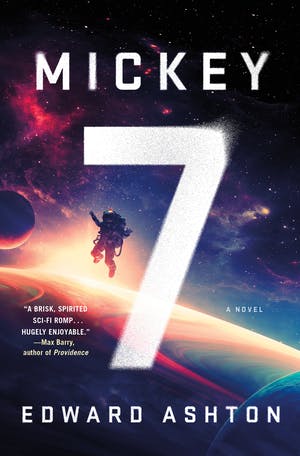
Cover of the book Mickey7 by Edward Ashton
Mickey7
by Edward Ashton
St. Martin’s, 2022

This review was first published by Booklist on January 1, 2022.

Expendables die. A lot. They’re people whose bodies and minds are stored and replicated as often as necessary. They do the deadly jobs that no one else can do. Mickey Barnes, an amateur historian and layabout, signed up to be an Expendable on a new colony ship to get away from some problems on his home planet. Now on his seventh incarnation, he’s left for dead on a mission on his new planet, but he survives—and now there are two of him. Duplicates aren’t allowed, though, so they need to hide their dual existence. And Mickey7 is the only one who knows that the local life-forms are sentient, and only he can avert an all-out war. Mickey7 is a fast-paced, character-driven, amusing romp of a tale. The concept is compelling and well developed, along with the backstory of how humanity spread out among the stars. Ashton crafts interesting characters and lets their relationships take center stage, and his world building is solid. This is an excellent choice for anyone who enjoys smart and funny science fiction.

Moral Certainty vs. Practical Action

If there’s one thing I’ve learned over the years, it’s this: Moral certainty is easy. Practical action is hard and almost always requires some degree of compromise.

Here are two principles of public librarianship which underlie our work:

  • Public libraries have a mandate to provide materials that represent multiple perspectives on a range of issues and subjects, especially to reflect the various viewpoints of members of the library’s community.
  • Public libraries are trusted sources of reliable, authoritative information. We vet information sources to be sure we offer good info to our patrons.

What happens when these two principles stand in direct contradiction with each other? What do you do when you can’t fulfill both of these principles?

As Neil Gaiman said, “Google will bring you back … a hundred thousand answers. A librarian will bring you back the right one.” There’s been a great deal of talk these past few years about the role libraries can play in fighting the spread of misinformation and promoting information literacy.

But we have people in our communities who hold to ideas and perspectives that are incorrect, at least when assessed by standards of information literacy and authority. These people expect to come into their library—which their tax dollars help fund—and find materials which reflect their beliefs.

How do you balance that?

Continue reading “Moral Certainty vs. Practical Action”

Book Review: How to Take Over the World: Practical Schemes and Scientific Solutions for the Aspiring Supervillain by Ryan North

Cover of the book How to Take Over the World: Practical Schemes and Scientific Solutions for the Aspiring Supervillain by Ryan North
How to Take Over the World: Practical Schemes and Scientific Solutions for the Aspiring Supervillain
by Ryan North
Riverhead, 2022

This review was first published by Booklist on December 1, 2021.

North, creator of the webcomic Dinosaur Comics, offers budding supervillains a how-to guide with instructions to pull off a variety of evil schemes, from building an impregnable fortress, to cloning dinosaurs, controlling the weather, becoming immortal, ensuring your evil message survives to the heat death of the universe, and more. But unlike comic books and movies which rely on unbelievable and fantastical devices, these are schemes you can theoretically accomplish with existing technology, based on real-world science. Make no mistake: these schemes will be difficult and costly, but they’re just this side of actually possible. This humorous framing device, accompanied by delightful illustrations by Carly Monardo, allows North to explore a range of topics around science and technology, explaining the current state of our knowledge and ability and considering what might be possible within an array of subjects. It’s an eclectic journey, full to the brim with North’s trademark sarcasm and humor. An excellent starting point for anyone interested in learning more about cutting edge science or becoming a supervillain.

This title has been recommended for young adult readers:

YA/S – special interest: This playful, humorous approach to science concepts will be a hit with many teens. —Julia Smith

Ditch the Small Talk

When I was younger, I was very much one of those people who hated small talk. I’m a strong introvert and I was painfully shy as a child. Small talk was too much social effort for something I considered trivial and unimportant. If I had to interact with people, I would much prefer to share deep meaningful conversation than chat about nothing. Deep meaningful conversation is worth the energy; small talk costs too much for something with no substance.

I reconsidered my stance on small talk as I got older. For one thing, I grew less shy and less frightened by the prospect of interacting with strangers. But, too, I realized it’s a matter of respect. I have to earn the right to know someone’s deepest thoughts and feelings. That’s not a level of intimacy I can demand from anyone. You have to earn a person’s trust first and that takes time. It requires an investment of attention and care. Relationships matter more than any single conversation, and I need to do the work to build a relationship so someone will know they’re safe to share more meaningful things with me.

Small talk is how people start to establish that sense of safety with each other. It’s how people feel each other out without too much risk to start. It’s the first step on a path to earn someone’s trust.

But then I read this article:

Continue reading “Ditch the Small Talk”

Reconsidering My Career Goals

I decided pretty early on in graduate school that I wanted to be a library director someday. I could picture myself in that role and I wanted it. That’s how I knew librarianship was the right career for me: it’s literally the only thing I’ve ever done in my life where I want to take on that level of responsibility.

I’ve been questioning this goal over the past few years, though. I’ve been thinking lately that maybe I don’t want to be a director anymore. This sounds like a major shift in my goals but it doesn’t actually feel like it. I don’t feel like my goals have changed. This career still feels right for me.

I’ve realized that library director wasn’t my goal: it was an assumption I had made about my goal. My goal, put simply, is this:

To do the most good I can for my community and my chosen profession.

I assumed library director would be the role where I could do the most good. I now believe this assumption was incorrect.

Continue reading “Reconsidering My Career Goals”

Book Review: Leviathan Falls by James S. A. Corey

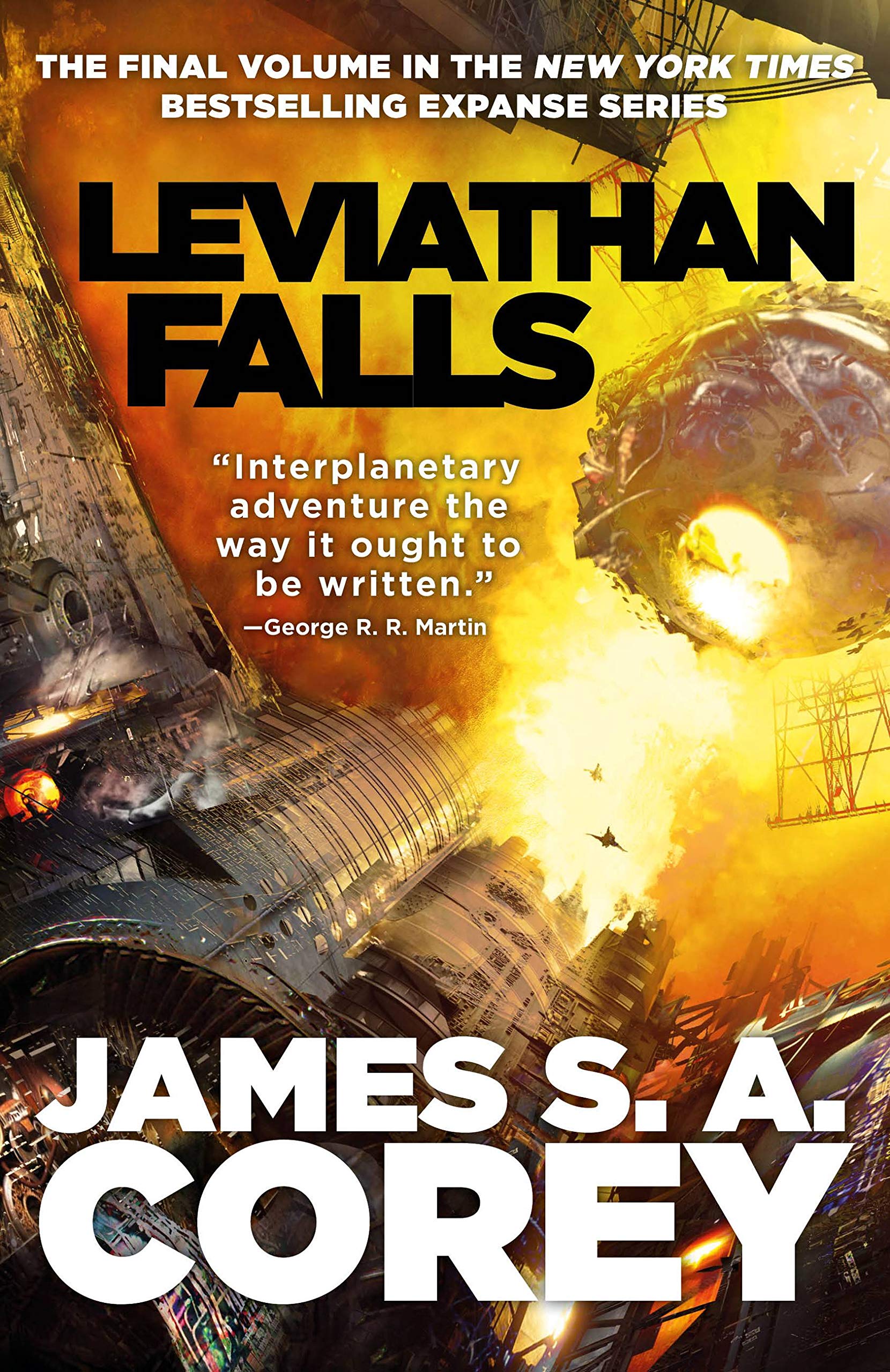
Cover of the book Leviathan Falls by James S. A. Corey
Leviathan Falls
by James S. A. Corey
Orbit, 2021

This review was first published by Booklist on November 1, 2021.

**STARRED REVIEW** Leviathan Falls picks up where Tiamat’s Wrath (2019) left off: the Laconian Empire defeated, Teresa Duarte onboard the Rocinante with Holden and crew, and the ancient enemy of the gate builders seeking ways to destroy reality itself. The final installment of Corey’s Expanse series is its strongest yet. It’s a thrill ride of a tale, boasting the same kinetic momentum of the first book, with the highest possible stakes and profound emotional resonance. The story is masterfully paced and structured, filled to bursting with some of the genre’s best world building. One of the central themes is how individual selfishness sabotages the greater good. It’s easy to read this as a commentary on current real-world circumstances, but it is elevated into an exploration of universal truths. This book illustrates the greatest strength of speculative fiction: to imagine unique circumstances as strange mirrors to help us see ourselves more truly. Corey maintains an impressive balance between unflinching realism and hope, with no illusions about the myriad faults of humanity, but still holds a fundamental belief in the essential worthiness of people. This is a deeply satisfying and fitting conclusion to one of the best space opera series in many years.

Masterpost of My Current Beliefs about Queer Identities

I’ve posted somewhat often over the past few years about queer identities and the issues surrounding them. I think it might be useful to try and gather together my thoughts and offer a mostly comprehensive explanation of my beliefs.

Let me be clear: I have very strong beliefs and principles around this—fundamental value buttons—so I’ll do my best to lay out my perspective as clearly as I can. Forgive me if this gets long-winded. Brevity may be the soul of wit but it’s not the soul of precision nor comprehensive and nuanced understanding.

Keeping up with the vocabulary is one of the biggest challenges of committing to being a queer ally and accomplice, which is something I’ve commitment myself to. The vocabulary around queer identities is in a state of flux and changes frequently. Culture evolves, politics change, movements coalesce and grow and fracture, visibility and acceptance waxes and wanes, and language changes concomitantly. It’s also worth noting that the “queer community” isn’t a monolith and there’s disagreement between queer folk about what words should be used and what they should mean.

Part of the challenge is that English has a poverty of words sufficient to describe the variety of queer experiences. We have to make due with many words that aren’t quite good enough, or try to convince people to accept new words we invent. Neither option is ideal. We do the best we can.

Continue reading “Masterpost of My Current Beliefs about Queer Identities”

Grammar Doesn’t Matter

A Rant about the Arguments over “They/Them” Pronouns

Once again, I see arguments online about the grammaticality of the singular “they/them” pronoun. People yelling that it can’t be singular and using it that way is just confusing and it’s therefore illegitimate, followed by people illuminating the history of the word and pointing out that language changes all the time anyway and citing numerous examples of how easy singular “they” is to understand in practice. I, myself, have done the latter on multiple occasions. And I’ve come to the following conclusion:

This is all bullshit distraction. The grammar DOES NOT MATTER.

Trans youth are at the highest risk of suicide of any group in our country. When trans youth have adults in their lives who support and affirm their chosen gender identity, their risk of suicide drops by half.

Using people’s preferred pronouns can help save lives.

Trans folk of all ages are at elevated risk of violence, suicide, employment discrimination, healthcare discrimination, homelessness, and incarceration. When communities support and affirm trans identities these risks are substantially reduced.

Using people’s preferred pronouns can help save lives.

I don’t give a shit about grammar. People’s lives are at stake.

If you’re more concerned about grammar than the lives and well-being of actual people, your position is morally indefensible.

I personally found the singular “they/them” confusing at first. It contradicts a lifetime of grammatical conditioning and it took time for me to get used to it. I honestly don’t think I’ll ever not be confused by of most of the newly invented gender-neutral pronouns that have been introduced over the past few years. I’m afraid of messing them up. I’m afraid I’ll hurt someone if I get their pronouns wrong, and I’m afraid of how people might judge me for my mistakes.

My confusion doesn’t matter.

If using preferred pronouns can help a trans kid turn away from contemplating suicide, I’ll do it whether I understand the language or not. If using preferred pronouns helps a trans person feel accepted and affirmed, I’ll do it. If using preferred pronouns contributes even in some small way to building a more accepting and supportive culture, one which materially improves the lives of people and reduces suicide rates, then HELL YES I’ll do it. I have a moral obligation to do it.

I don’t give a shit how confusing it is.

There’s no morally defensible position which can hold my personal confusion as more important than the lives and well-being of other people. Pronouns may confuse me but they don’t do me any actual harm. If using them can materially improve the lives of trans individuals, then I’m happy to be confused.

We need to stop engaging with arguments about grammar. Engaging in this allows TERFs and transphobes to control the terms of the argument. It grants de facto legitimacy to an anti-trans platform that should never be legitimized. It’s a distraction and a sidetrack and we keep falling for it. We have to stop.

People’s lives and well being will always matter more than any concerns about grammar.

Anyone who argues about the grammar of pronouns for trans folk has no legitimate argument to make.