Book Review: Platform Decay by Martha Wells

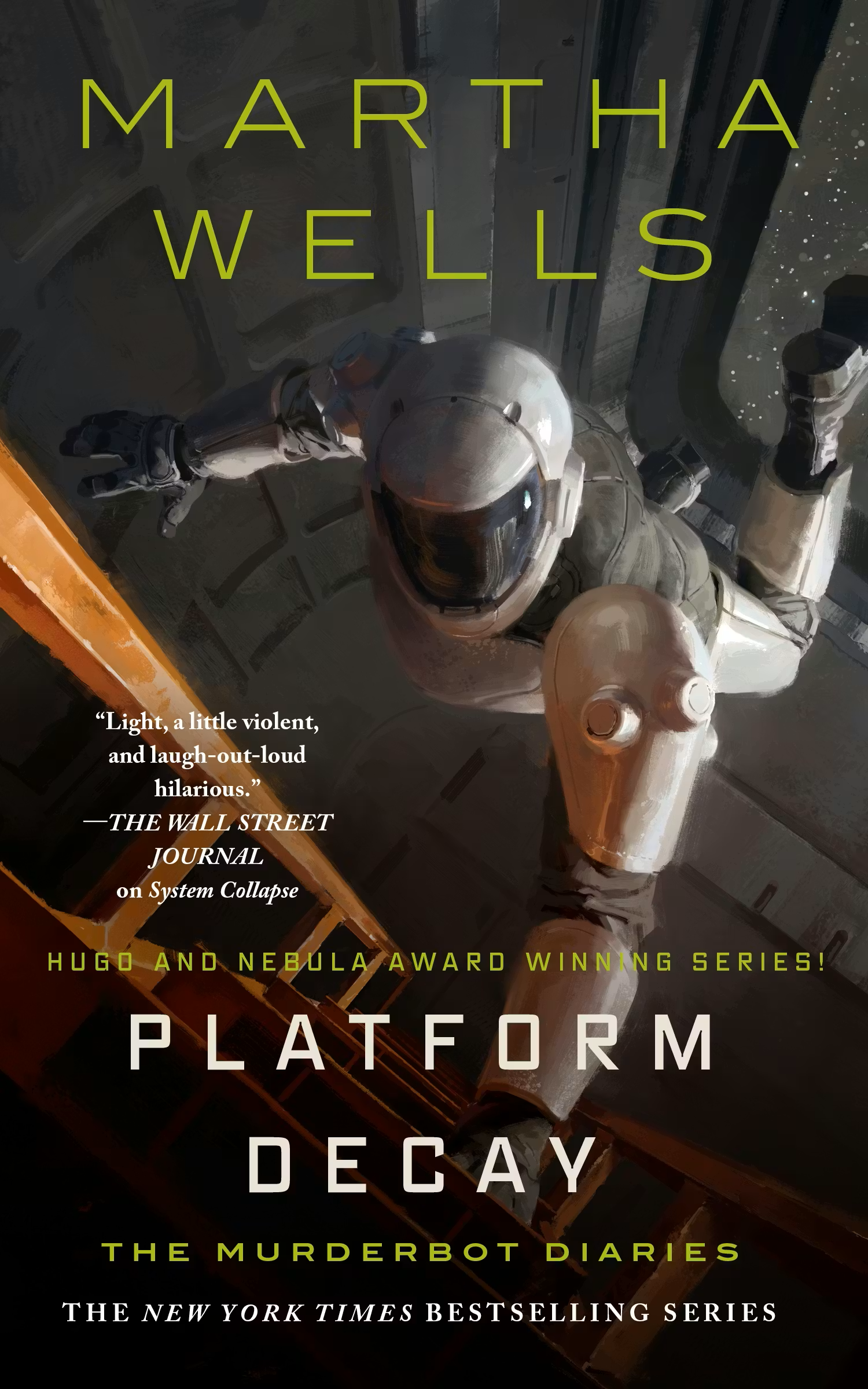
Cover of the book Platform Decay by Martha Wells
Platform Decay
by Martha Wells
Tor, 2026

This review was first published by Booklist on March 1, 2026.

**STARRED REVIEW** The newest Murderbot novel (after System Collapse, 2023) has our titular (not really an anti) hero aided by Three, the newest rogue SecUnit, on a stealth mission in a planetary ring habitat to retrieve members of Mensah’s family, who’ve been kidnapped by the Barish Estranza Corporation in retaliation for her role on the plague planet. Along the way, an unexpected ally complicates the mission, and somehow the corporate mercs seem to know they’re coming. The plot starts off in the middle of the action and doesn’t let up until the very end. It’s an incredibly satisfying ride, and one of the funniest installments in the series: After their false memory issues, Murderbot installed an “emotion check” subroutine and it’s a perfect vehicle for the sarcastic, cynical humor readers crave. Perhaps most intriguing is a small side plot that teases a change with potentially huge implications. Wells returns to form with this one, offering a setting and cast that feels smaller and more intimate, more like her earlier novellas. At the same time, she sets up exciting possibilities for where this universe could go next. The family dynamic adds real poignancy, providing one of the most emotionally resonant Murderbot tales yet.

HIGH-DEMAND BACKSTORY: The success of the Apple TV series only adds to Murderbot’s popularity, and readers have patiently waited several years for the next installment in the series.

Book Review: The Faith of Beasts by James S. A. Corey

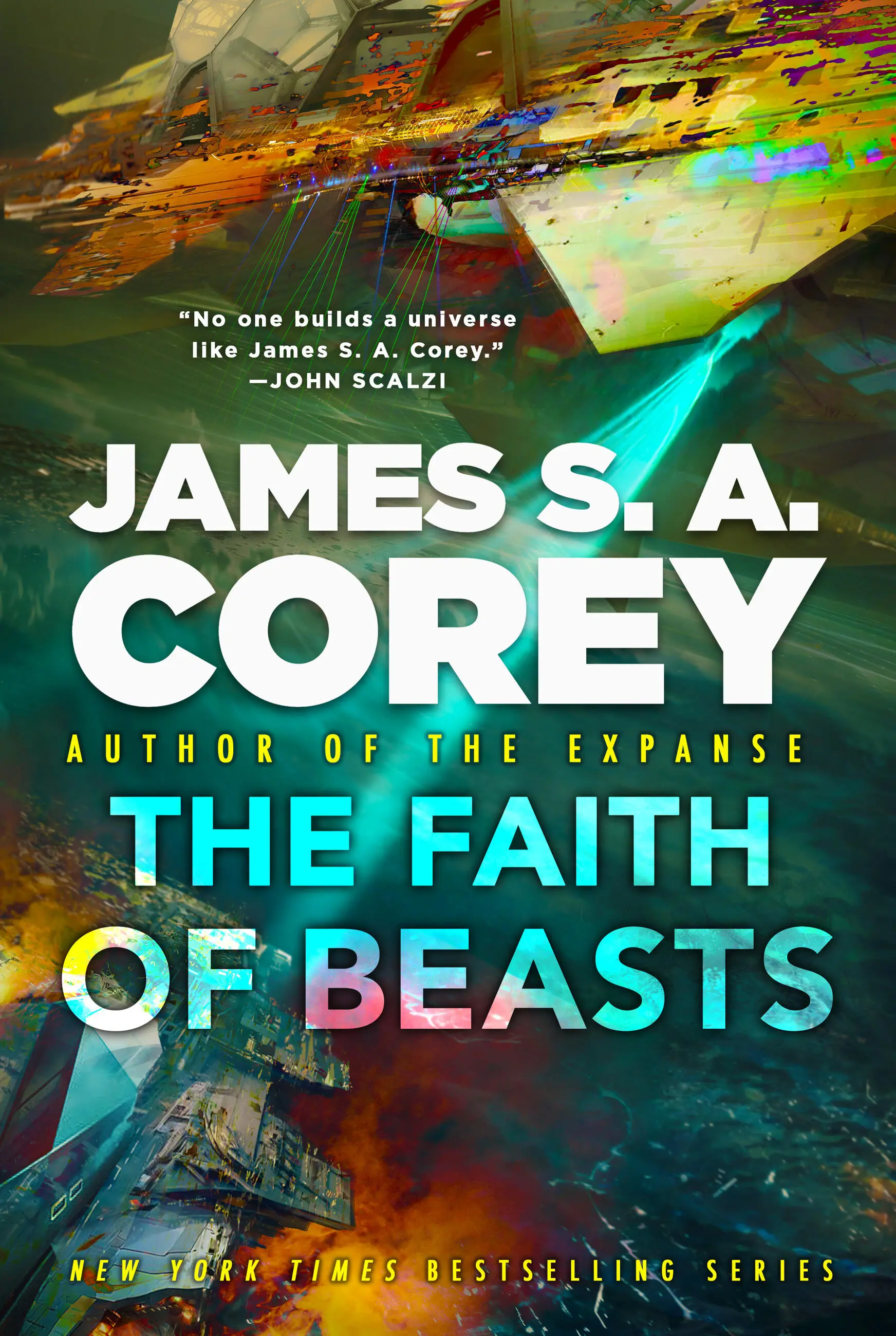
Cover of the book The Faith of Beasts by James S. A. Corey
The Faith of Beasts
by James S. A. Corey
Orbit, 2026

This review was first published by Booklist on March 1, 2026.

The human moiety (last seen in The Mercy of Gods, 2024) has adapted surprisingly well to their imprisonment on the Carryx world, proving their usefulness and even making their prison something like a home. The conspirators continue to wait for the right moment, and potential new allies are revealed. A handful of humans sent out into the wider galaxy make discoveries that radically alter their understanding of what underlies the never-ending galactic conflict. This entry in the Captive’s War series feels more intimate than its predecessor. With less world building to do, the focus has shifted more toward exploring the characters, including their relationships and complexity, as well as the ways they adjust to their new circumstances, offering an examination of how people acclimate even during horrific upheaval. Readers also learn more details about the society of the Carryx. While it’s somewhat less propulsive than The Mercy of Gods, The Faith of Beasts is a wonderful set-up for whatever is next. Fans of the series should be satisfied here and excited for the next installment.

AI: What I Really Think

I’ve spent a lot of time and devoted a lot of attention to the development of AI over the past few years, and my thoughts about it can be summed up very simply:

Why are we trying so hard to remove people from the world we’re building for ourselves?

I don’t understand why this is the thing we’ve decided we should want.

Years ago, I read some commentary that said this about social media: “More and more of our social lives are being designed and maintained by deeply antisocial people.”

This is especially true of AI. The people building it all seem to be deeply antisocial, even misanthropic. I could also update this criticism for AI a couple other ways:

Continue reading “AI: What I Really Think”

2025: My Year in Reading

I read 38 books this year. Mostly nonfiction, and proudly representative of my major interests: cosmology, deep time, and human nature. I ended the year with a stack of around 10 books sitting on my end table, most of which I’ve had checked out for several months and I just haven’t bothered to read yet. I keep renewing them from the library but when the time comes, I choose to sit in front of the TV rather than read.

When I have done some reading this year, it’s been in intense spates, several titles all in a row, all in a couple days. A punctuated equilibrium: watching TV is my default state, with quick periods of ravenous reading scattered around.

I’ve been struggling with this for the better part of decade. Peruse any of my past Year in Reading posts and you’ll see me harping on this. I consistently get to the end of each year with a feeling that I didn’t read enough, or didn’t read regularly enough. I have this idea in my head that I’m supposed to be a more dedicated reader than this.

Thing is: I didn’t used to worry about this. I didn’t used to think about it much at all. So why has it been such a major source of pressure and disappointment for me over the past decade? Let’s do some honest accounting of my history as a reader…

Continue reading “2025: My Year in Reading”

Mastery

Malcolm Gladwell famously stated it takes 10,000 hours to master a skill. This has been debunked over and over again by various experts. You can’t reduce growth and development to a formula: 10,000 hours = Mastery! How you spend each hour is the key.

I’m reminded of story I heard from my tai chi instructor:

A student of tai chi isn’t making any progress. The teacher asks him, “Have you practiced?”

The student replies, “I’ve practiced 100 hours since our last class.”

The teacher asks, “What do you do when you practice?”

“I do the form.”

“Do you pay attention to how you’re applying the principles?”

“No.”

“Do you actively seek out pockets of tension in your body and try to let it go?”

“No.”

The teacher tells the student, “You have not practiced 100 hours. You practiced one hour, 100 times.”

Intent and attention drive development. Even 10,000 hours will only add up to mastery if you spend those hours the right way. This brings me back to something I’ve posted about before: our cultural beliefs about time. “Time equals money!” is a frequent declaration, and it implies that we should reduce time spent in order to maximize profit.

But the key to quality is attention and care. Attention and care require an investment of time. 10,000 hours is a lot of time!

It’s also true that “haste makes waste.” Things done quickly are usually not done well.

In the end, my conviction is that quality matters most. Quality requires an investment of time. Things take as long as they take, if you want them done well. Stop worrying about time. What matters, what brings value to our endeavors, is intent, attention, and care.

Diversity Means Survival

I was perusing Bluesky recently, and saw a post about the newly discovered Neanderthal animal fat processing site:

Please can we stop being _surprised_ at Neanderthal intelligence! They had c. 400,000 years, longer than we've been around, to develop sophisticated solutions to problemswww.livescience.com/archaeology/…

Natalie Bennett (@nataliegreenpeer.bsky.social) 2025-07-05T14:11:57.191Z

This was my reply to it:

Their brains were larger than ours, with proportional frontal lobes and cortical folding (we’re pretty sure), they created symbolic images, had funerary rites. So, yeah… We know they were smart, in most of same ways we are.

John the Librarian (he/him) (@johnthelibrarian.bsky.social) 2025-07-05T17:12:55.971Z

This got me thinking in a different way about the value of diversity.

We know that Neanderthal was as smart, maybe smarter, than us, and engaged in similar methods of thinking. And yet, they died out at the end of the last ice age and we didn’t. Why is that?

Continue reading “Diversity Means Survival”

Sometimes Our Job Is Hard

Several years ago, I worked for a nonprofit that did event-based fundraising. We purchased a new all-in-one software service that ran both the back-end fundraising and participant database, and our front-end event website, where participants could have a profile page and accept online donations. Because it was an all-in-one package, the way you configured each end affected how the other end functioned. Changes to any part of the system caused ripples to other parts. My job was to set up and configure the software, and provide tech support to participants.

The back-end database wasn’t easy to use: overly complicated, nonintuitive workflows. A colleague who worked in the accounting department, and who only interfaced with the back-end database, came to me with a list of things she hoped I could reconfigure to improve the workflow. I looked at the list and realized these changes would alter the participant front-end in ways that would make it much harder for people to use.

So I said no.

My colleague agreed when I showed her what the impact would be. We couldn’t make it harder for participants and donors in order to make our jobs easier. Better we deal with the difficulty than them.

I think about this whenever we look for ways to make our jobs easier. It’s totally fine to want to make our jobs easier, but there are going to be ripples that affect other people, either customers or colleagues. We need to be aware of how our workflows affect someone else’s, especially if we make their job more difficult in order to make ours easier. We need to consider whether that’s really what’s best for customers and the organization, and not just whether it’s best for ourselves.

Sometimes our job is just going to be hard.

Continue reading “Sometimes Our Job Is Hard”

Efficiency Is A Terrible Goal

In a recent discussion, a group of us were talking through options for using LLMs to make some our work tasks more efficient. I made the comment that I don’t believe efficiency is the correct goal for us to focus on. This statement set some of my colleagues aback. Modern American work culture is so steeped in the ideal of efficiency, it seems tantamount to sacrilege to suggest we shouldn’t value it the way we do.

I want to take some time here to unpack this belief. There are good reasons why I feel this way, but I also need to caution myself against dismissing the very real values that efficiency can bring.

Let’s start with a trite phrase: “Time is money.”

This phrase never sat quite right with me. It feels more correct to say, “Time is value.” On the face of it, these seem like they should be the same statement: money is intended as a measure of value, after all. But something interesting happens when you delve deeper into them.

Continue reading “Efficiency Is A Terrible Goal”

NaPoWriMo 2025: Wrap-Up

I did it! I completed NaPoWriMo 2025! With a couple caveats:

I didn’t write and post one poem per day. I kept up daily through April 5 (including the early-bird prompt on March 31), then fell about a week behind, then wrote a bunch of poems in one day to get mostly caught up, then fell about a week behind again, got mostly caught up all in one day… Regardless, I wrote thirty poems in thirty days.

I actually wrote more than thirty poems: Before the month even started, I wrote and posted a poem that popped into my head when I decided to participate; I did the early-bird prompt; and I wrote two poems on day sixteen (although one is a silly toss-off haiku which I probably shouldn’t count).

You’ll notice I didn’t post anything for day eight. (Even without this one, I still wrote more than thirty poems.) The prompt for this day was to write a ghazal, and frankly, I don’t think I can. I’m not skilled enough and I’m not confident to attempt one. I’m trying to talk myself into it, and one may be forthcoming, but I don’t promise anything. If I try it, I want to take it seriously, and not make a joke of it like I did with my sonnet this year (although I do really enjoy this joke!)

I don’t know why I didn’t title any of my work this year. I just… didn’t.

I enjoyed the prompts this year, more so than previous times I’ve participated, even though I didn’t strictly follow all of them. The inspirational links seemed disconnected from the prompts, which was a bit odd. Maybe I wasn’t clever enough to use the inspiration.

Continue reading “NaPoWriMo 2025: Wrap-Up”

NaPoWriMo 2025: Day 30

“Write a poem that … describes different times in which you’ve heard the same band or piece of music across your lifetime.” (https://www.napowrimo.net/day-thirty-11/)

My music lingers, in
my mind, my memory, my ears.
My music maintains meaning
down through all these years.

Music’s meaning may change,
age reveals new aspects.
New music enters my life,
new ways for meanings to connect.

A favorite song then,
years later, what was I
thinking? A favorite song
now, maybe someday to defy

its own meaning, as life
changes, music changes,
meaning changes. This is
the glory of how music ranges

The full spectrum of
human being, how it speaks
of the complexity of our
selves, our nadirs and peaks.

My music lingers,
long and lovely, loud
then quiet, soft and strident,
joyous, mourning, unbowed.