Inherent Bias in Classification Systems

December 10th is Dewey Decimal System Day. Maybe it’s only librarians who care much about it but to us it’s a big deal.

The entire history of our profession has been a quest to organize information. Sometimes organizational schemas were focused on preserving resources, on merely keeping a list of a collection’s holding, and sometimes systems were intended to restrict access. Indeed, for most of our history, knowledge institutions were exclusive and exclusionary.

But beginning with the birth of public libraries in the 1800s, we conceived the idea that knowledge should be accessible for the betterment of all people. The challenge was—and continues to be—to find ways to accomplish this goal through practical application in real-world situations, in day-to-day activities.

Melvil Dewey’s system was a massive paradigm shift. It seems like such an esoteric thing to celebrate but realize this: before Dewey’s organizational scheme, there existed no universal method for organizing collections of materials, and too many systems were obscure and overly complicated, to the point where people were often discouraged from attempting to access them.

Dewey created a system that anyone could understand and use. For the first time, people could walk into a library and find what they wanted on the shelf, or explore the catalog, without the mediation of a specialist. In a real sense, the Dewey system effectively transferred our collections of knowledge out of the hands of specialists and into the hands of the general populace. *

Still, for all my appreciation and admiration of Dewey’s achievement, when a coworker asked if I wanted to participate in Dewey Day activities at my library, my response was this:

“I have no interest in celebrating the Dewey system. It’s an archaic monument to Western superiority and colonial oppression which obscures the diversity of human cultures and silences diverse voices.”

Continue reading “Inherent Bias in Classification Systems”

Classic SF & Welcoming New Readers

On November 28, 2017, the author Seanan McGuire posted an excellent tweet thread about classic SF and entry points for readers new to the genre. She addresses crucial issues of diversity and inclusion. This perspective is important. Please take the time to click through and read it.

Conclusion: classic SF will always be important but it’s not a good way to bring in new readers.

Introducing new readers to science fiction can be tricky. It’s a challenging genre to learn and get used to. I decided years ago (long before I became a librarian or knew anything about readers advisory) that it doesn’t work to get people started in the genre with classic Asimov, Clarke, et al.

I’m ashamed to admit my reasoning at the time had nothing to do with the narrow Western cultural male whiteness of the work. It was because of the writing and the science.

Consider Isaac Asimov.

Continue reading “Classic SF & Welcoming New Readers”

Book Review: Black Star Renegades by Michael Moreci

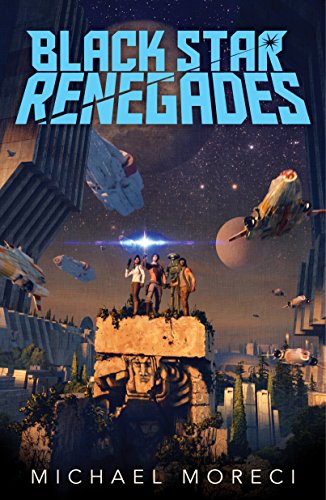
Cover of the book Black Star Renegades by Michael Moreci
Black Star Renegades
by Michael Moreci
St. Martin’s, 2018

This review was first published by Booklist on December 1, 2017.

Rai brothers Cade and Tristan Sura are elite warriors dedicated to keeping peace. Tristan is destined to become the Paragon, wielder of a legendary weapon that can protect civilization from an evil empire threatening to take over the galaxy. But when Tristan dies, Cade is stuck with the weapon—and saving civilization. Problem is, he doesn’t want the job. Moreci’s debut novel is a delightful mash-up of genre tropes: a reluctant hero, swashbuckling space adventure, martial arts, an evil empire, a scrappy band of outcasts, and a sentient killer robot. It’s a loving ode to the science fiction Moreci grew up with. The pacing is fast and exciting, strong on action and generous with humor. Moreci’s writing style could stand to be a bit more sophisticated; he doesn’t fully adapt to prose from his beloved work in comics (Roche Limit, 2015). But he clearly has fun telling this story, and his joy is infectious; fans of his work in comics and the online Star Wars community will be looking for this one.

Poetry and Nonsense

I was talking to my parents recently about some of the poetry I’ve written in the past few years. I mentioned how I’d developed a fascination with ways to integrate technology into poetic experimentation. I explained how much I enjoy Google search poems. I told them how I created a method of generating something akin to found poetry, using my smartphone’s auto-suggestion typing feature.

My mom said she’d like to read my tech-based poems, so I sent her links to my first auto-suggestion poem and a Google search poem I built (both written for National Poetry Writing Month in 2016).

My mom responded to these poems with this: “Is playing with words poetry in and of itself?”

Continue reading “Poetry and Nonsense”

Book Review: Terminal Alliance by Jim C. Hines

Cover of the book Terminal Alliance by Jim C. Hines
Terminal Alliance
by Jim C. Hines
DAW, 2017

This review was first published by Booklist on November 3, 2017.

A biological attack turns most of the crew of the spaceship Pufferfish into ravening zombies. Only the janitorial crew members survive unscathed. It’s up to them to figure out how to avoid the attackers still hunting them—but first they have to figure out how to fly the ship. Thus begins Terminal Alliance, the first novel in a new series from the author of the Magic Ex Libris series (Revisionary, 2017) that raises the bar for humorous postapocalyptic science fiction with charming underdogs, fascinating alien races, complex intergalactic politics, and a far-reaching conspiracy. With so much serious dystopia on the shelves, a story like this is a genuine pleasure to read: proudly funny and ridiculous. But don’t dismiss this novel as only silly fun. It is also good science fiction: a solid premise, an expansive universe, a compelling history, a strong and varied cast of characters, pulse-pounding action, and a galactic crisis with high stakes. The fact that it’s funny is icing on a rich and delicious cake. Clever, and should appeal to fans of Douglas Adams and John Scalzi.

Book Review: The World of Lore: Monstrous Creatures by Aaron Mahnke

The World of Lore: Monstrous Creatures by Aaron Mahnke
The World of Lore: Monstrous Creatures
by Aaron Mahnke
Del Ray, 2017

Aaron Mahnke’s Lore podcast is one of the more fascinating and informative podcasts available. He explores the world of lore: folktales and legends—usually creepy or macabre—and shares the interesting things he finds. He’s an accomplished and entertaining storyteller.

Podcasts are subject to time constraints: there’s only so much you can fit into each episode. While the stories he shares with his listeners are clearly well researched, he doesn’t go into much depth with them. And that’s OK for a podcast—the point of these stories is to share them and entertain his audience. While he occasionally asks the Big Questions (“Why are we drawn to myths and legends like these? What purpose do they serve?” etc.) he never offers much more than cursory, broad strokes answers. Again, that’s fine for a podcast—he needs to focus each episode on telling the cool stories he finds.

Continue reading “Book Review: The World of Lore: Monstrous Creatures by Aaron Mahnke”

How Can Libraries Compete with Amazon?

I’m so bored by this question. Let’s talk instead about some things Amazon can’t do:

  • Amazon can’t be part of a community.
  • Amazon can’t build meaningful, multifaceted relationships with people at a local level.
  • Amazon can’t provide communal space.
  • Amazon can’t provide boots-on-ground, in-the-trenches, front-line community services.
  • Amazon can’t provide anything beyond purely commercial transactions.
  • Amazon can’t be assumed to care about the common good.
  • Amazon can’t build trust with people.

Libraries do all these things. Libraries do so much more than these things. All without ever advertising to you, without leveraging your needs for commercial gain.

Amazon values monetization. Libraries value people.

Can libraries compete with Amazon? This isn’t a legitimate question. If you think Amazon is competition for libraries, then you fundamentally don’t understand what libraries do.

The truth is this:

Amazon can’t compete with us.

Book Review: Too Like the Lightning by Ada Palmer

Too Like the Lightning by Ada Palmer
Too Like the Lightning
by Ada Palmer
Tor, 2016

In the future, mankind has avoided self-destruction by a hair’s breadth. Organized religions have been outlawed. Ultrafast transportation has rendered geographical nations irrelevant. Society has been rebuilt according to the ideals of 18th century Enlightenment philosophy. The world’s most notorious criminal—serving a sentence in service to any who command—and a sensayer (a spiritual therapist and guide) discover a child who can perform miracles, with the power to irrevocably change the nature of reality itself. And a brazen theft threatens to expose secrets that could topple the world’s greatest powers.

Too Like the Lightning by Ada Palmer is a near perfect blend of science fiction and philosophy.

Continue reading “Book Review: Too Like the Lightning by Ada Palmer”

Book Review: Tropic of Kansas by Christopher Brown

Cover of the book Tropic of Kansas by Christopher Brown
Tropic of Kansas
by Christopher Brown
Harper/Voyager, 2017

This review was first published by Booklist on September 27, 2017.

In the near future, the U.S. is broken apart into warring territories, the president is a tyrant, and rebellion rends the land. Immigration across all borders is restricted. Sig, a feral and fugitive young man, and Tania, a lawyer working for the government and daughter of a revolutionary, are connected by their past, and both get caught up in the burgeoning rebellion. They journey into the Tropic of Kansas, through the broken heartland of America to a flooded New Orleans, a world populated by smugglers, militia bands, monolithic corporations, and revolutionaries. Confronted by unreliable alliances and uncertain trust, they both must decide where their loyalties lie. This vision of the future is violent, unforgiving, and bleak: Cormac McCarthy meets Philip K. Dick. It’s disturbing because of how believable it is. The novel’s structure is fractured: chapters are short, with frequent jumps between characters. This gives the work an uncertain and unsettled feel and captures the fractured nature of the world these people inhabit. It’s remarkably effective. Recommended for fans of Paolo Bacigalupi and China Miéville.

Book Review: What the Hell Did I Just Read by David Wong

Cover of the book What the Hell Did I Just Read by David Wong
What the Hell Did I Just Read
by David Wong
St. Martin’s, 2017

This review was first published by Booklist on September 21, 2017.

David, John, and Amy are back in their third adventure (after This Book Is Full of Spiders: Seriously, Dude, Don’t Touch It, 2012), and it’s as snarky, bleak, and funny as one could hope for. The narrative starts with a high-speed car chase and never slows down, racing headlong at a breathtaking pace. Children are being kidnapped; the Big Bad is a shape-shifter; and there’s an abandoned mine, a motorcycle gang, and yet another mysterious black-cloak organization. Our heroes remain hilariously incompetent and incredibly lucky. Then things get really weird. This book is a mind-trip, messing with the characters’ heads and making the reader question reality right alongside them. These are established characters, so readers shouldn’t look for much development. It’s also a bit too fast-paced: it’s easy to miss details that need to be remembered later. Although it’s not the strongest entry in the series, it’s exciting and a great deal of fun, which is really what Wong’s fans want.