Book Review: Power Play: How Video Games Can Save the World by Asi Burak and Laura Parker

Cover of the book Power Play: How Video Games Can Save the World by Asi Burak and Laura Parker
Power Play: How Video Games Can Save the World
by Asi Burak and Laura Parker
St. Martin’s, 2017

This review was first published by Booklist on December 15, 2016.

This book is a survey of the movement to use video games as tools to educate and empower positive social change. Each chapter dives into a specific game or media company to present the history of this movement through real-world examples. Games can be forces for good—these games have been used to foster empathy and compassion, to illuminate mutual understanding, to promote involvement in civics and science, and even to help the sick deal with illness. Lead author Burak has been a pivotal figure in the Games for Change movement. Just about all of the games profiled in this book were projects that his organization, Games for Change, was involved with in some way. This makes him biased on the subject, certainly, but it also makes him better informed about the state of social-impact games than just about anyone else. This is an insider’s perspective, and the authors make a compelling argument. Games for Change might just change the world someday. It will be exciting to see what comes next.

Hate Speech in Libraries

There have been several reports over the last few weeks identifying a rise in incidents of hate speech, racist graffiti and slogans, and acts of violence toward members of various minority groups throughout the country. Several libraries have been targeted—books and buildings have been defaced with swastikas, racist, sexist, homo- and transphobic epithets, explicit threats of violence toward minority groups, etc.

Libraries are targets because we stand at the vanguard of promoting inclusion and diversity. We seek to empower the disempowered, to give voice and provide access to all individuals and groups within our community. We hold as a core value that no one be excluded from the tools and services we offer, that no one be silenced or impeded from equal participation in our community. Libraries function as a safe space for anyone who needs it.

Libraries pose a great threat to those who seek to exclude all those who are different from them.

Libraries hold a resolute belief in the freedom of speech and expression. This is fundamental to everything we do. How, then, are libraries supposed to handle incidents of hate speech?

Continue reading “Hate Speech in Libraries”

Book Review: The Passage by Justin Cronin

The Passage by Justin Cronin
Ballantine Books, 2010

On paper, there’s a lot I could criticize about The Passage by Justin Cronin.

The plot isn’t terribly original: a virus is unwittingly unleashed by the government which turns people into something very much like vampires. Mr. Cronin presents the standard well-intentioned scientist whose work is hijacked by the military (which, as expected, doesn’t go well). There’s a roster of bad guys, a cop with a conscience, and a Chosen One whose arrival can save mankind. There’s even an oracle of sorts.

It’s a man-made apocalypse story built on fairly generic story tropes. We witness the moment it all goes wrong and then spend the rest of the novel living in the post-apocalyptic world of the few survivors.

We’ve seen all this before. I Am Legend, zombie movies, The Walking Dead, et al. The ending offers a faint wisp of Buffy the Vampire Slayer. Even the hive-mind wrinkle the author incorporates into his vampires is a familiar idea.

But none of that is a problem. None of it is a weakness. None of it feels derivative. This is one of the best renditions of all these ideas I’ve read.

Continue reading “Book Review: The Passage by Justin Cronin”

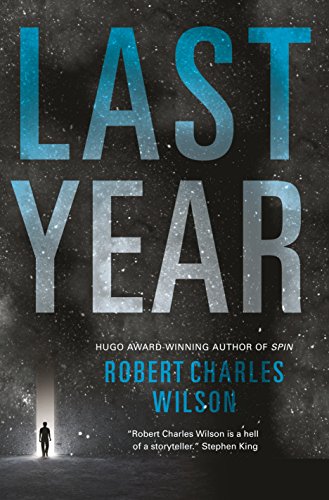
Book Review: Last Year by Robert Charles Wilson

Cover of the book Last Year by Robert Charles Wilson
Last Year
by Robert Charles Wilson
Tor, 2016

This review was first published by Booklist on November 15, 2016.

People from the twenty-first century have opened a portal in rural Illinois that allows them to visit 1877. They’ve built a tourist resort called the City of Futurity, where wealthy individuals can experience the past and locals can catch a sanitized glimpse of the future. Jesse Cullum is a native of 1877 who works for the City. A man with a violent history, he meets and falls for a woman from the future. Meanwhile, someone is smuggling future technology into the past and sowing discord toward the City. Soon enough, it all starts to fall apart. There’s a lot going on in the latest from Hugo Award–winning Wilson. It’s an alternate-history novel, a time-travel story, and a whodunit all in one. It explores parallel universes, corporate greed, and culture clashes while critiquing the entitlement of modern society and our tendency to romanticize the past. Wilson wrangles all these threads with skill and vividly renders the reality of the past. The story is well paced, builds to an epic crisis, and makes for a satisfying read.

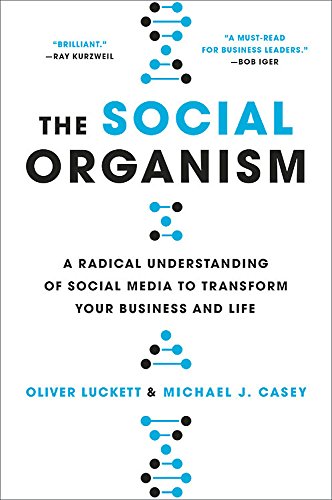
Book Review: The Social Organism: A Radical Understanding of Social Media to Transform Your Business and Life by Oliver Luckett and Michael J. Casey

Cover of the book The Social Organism: A Radical Understanding of Social Media to Transform Your Business and Life by Oliver Luckett and Michael J. Casey
The Social Organism: A Radical Understanding of Social Media to Transform Your Business and Life
by Oliver Luckett and Michael J. Casey
Hachette, 2016

This review was first published by Booklist on November 1, 2016.

Luckett and Casey are established authorities in the world of social media. If anyone can help us understand this digitally connected world, it’s them—and they don’t disappoint. They propose that the best way to comprehend the nature of social media is through the model of the seven characteristics of biological life. The book offers a deeply informed and nuanced portrait of the social-media landscape, supported by numerous examples. Although the outlook is hopeful, the authors clearly recognize the pitfalls and dangers social media presents and argue that we must guide its development if we want to make it better. The title implies that this will be a practical how-to manual for anyone who wants to take advantage of social media. It’s not. This is an overarching theory of social media, spanning disciplines from biology to anthropology to business to computer science. Whether or not you agree with their vision for what social media can be and do, this work offers a compelling model to understand what social media is.

Book Review: Into the Woods: A Five-Act Journey Into Story by John Yorke

Into the Woods: A Five-Act Journey Into Story by John Yorke
The Overlook Press, 2014

Why do stories work the way they do? Why are they structured the way they are?

These questions fascinate me. Storytelling—its nature, how it works, the role it plays in human lives and society—fascinates me. As much as anything, storytelling is what marks human beings as unique among all the animals of Earth. The act of telling stories partakes equally of our capacity for imagination and our need to discern pattern in world around us. We use stories to try and make sense of our experiences and simultaneously celebrate the mysterious and unknowable. It’s both creative and formulaic.

The stories we choose to tell, and the ways we choose to tell them, tell us who we are and how we understand our role in existence.

Continue reading “Book Review: Into the Woods: A Five-Act Journey Into Story by John Yorke”

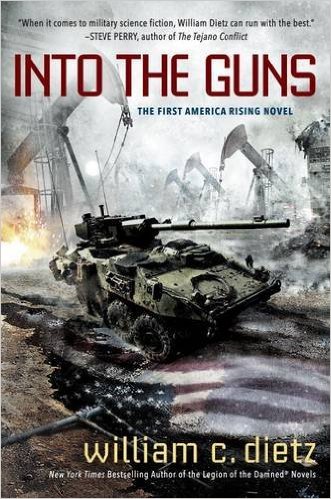
Book Review: Into the Guns by William C. Dietz

Cover of the book Into the Guns by William C. Dietz
Into the Guns
by William C. Dietz
Ace, 2016

This review was first published by Booklist on October 13, 2016.

Into the Guns begins a new near-future military sf series from Dietz. In 2018, several meteors strike the earth and decimate civilization, and the American government is left in turmoil. Members of the armed forces are left stranded without command. The southern states secede from the union, a second Civil War looms, and a new president struggles to rebuild. The plot’s not very original, but it works. Dietz’s depictions of military operations and hardware are detailed. That alone is a major appeal factor. He delights in throwing around military jargon, although he’s inconsistent about defining some of the terms for readers unfamiliar with the argot. Unfortunately, characters are sketches more than fully rendered. Yet this will be a worthy purchase, given Dietz’s many fans.

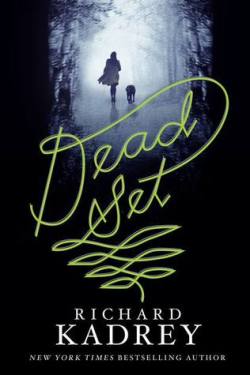
Book Review: Dead Set by Richard Kadrey

Dead Set by Richard Kadrey
Harper Voyager, 2013

Dead Set by Richard Kadrey wasn’t what I expected.

The basic plot summary is very much in keeping with Kadrey’s métier:

A teenage girl starts having strange dreams after her father dies. She’s in turmoil, she and her mom fallen on hard times, their life turned upside down. She discovers a record store with a room full of records which contain the lives of dead people… including her father’s. There’s an imaginary brother she relies on who only appears to her in dreams, and an underground world full of dead people, monsters and myth.

It’s the kind of dark, fantastical setting Kadrey is so good at. Literally underground, too, like most of his settings. Dead Set gives us a compelling main character, a satisfying story, and takes on important themes.

So, too, Dead Set has all the attitude and swagger, the sense of outsiderness, and it drips with a punk aesthetic.

So far—typical Kadrey.

Continue reading “Book Review: Dead Set by Richard Kadrey”

On Customer Service & Reference Interviews

When I went through my library & information science graduate program, I took the required reference classes and I learned the basics of how to conduct a reference interview. The idea behind a reference interview is pretty simple:

People don’t always know how to ask for what they really need.

We all frequently struggle to voice our needs properly—we say things badly, misunderstand ourselves, head down misleading paths, etc. Also, library patrons often aren’t aware of all the options and resources that are available to meet their needs—but they usually think they know what the best option is, and so come in asking for something specific without realizing that there may be much better resources for them.

When it comes to digital library services, the issue tends to be that patrons don’t understand how these systems work, aren’t fully aware of what they can and can’t do, so when a service doesn’t behave the way they expect it to, they assume that it’s broken.

As librarians, it’s our job to connect our patrons to the best resources to answer their needs. The purpose of the reference interview is to make sure we know what their need really is, so we can find the best resources for them, or teach them how to get the most out of the services we provide.

Continue reading “On Customer Service & Reference Interviews”