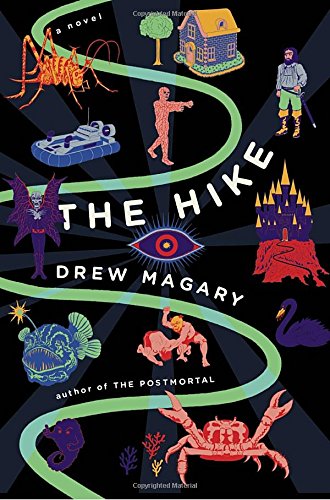
Book Review: The Hike by Drew Magary

Cover of the book The Hike by Drew Magary
The Hike
by Drew Magary
Viking, 2016

This review was first published by Booklist in July, 2016.

In simplest terms, this is the story of a man, Ben, who goes for a walk in the woods, gets very, very lost, and stumbles into a fantastic and monstrously dangerous realm from which he can’t seem to escape. The bizarre, funny, and haunting narrative achieves a dream-like quality, with events that feel simultaneously random and inevitable. Magary’s writing echoes the compelling lyricism of folktales, which juxtaposes surprisingly well with his sarcastic sense of humor. More than anything else, this novel may remind readers of classic adventure computer games like King’s Quest. The main character is faced with an arbitrarily circumscribed world and limited options, and the story unfolds in ways that are strange and disturbing. Just like those old computer games, it has an addictive quality; you need to know what’s going to come next. The book stumbles a bit at the end, trying too hard to be philosophical, and there’s a last-second twist that’s harmless but also unnecessary. Otherwise, an engrossing and imaginative read.


Book Review: The Swarm by Orson Scott Card and Aaron Johnston

Cover of the book The Swarm by Orson Scott Card and Aaron Johnston
The Swarm
by Orson Scott Card and Aaron Johnston
Tor, 2016

This review was first published by Booklist in July, 2016.

Earth survived the attack of the first Formic scoutship. But can the heroes of that first invasion save humanity from the full fleet that’s on its way? The Swarm picks up a few years after the conclusion of the First Formic War series. Earth has begun preparing a desperate defense. The Hegemon, Polemarch, and Strategos are in place, and the newly minted International Fleet is working with corporate forces to build an armada and weapons as fast as possible. Will it be enough? And can humanity overcome the dangers posed by political machinations, careerism, international squabbles, and petty bureaucracy? The greatest threat may be ourselves. This is a solid outing, well-paced and exciting with a mounting sense of crisis, grand in scope yet human in perspective. Fans of the Ender Universe and the First Formic War series will be eager for this one—readers will find the same central characters as well as some new faces. It will be particularly satisfying for longtime fans to finally see the creation of the Battle School.

Virtues, Dogs & Love: Scattered Thoughts in the Wake of the Orlando Tragedy

When I was a kid, I was taught the basic virtues: love, honesty, charity, hope, loyalty, modesty, tolerance, temperance, courage. I was taught that these are what we should strive for, as individuals and as a culture.

As a kid, I remember thinking how well these virtues describe a happy, healthy dog. As an adult, it sometimes seems that too many humans have too little of any of these virtues.

This is a picture of me and our dog.

Addison & Me, June 10, 2016
Addison & me, June 10, 2016

She doesn’t care what color my skin is, what country I come from, what my gender is, who I want to have sex with (or don’t want to have sex with), what god I believe in (or none at all), how much money I make.

None of that matters.

She only knows that we love her as best we can and she loves us. We keep her safe, sheltered, fed. We play with her and show her the world. We’re kind to her and we will never hurt her. And for that, she gives us everything she has.

That’s all that matters. Everything else is just vanity.

Dogs love so easily. There’s never any struggle for them to love unconditionally. It’s their default state.

But they don’t hate. They may learn to fear, they may become conditioned to be distrustful, but their fear is only ever that: fear. It never translates into hatred. Dogs can learn fear and caution through repeated experience but they never hold grudges.

And no matter how damaged or distrustful or fearful a dog may be, they can always be led back to love.

It’s so easy to love each other. Why do we have such a hard time with it?

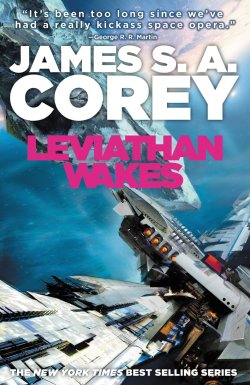
Book Review: Leviathan Wakes by James S. A. Corey

Leviathan Wakes by James S. A. Corey
Orbit Books, 2011
Cover Art by Daniel Dociu

The first real science fiction I ever read was Isaac Asimov’s Foundation trilogy. I read it when I was in 3rd grade. It remains one of the most transformative experiences of my life. It single-handedly awoke my passion for science fiction. It inspired my ongoing fascination with science—particularly cutting-edge theoretical cosmology.

More than that: Foundation (along with Star Wars) taught me that human imagination doesn’t need to be limited to only the world we know. Our dreams and stories can encompass the Universe and beyond, aliens and environments vastly different from us and ours.

While reading Leviathan Wakes by James S. A. Corey, I kept flashing back to my experiences with Asimov in 3rd grade. I kept recalling what it was like to have my mind opened by Asimov’s stories.

Continue reading “Book Review: Leviathan Wakes by James S. A. Corey”

Conversations about Libraries, Conversations about Privilege

A couple of years ago, I had a conversation with a gentleman who insisted that public libraries are going to disappear soon. He voiced the standard arguments about how everything is online now, and how ebooks are going to replace print entirely. His conclusion: libraries are irrelevant in the modern digital age.

Like so many people who take this position, this gentleman personally loves libraries and sees their inevitable passing as a loss to society. It makes him sad to think that there won’t be any more neighborhood libraries (even though he freely admits that it’s been years since he last set foot in his local library).

Of course, I spoke up to correct him. The stats make it very clear that libraries are as relevant to their communities as ever. Public library usage has actually increased with the advent of the digital information age, increased yet more during the recent economic crisis, and popular approval ratings are as high as they’ve ever been and holding steady. I shared all these stats with him. I shared multiple calculations of the economic impact of libraries and the ROI for every tax dollar invested—libraries are the single best public investment most communities can make. I talked about how libraries bolster and expand educational opportunities for kids and adults, citizens and immigrants, and the illiterate. I talked about how libraries can function as neutral gathering places during times of community upheaval. I talked about the library’s role in upholding the freedom of information and expression in our society. I talked about our computer labs and maker spaces and coding sessions and 3D printers and recording studios, our creative writing groups, our book groups, and our art spaces. I talked about our public programming and community discussion forums.

It was so clear to me that this gentleman would be happy to know that libraries are doing very well, adapting more-or-less adeptly to changing circumstances as they’ve always done, and they remain well-used and beloved by their communities.

That’s not what happened.

Continue reading “Conversations about Libraries, Conversations about Privilege”

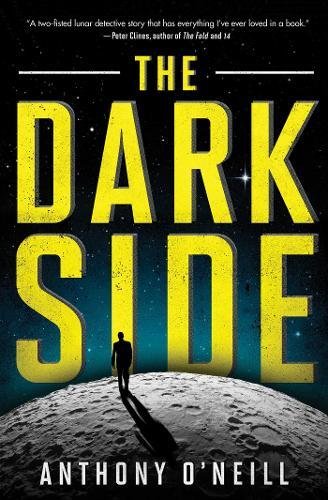
Book Review: The Dark Side by Anthony O’Neill

Cover of the book The Dark Side by Anthony O'Neill
The Dark Side
by Anthony O’Neill
Simon & Schuster, 2016

This review was first published by Booklist on June 1, 2016.

**STARRED REVIEW** There’s been a series of terrorist acts in the anarchic criminal city of Purgatory on the far side of the Moon. Damien Justus is the cop tasked with solving these crimes—but he’s a newbie ex-pat from Earth who doesn’t understand the complicated politics involved. Meanwhile, a murderer is making his or her way toward Purgatory through the back country of the Moon’s so-called “dark side” and leaving bodies in the wake. This is a smart, rollicking sf-detective-noir genre-blend with a delightfully dark and snide sense of humor. It’s formulaic in the best way possible—a good cop, a corrupt system, powerful forces at play—with excellent characterizations, first-class world building, fast-paced plotting, a main character you want to root for, and a genuinely sinister villain. While the ultimate solution of the mystery is a little pat, it’s satisfying, and the book’s ending isn’t quite what you expect. This incredibly entertaining novel is unmitigated fun to read, and is sure to be at the top of many genre readers’ favorite books of the year.

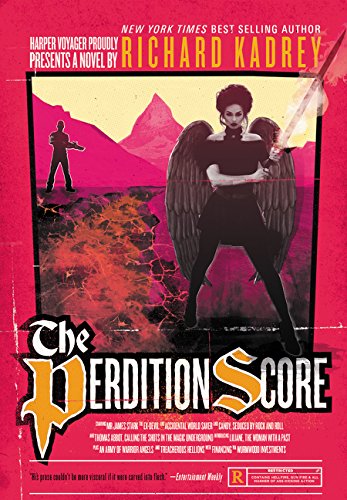
Book Review: The Perdition Score by Richard Kadrey

Cover of the book The Perdition Score by Richard Kadrey
The Perdition Score
by Richard Kadrey
Harper/Voyager, 2016

This review was first published by Booklist on June 1, 2016.

James Stark (aka Sandman Slim) is living the closest thing he can to a normal life: he works for the Sub Rosa, and he has a girlfriend and a social life (well, he’s part of an underground fight club). Then a dying angel gives him a vial of mysterious “black milk” and another angel tries to kill him for it. The Wormwood Corporation is up to no good, a kid goes missing, and too many coincidences start to pile up. His friends are in danger, Heaven is in revolt, and everyone’s soul hangs in the balance. Now Stark needs to find a way to get back to Hell . . . . The eighth entry in Kadrey’s Sandman Slim series is well paced, gritty, cool, funny, and insightful. The dialogue is whip-smart, the characters remain compelling, and Stark continues to evolve in surprising ways. Not only is this a welcome return for existing fans, it’s also easy for new readers to follow along. This fun and rewarding book has an ending that will leave readers eager for the next one.

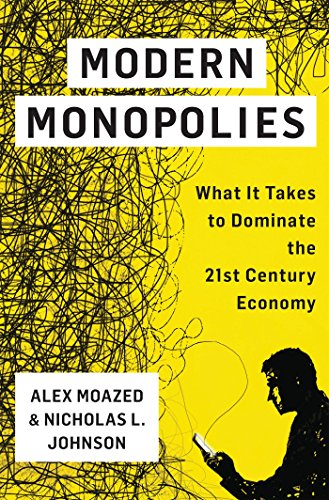
Book Review: Modern Monopolies: How Online Platforms Rule the World by Controlling the Means of Connection by Alex Moazed and Nicholas L. Johnson

Cover of the book Modern Monopolies: How Online Platforms Rule the World by Controlling the Means of Connection by Alex Moazed and Nicholas L. Johnson
Modern Monopolies: How Online Platforms Rule the World by Controlling the Means of Connection
by Alex Moazed and Nicholas L. Johnson
St. Martin’s, 2016

This review was first published by Booklist on May 18, 2016.

When we think about companies like Facebook, Google, Apple, Amazon, YouTube, and Uber, we tend to focus on the technology they innovate and how they’re changing our daily lives. But these platform businesses are some of the largest in the world today, commanding huge swaths of the modern economy. They’ve attained a scale long considered impossible by more traditional business models. Modern Monopolies analyzes platform businesses from the perspective of economics. Platform companies haven’t just beaten more traditional businesses; they’ve changed the nature of business itself, created whole new markets, and redefined what constitutes value. The authors analyze the path to success for platform companies and explore several ways that these businesses can fail. They display a strong grasp of the theoretical principles at play here but also evince a down-to-earth, nuanced, and critical view of how these companies function. Of particular importance, they suggest a fundamental reanalysis of the assumed value of “network effects.” This book is satisfying and timely, a valuable contribution to our understanding of modern business.

Shakespeare’s Language

To commemorate the 400th anniversary of the death of William Shakespeare, the Folger Shakespeare Library is sending 18 original copies of the First Folio on a tour of the United States. First Folio! The Book That Gave Us Shakespeare will exhibit the Folio in each of the 50 states, Washington D.C., and Puerto Rico.

The Kansas City Public Library—my library—is the host for Shakespeare’s First Folio during its Missouri showing in June. We’ve planned a year’s worth of activities and programming around it.

So it’s pretty much all Shakespeare, all the time around here. Being a library, we like to emphasize the influence that Shakespeare’s writing had on the course of literature and language in the English-speaking world.

One fact that lots of people love to cite is that Shakespeare invented over 1,700 words and phrases in the English language. This fact tends to be presented as though he sat down and made them up out of whole cloth (a la Lewis Carroll).

I find this scenario unlikely. I consider it far more likely that Shakespeare was merely the first (or the first that we know of) to write down many words and phrases that were already being used in his era.

Continue reading “Shakespeare’s Language”

National Poetry Writing Month 2016: A Summary

When I set out to participate in National Poetry Writing Month, I didn’t intend to write a poem every day. I just wanted to write two or three each week. I managed that, with quite a few more than two or three during the first full week of it. I hoped to end the month with anything between six and twelve new works. I did a bit better than that.

I confirmed that I do my best writing when I have external prompts to stimulate my creativity. However, I don’t always need to follow the prompts to take advantage of them—with my creative juices flowing, I’m more likely to write unprompted work, as well.

I attempted a wider variety of poetic styles and voices than I’ve done before, with varying levels of success. The challenge also gave me a chance to try a couple of new ideas I had for using modern technological devices to create poetry. I don’t know if this experience will get me to write more poetry overall, but I think it will improve my work when I do.

Now I have a year to decide if I want to do this again next April.

Here’s how my NaPoWriMo 2016 numbers break down:

Continue reading “National Poetry Writing Month 2016: A Summary”