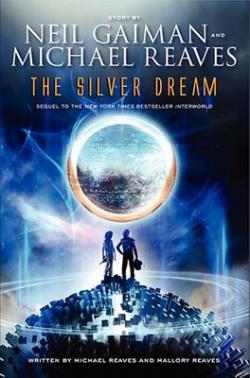
Book Review: The Silver Dream by Michael & Mallory Reaves

The Silver Dream by Michael & Mallory Reaves
HarperTeen, 2013

The Silver Dream, story by Neil Gaiman & Michael Reaves, written by Michael & Mallory Reaves (Book #2 of the InterWorld series) is both better and not as good as its predecessor.

The story in this one is better. My main complaint about the first book in the series is that it read more like the outline of a TV show concept (which is what it is) than a fully fleshed out novel. The Silver Dream works as a cohesive, contained novel. As such, it’s more compelling.

Joey Harker has been with InterWorld for two years now. His team has gained experience in the field. When new and powerful Walkers are discovered in both the HEX and Binary sections of the Altiverse, InterWorld agents (including Joey) retrieve them and bring them back to Base Town. Along the way, Joey meets Acacia (“Don’t call me Casey”) Jones, a mysterious young woman who turns out to be far more important than she lets on. That’s when things start to go wrong … and FrostNight begins.

Continue reading “Book Review: The Silver Dream by Michael & Mallory Reaves”

Book Review: InterWorld by Neil Gaiman & Michael Reaves

InterWorld by Neil Gaiman & Michael Reaves
HarperCollins, 2007
I admit: the only reason I checked out InterWorld is because it has Neil Gaiman’s name on it and it was available at my local library. I was waiting for a copy of a different book that I wanted to read, and I needed something to fill the time while I waited. I admit, as well, that I hadn’t paid any attention to the fact that InterWorld is a YA novel.

I wish I knew how much of InterWorld comes from Mr. Gaiman and how much is from the coauthor, Michael Reaves. I hope this is mostly Mr. Reaves book because, otherwise, I have to accept that Mr. Gaiman finally wrote something that disappointed me.

I’m not saying InterWorld is a bad book. It’s not. It’s smart and funny and fast-paced. It’s entertaining, with a delightful cast of characters.

Continue reading “Book Review: InterWorld by Neil Gaiman & Michael Reaves”

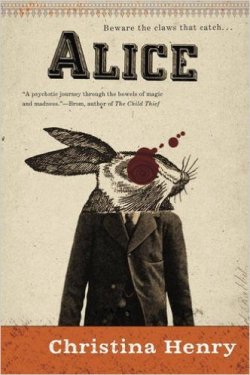
Book Review: Alice by Christina Henry

Alice by Christina Henry
Penguin, 2015

Alice by Christina Henry is… interesting. Compelling. Artful. There’s a poetry to the writing, the dialog is spare and evocative. The author’s vision of a violent Victorian world, shaped by sharp caste divisions and twisted by strange magic, is deeply rendered and believable.

We meet Alice in an insane asylum, suffering from post-traumatic stress after a violent encounter ten years prior which she can’t fully remember. She’s from the wealthy part of town but her family has abandoned her. Her only friend is the man in the adjacent cell, who, if anything, is even more insane than Alice and also suffering from memory loss. He knows about a monster trapped in the basement.

There’s a fire, they escape, and thus begins a quest through the darkest parts of the City’s underworld, which returns their memories and brings Alice into her own as a Magician in a world where magic has been banned.

Continue reading “Book Review: Alice by Christina Henry”

When People Ask Me about My Favorite Authors

In my continuing quest to find my way into and through the world of Readers’ Advisory…

Sometimes people will ask me how to get started on a particular author. They haven’t read anything by this author, but they know I have and they want to give ’em a try. They ask me which of the author’s books is my favorite, or which they should read first.

My initial impulse is to tell them which book is my personal favorite by the author. But I also know that what appeals to me might not be what appeals to them, and so my favorite might not be theirs. Learning which is my personal favorite might tell them something about me, but it might not be their best entrée into the author’s body of work.

Continue reading “When People Ask Me about My Favorite Authors”

Internet Access as Public, Social & Cultural Space

In his book, Part of Our Lives: A People’s History of the American Public Library, Dr. Wayne Wiegand groups library services into three major categories:

  • Information access
  • Reading materials
  • Public space

These categories clarify a nagging issue I have with the language we use to talk about the importance of internet access in libraries. The following quote from a recent article by Larra Clark is a good example:

Continue reading “Internet Access as Public, Social & Cultural Space”

2015: My Year in Reading

All of the data that follows was collected by me using a combination of Google Sheets and Google Calendar. Once again, I elected not to track pages read—too much discrepancy between formats to generate meaningful comparisons.

A complete list of all the books I read in 2015 is at the bottom of this post.


I read 66 books in 2015. Fiction titles outnumbered nonfiction by 2-to-1:

Continue reading “2015: My Year in Reading”

Bridging the Digital Divide: A Matter of Equality

I spoke to a gentleman recently about the efforts of public libraries to bridge the Digital Divide, both in terms of offering broadband internet access to those who otherwise don’t have it, and teaching digital and information literacy to those who need it.

This gentleman told me that he thinks the internet is useless. He’s been online, tried the social media thing, wandered around the web, and he sees no value in any of it. He concluded that it’s all just a flood of unreliable, unverified information, and people being mean and wasting time. He believes that we’d all be better off without it.

He told me that he can’t understand why we work so hard to provide access to something that people don’t need and shouldn’t be using in the first place. I don’t believe this man was intentionally exclusionary or prejudiced—he sincerely couldn’t understand why anyone would value something which, to him, is so obviously value-less.

Rather than argue with this gentleman’s opinions regarding the supposed value of the internet, I responded:

Continue reading “Bridging the Digital Divide: A Matter of Equality”

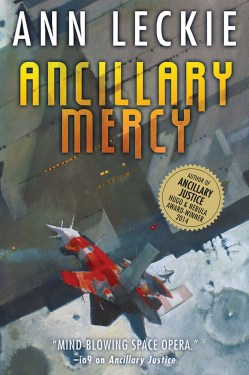
Book Review: Ancillary Mercy by Ann Leckie

Ancillary Mercy by Ann Leckie
Orbit, 2015
Cover art by John Harris

Ancillary Mercy by Ann Leckie satisfies my hopes for her Imperial Radch series. It’s a worthy conclusion to the story of Breq Mianaai / Justice of Toren One Esk Nineteen.

I admit I had reservations going into this third book of the series. The first novel showed so much promise but the second was strangely limited and left much to be desired. I really couldn’t get a sense of where the concluding volume would go.

Ancillary Mercy is a well-balanced amalgam of its predecessors. It takes place in the same location as Ancillary Sword but brings back the galactic scope of Ancillary Justice. It presents an ending which manages to be believable and appropriate, but also unexpected and compellingly unresolved.

Continue reading “Book Review: Ancillary Mercy by Ann Leckie”

Do Public Libraries Promote Democracy?

In his book, Part of Our Lives: A People’s History of the American Public Library, Dr. Wiegand challenges the traditional theory that public libraries are institutions which promote an informed democracy. He correctly points out that it’s “hard to prove that American public libraries are essential to democracy.” I’m certain it’s difficult, just as it’s difficult to prove many of the intangible benefits that libraries present their patrons.

Public libraries were conceptualized in large part to provide citizens access to information and “useful knowledge” which would help them to become more informed voters and civic actors. This theoretical framework is a political version of Ben Franklin’s ideal of the “self-made man”.

But historical data of public library usage makes it abundantly clear that very few people use their library this way. The maintenance of an informed democracy via access to “useful knowledge” isn’t something our patrons are all that interested in.

So it’s appropriate and useful to question this orthodoxy.

Continue reading “Do Public Libraries Promote Democracy?”

Book Review: Library of Souls by Ransom Riggs

Library of Souls by Ransom Riggs
Quirk Books, 2015

Overall, I’m very happy with Library of Souls, the final novel in Ransom Riggs’ Miss Peregrine’s Peculiar Children series. It starts out at a dead run and doesn’t slow down until the end. It builds to a truly gigantic climax of staggering proportion.

It’s exciting, a surprising and worthy conclusion to the story.

It’s also laugh-out-loud funny at several points. There’s an unexpected influence of Monty Python at work in this installment and it’s very effective. It allows the ridiculous to coexist seamlessly with the horror and constant danger, which is ultimately what empowers the reader to go along for the ride.

Continue reading “Book Review: Library of Souls by Ransom Riggs”