Book Review: Part of Our Lives by Wayne A. Wiegand

Part of Our Lives by Wayne A. Wiegand
Part of Our Lives: A People’s History of the American Public Library by Wayne A. Wiegand
Oxford University Press, 2015

I recently read the book, Part of Our Lives: A People’s History of the American Public Library by Wayne A. Wiegand. Rather than write a typical review of it, I want to share a letter that I sent the author.

(TL;DR version: This book is wonderful and every public librarian and public library user should read it. I think it’s important.)


Dear Dr. Wiegand,

I’d like to thank you for writing Part of Our Lives: A People’s History of the American Public Library. Before I proceed to explain why I want to thank you, I need to spend some time voicing a complaint about something you wrote in your introduction. Bear with me—the extent of my gratitude for your work won’t be clear without this context.

Continue reading “Book Review: Part of Our Lives by Wayne A. Wiegand”
Dante’s Divine Comedy, Terza Rima & Why the Limerick Is the Greatest English Poetic Form

I took a class on Dante’s Divine Comedy in college. The class was taught by a visiting professor from the University of Padua. He talked about Dante the same way English speakers talk about Shakespeare, only even more so. The Divine Comedy is widely considered by native Italians as having invented the modern Italian language. This professor spoke of it as the purest and most perfect expression of his “mother tongue” (see footnote).

He spent significant time analyzing the terza rima structure of the work. In particular, he stated that many native Italians consider it to be, once again, the greatest expression of their language. It’s perfectly suited to Italian: the cadence captures the robust, rounded, plosive earthy lilt and rolling quality of it; Italian is one of the most rhyme rich languages in the world, and the complex rhyme scheme of terza rima is calibrated to make the most of that fact. Moreover, terza rima doesn’t work well in any other language. It’s purely Italian.

This got me wondering if there’s a poetic structure equally well suited to English, a structure as deeply native to English as terza rima is to Italian.

I’ve concluded that the limerick comes closest.

Continue reading “Dante’s Divine Comedy, Terza Rima & Why the Limerick Is the Greatest English Poetic Form”

Are We Really Living in a Golden Age of Information?

Information professionals like to crow that we’re living in a Golden Age of Information. More information is available to more people than ever before in history, and it’s easier to access than ever.

The standard response is to point out that there’s more bad information than ever before. A whole lot of the information currently circulating around out there isn’t reliable.

This is true. But it’s also true that there’s more good information available to us than ever before, too. Just as bad information has increased, good information has increased alongside. I believe this firmly and I’ll stand by this statement.

But I’m not sure if the increase in good information is keeping pace with the increase in bad. It may be the proportion of good-to-bad has become more unbalanced. It may be that good information is being increasingly overwhelmed by the bad.

Continue reading “Are We Really Living in a Golden Age of Information?”

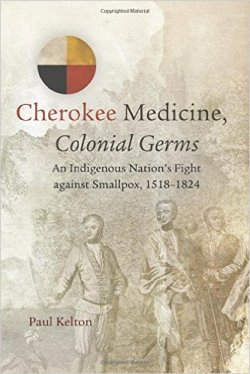
Book Review: Cherokee Medicine, Colonial Germs by Paul Kelton

Cherokee Medicine, Colonial Germs by Paul Kelton
Cherokee Medicine, Colonial Germs: An Indigenous Nation’s Fight against Smallpox, 1518–1824 by Paul Kelton
University of Oklahoma Press, 2015

Cherokee Medicine, Colonial Germs by Paul Kelton is an essential challenge to the “virgin soil” thesis that has governed the standard historical narrative of the European colonization of the New World. Dr. Kelton argues that this narrative is too simplistic, and largely fails to comprehend or address the complexity of Native cultures during that period. Moreover, the “virgin soil” thesis is based entirely on the testaments left behind by European colonialists—who misunderstood Native actions and behaviors more often than not—and incorporates no significant input from Native Americans’ own historical knowledge.

Worse yet, the “virgin soil” thesis whitewashes the effects of the violence and oppression inherent in the colonization of the New World.

Dr. Kelton uses the Cherokee as an example of how the traditional narrative of colonization falls apart when asked to answer to the historical resources of a Native people. Moreover, he points out that even the reliable documentary evidence we have from the European colonists themselves doesn’t support the “virgin soil” thesis.

If you liked Guns, Germs, and Steel, this book will make you see things in a very different light. This is exactly what good history is supposed to do.

Another Benefit of Ebooks for Libraries

A friend of mine was recently introduced to a certain genre fiction author who has been writing an ongoing series for the past couple of decades. My friend naturally wanted to start this series at the beginning and read it all the way through, in order. So, my friend turned to their local public library.

Ongoing series pose a difficulty for library collections. The earliest titles stop circulating after so many years, or our copies become worn out and damaged beyond repair. As a result, these items get weeded. Sometimes there’s not enough demand to justify restocking an older title. Sometimes we can’t restock them because we can’t afford the physical shelf space to hold them.

Frequently, publishers stop printing older titles from their catalogs, or distributors stop carrying them, which means libraries often can’t replace these titles in our collections even if we see a need for them. Therefore, it’s not uncommon for libraries to have more recent titles in ongoing fiction series on their shelves but not the earliest ones.

Continue reading “Another Benefit of Ebooks for Libraries”

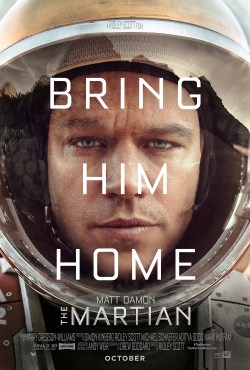
Movie Review: The Martian directed by Ridley Scott

The Martian, directed by Ridley Scott
Screenplay by Drew Goddard
Twentieth Century Fox, 2015

I finally got around to seeing the movie of The Martian. (Yeah, I know—it took me way too long to make this happen.)

I’m so happy with it!

I think it stands as one of the best book-to-movie adaptations ever. More than that—I think it’s one of the best movies about space ever made. I love it. I think the filmmakers did a fantastic job deciding what to leave in and what to leave out. They capture the essence of the story nicely.

The big screen creates a powerful visual layer for the narrative. The panoramas of Mars are breathtaking. It’s shocking to see how his time on Mars affects Mark Watney physically. The filmmakers take full advantage of their visual medium to tell this tale.

It’s a stunning work of art.

Continue reading “Movie Review: The Martian directed by Ridley Scott”

Book Review: The Shadow of Your Smile by Mary Higgins Clark

The Shadow of Your Smile by Mary Higgins Clark
Simon & Schuster Audio, 2010
Read by Jan Maxwell

The Shadow of Your Smile is the first Mary Higgins Clark novel I’ve ever read.

Of course I’ve heard of Mary Higgins Clark. Her name has been all over bestseller lists for years, and she occupies quite a lot of shelf space in public libraries and bookstores across the country. But she’s not an author I was ever interested in reading. So I wasn’t sure how I would react when I ended up listening to the audiobook of The Shadow of Your Smile on a recent road trip.

Reading other reviews of The Shadow of Your Smile, I realize this probably isn’t the best book Ms. Clark has written. Consensus appears to place this novel on the low end of quality for her output. Perhaps it’s regrettable it became my first Mary Higgins Clark novel.

Continue reading “Book Review: The Shadow of Your Smile by Mary Higgins Clark”

Conflicted Thoughts about Kim Stanley Robinson

Kim Stanley Robinson has come up a couple of times on this blog lately. I recently reviewed his latest novel, Aurora, and of course his Mars Trilogy came up in my thoughts about The Martian by Andy Weir. The Mars Trilogy was at the back of my mind the whole time I was reading the short story anthology Old Mars—I wasn’t sure how I’d react to retro Planetary Romance-style stories about the Red Planet in a post-Robinson world.

I have Robinson on my mind.

Continue reading “Conflicted Thoughts about Kim Stanley Robinson”

Book Review: Old Mars / Old Venus edited by George R. R. Martin & Gardner Dozois

Old Mars / Old Venus edited by George R. R. Martin & Gardner Dozois
Bantam Books, 2013 / 2015

I admit I waffled a bit over reading the George R. R. Martin and Gardner Dozois edited anthologies, Old Mars and Old Venus. These were put together as a nostalgic celebration of the Planetary Romance era of science fiction from the 1930s through the ’50s. Mr. Martin and Mr. Dozois grew up on that work, it forms the deep core of their love of SF, and it’s rather delightful how delighted they are to harken back to those times.

But I have no nostalgia for Planetary Romance. It’s not the SF I grew up on. I’m not intrinsically inclined to like these stories simply because they remind me of the bygone good old days.

I didn’t need them to be nostalgic, I just needed them to be good stories.

I admit, as well, that I was somewhat cautious about the premise of these anthologies: stories set on the versions of Mars and Venus we imagined before probes and exploration taught us otherwise—the canaled Mars of Burroughs and Bradbury; the hot, wet, jungle and watery Venus of Leigh Brackett and Roger Zelazny. I was skeptical of a premise that requires both authors and readers to ignore everything that science has taught us about these planets in the intervening 50+ years.

Continue reading “Book Review: Old Mars / Old Venus edited by George R. R. Martin & Gardner Dozois”

Book Review: Aurora by Kim Stanley Robinson

Aurora by Kim Stanley Robinson
Orbit, 2015

I’m of two minds as to how I should review Aurora by Kim Stanley Robinson.

Taken in-and-of itself, my response to this novel is overwhelmingly positive. It’s damn good. Good enough that I fully expect it to be nominated for some awards (although I don’t know if it’s good enough to win any).

Compared to some Mr. Robinson’s other work, however, my reaction to this novel is less favorable. But, then, maybe it’s unfair to compare Aurora to his other work…

I’ll start by mentioning some of the reasons why this book works well:

Continue reading “Book Review: Aurora by Kim Stanley Robinson”