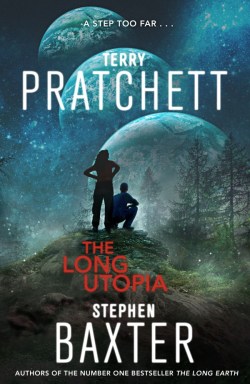
Book Review: The Long Utopia by Terry Pratchett & Stephen Baxter

The Long Utopia by Terry Pratchett & Stephen Baxter
HarperCollins, 2015

The Long Utopia by Terry Pratchett and Stephen Baxter is my favorite book of this series, since the first one.

The first book in the Long Earth series captured my imagination to a degree that’s rare. The world of the Long Earth is stunning. The characters Mr. Pratchett and Mr. Baxter created are fascinating individuals and it’s a rewarding experience to spend time with them.

When I read a book, I want to feel like the story exists for its own sake. I want to feel like the authors are compelled to tell this story, and no other. But the stories in The Long War and The Long Mars feel like they exist mostly as excuses to explore the expanding world of the Long Earth. This isn’t to say that the stories haven’t been good—they’re well-structured and well-told, populated by characters who I care about—but I can’t shake the feeling that different stories would have served the purpose just as well. Exploring the world takes precedence over telling the best possible story.

Continue reading “Book Review: The Long Utopia by Terry Pratchett & Stephen Baxter”

Book Review: The Long Mars by Terry Pratchett & Stephen Baxter

The Long Mars by Terry Pratchett & Stephen Baxter
HarperCollins, 2014

I enjoyed The Long Mars, the third book in Terry Pratchett and Stephen Baxter’s Long Earth series, better than the second entry. This outing managed to recapture some measure of the sense of wonder that characterized the first book in the series. Opening up the Long Mars adds a welcome layer of new complexity to the milieu.

There are three separate plot lines in this novel:

  1. Sally, her father, and Frank Wood travel to and explore the Long Mars.
  2. Captain Maggie Kauffman and her crew take another epic journey into the Long Earth—this time, traveling to Earth West 250,000,000.
  3. Joshua and Lobsang search the Long Earth for what Lobsang believes are a newly emergent and highly developed strain of homo sapiens. Nelson Azikiwe and Roberta Golding make appearances in this plot line.

Continue reading “Book Review: The Long Mars by Terry Pratchett & Stephen Baxter”

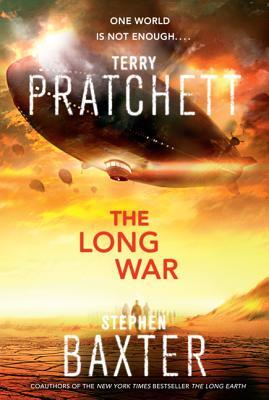
Book Review: The Long War by Terry Pratchett & Stephen Baxter

The Long War by Terry Pratchett & Stephen Baxter
HarperCollins, 2013

The Long War, the second book in The Long Earth series by Terry Pratchett and Stephen Baxter, gets a lot of things right. It corrects some of the structural missteps that the first book suffered.

And yet, I don’t enjoy this one as much as its predecessor.

Which is not to say that The Long War isn’t a good science fiction novel. It is, and I enjoyed the few hours it took me to read it. I don’t think it’s possible for two such talented authors to write something that isn’t good. The narrative structure is smoother than the first book in the series—the transitions between the various story threads are less haphazard. The tone of the writing is clearer—there are no discordant notes between the seriousness and the humor this time around.

Continue reading “Book Review: The Long War by Terry Pratchett & Stephen Baxter”

Book Review: The Long Earth by Terry Pratchett & Stephen Baxter

The Long Earth by Terry Pratchett & Stephen Baxter
HarperCollins, 2012

I wasn’t sure what to expect from The Long Earth by Terry Pratchett and Stephen Baxter. These two authors seem like an odd pairing. Sir Pratchett is one of the greats of humorous fantasy but certainly isn’t known for hard science fiction. Mr. Baxter is a leading light in hard science fiction and alternate history but he’s certainly not known for his comedic chops.

I’m happy to report that I enjoyed their first collaboration very much. This is a fine science fiction novel.

The Long Earth is a rather literal take on the multiverse theory—one day, people all over the world learn how to “step” into alternate Earths. There are uncounted millions—possibly an infinity—of these alternate Earths, and humanity eagerly spreads out into them. Most people require a device to step across to these other worlds, but some can step naturally, and some can’t cross the boundaries at all.

The strangest thing is that none of these other Earths have any humans in them—although there are other humanoid creatures out there…

Continue reading “Book Review: The Long Earth by Terry Pratchett & Stephen Baxter”
Book Review: The Magician’s Land by Lev Grossman

The Magician's Land by Lev Grossman
The Magician’s Land by Lev Grossman
Viking, 2014
Cover art: “Novembre (November),” 2007 © Didier Massard

The Magician’s Land by Lev Grossman is the perfect ending to his Magicians trilogy. I would say that it’s not the ending I expected, but I honestly had no idea what to expect. It’s not a typical happy ending, but that’s a good thing—a happy ending would betray the entire concept of the trilogy. So the ending isn’t fairy tale happy, but it’s very satisfying. It leaves the reader and the characters satiated, without any pandering or overly cheery false notes.

In retrospect, it takes on an appearance of inevitability. Having read it, it now feels like the only ending possible. It rings true.

The Magician’s Land is both grand in scope and strangely mundane. But that mundanity is also what makes it profound.

Continue reading “Book Review: The Magician’s Land by Lev Grossman”

Print Books vs. Digital Books & the Reading Brain

For a variety of reasons, for the past few days I’ve been thinking even more than I usually do about the differences between print books and digital books, and how our brain processes them. There are differences in how we read in different media, and it’s important for us to understand them. If our brain interacts with different formats differently, it means that different formats will best serve different purposes.

It’s our job as librarians to fulfill our patrons’ information needs as best we can. Selecting the best format for the information is increasingly important.

This is my latest attempt to summarize my understanding of how and why print and digital differ.

Continue reading “Print Books vs. Digital Books & the Reading Brain”

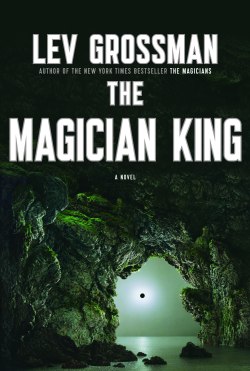
Book Review: The Magician King by Lev Grossman

The Magician King by Lev Grossman
Viking, 2011
Cover art: “La Grotte (The Grotto),” 2003 © Didier Massard

The Magician King by Lev Grossman is as good as I wanted the first book in this series to be.

The big flaw with The Magicians was that toying with the genre sometimes overshadowed telling the story. That’s not the case with this second book. The parameters of Mr. Grossman’s magical world are already defined and the genre gimmicks are already established. There’s no need to rehash them and so he doesn’t.

Which means that The Magician King can focus on simply telling a good story. The storytelling in this novel is more cohesive and coherent than its predecessor, and as a result it’s much more powerful and effective.

The Magician King has the substance that the premise of the first book promised but mostly failed to deliver.

Continue reading “Book Review: The Magician King by Lev Grossman”

The Pain of Bad Reference Interactions

People love to ask the question, “Why go to the library when you can just Google everything?” In answer, we tend to fall back on some version of Neil Gaiman’s famous quote:

Google can bring you back 100,000 answers. A librarian can bring you back the right one.

We talk about the authority of librarians, our ability to sift through the vast oceans of data with a far better eye toward quality than any search engine can match. We talk about the personalization of the interaction—librarians can recognize not just the right answer, but the answer that’s right for you.

Often, people don’t know how to ask their question. Google is stuck with whatever you enter—if you ask your question the wrong way then you only get results that aren’t what you need, and you’re left to your own devices to try and figure out what went wrong. A librarian can figure out what you really meant and guide your search, to bring you information that’s actually useful in a much more intuitive and rewarding way.

I agree with all of the above. Librarians can serve people’s information needs in ways that Google, or any other online search engine, simply can’t.

Which is why it especially pains me every time I have a bad reference interaction.

Continue reading “The Pain of Bad Reference Interactions”

Book Review: The Magicians by Lev Grossman

The Magicians by Lev Grossman
Viking, 2009
Cover art: “Arbre en Automne (Autumn Tree),” 2001 © Didier Massard

Honestly, I had hoped to like The Magicians by Lev Grossman more than I do. I like it a lot and I greatly enjoyed reading it. But I’d heard so many wonderful things from people who adore this book (and the trilogy) that I expected to be blown away by it.

I wasn’t.

I really like Mr. Grossman’s take on the “young magician” fantasy trope. I appreciate that he makes it much darker, a whole lot messier, and that he recasts this genre through the lens of cynical realism. It’s very effective. His riffs on Harry Potter and his criticisms of C.S. Lewis’ Narnia series are delightful and on point.

Continue reading “Book Review: The Magicians by Lev Grossman”

Education in America: An Expanded Argument

I keep thinking about my latest posts on education and the need I see for a three-legged balance between STEM, liberal arts, and vocational training. It occurs to me that this is incomplete. There needs to be a fourth leg:

Arts education.

Music, visual arts, performing arts—these are different from liberal arts (philosophy, history, literature study, rhetoric, etc.), just as liberal arts are different from STEM. But just like liberal arts and STEM, arts education also seeks to develop critical thinking skills, along its own lines and according to its own standards.

When I critiqued the STEAM concept, I did so in terms of liberal arts but that’s incorrect. The “A” in STEAM stands for “Arts”—as in arts education, not liberal.

I think my critique still stands: integrating arts education with STEM is a mistake. I believe that conflating them makes it virtually impossible to avoid subordinating the arts aspect to the STEM aspect. They’re both best served when they’re allowed to stand on their own.

A four-legged educational system: STEM—Liberal arts—Arts—Vocational training.

That should be our goal.