Book Review: Trespassing on Einstein’s Lawn by Amanda Gefter

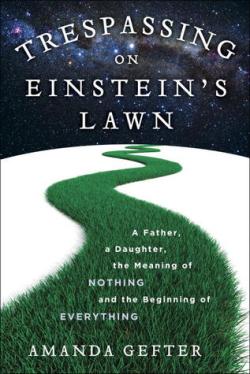
Trespassing on Einstein's Lawn book cover
Trespassing on Einstein’s Lawn by Amanda Gefter, published by Bantam 2014

I love Trespassing on Einstein’s Lawn by Amanda Gefter more than I’ve loved any book in a long time.

I first became fascinated by cosmology in third grade (no kidding, in third grade I wrote an essay for school titled, “When I Grow Up I Want to Be a Cosmologist.” You can ask my mom—she still has it.) While I didn’t dedicate my life to pursuing the subject the way that Ms. Gefter has, her delight and fascination with the theories of cosmology perfectly captures my own. I know the thrill of them the same way she does.

More than any other, this book reminds me why I love this field of study.

Continue reading “Book Review: Trespassing on Einstein’s Lawn by Amanda Gefter” →

Logos vs. Branding

My rant last week about library logos arose from a discussion I had with a co-worker about branding libraries.

Too often, people seem to think that their logo is their branding. Or that coming up with a good logo is the most important first step in creating their brand. The conflation of logos with branding is such a universal issue that there’s a whole school of thought dedicated to correcting this misunderstanding. Google “branding is not a logo,” or “brand vs logo,” and survey the results.

Whenever I discuss library logos, someone always brings up the New York Public Library’s lion as an example of how effective a logo can be. But the reason the lion works so well as a logo is because it was already an iconic image of a library with a deeply rooted history in the community. It’s specific to the NYPL and encapsulates the reputation and history the library already has.

The purpose of a logo is simply to reference the larger identity of an organization.

That larger identity—not your logo—is your true brand. Your brand grows out of the interactions you have with your patrons and the role your library fulfills in its community.

Continue reading “Logos vs. Branding” →

Death to Book Logos for Public Libraries!

Survey the websites for public libraries in the United States, and how many do you think feature some kind of book as their logo? It’s got to be well over 50% of them.

Some of my own favorite library systems use book logos. Take a look:

Oak Park Public Library in Oak Park, Illinois
Mid-Continent Public Library in Missouri
Garfield County Libraries in Colorado

These are fantastic libraries that do great work in their communities. I follow their work avidly. But seriously—what’s with the book logos?

I’ve developed an almost visceral aversion to seeing book logos on library websites. Why?

Continue reading “Death to Book Logos for Public Libraries!” →

Book Review: Ancillary Justice by Ann Leckie

Ancillary Justice book cover
Ancillary Justice by Ann Leckie
Orbit Books, 2013
Cover art by John Harris

Ancillary Justice by Ann Leckie has been on my “To Read” list since it swept all of the major SF awards last year. I enjoyed it tremendously.

This is old-fashioned space opera, reminiscent of the classics of the Golden Age. Unlike a lot of modern space opera (which I adore, for the record) Ms. Leckie is less concerned with the technology that makes galaxy- and time-spanning civilization possible and offers us a story focused on character and plot.

Continue reading “Book Review: Ancillary Justice by Ann Leckie” →

Serendipitous Discovery: A Critical Perspective

Given my passion for serendipitous discovery in libraries, I was delighted to read this paper by Patrick L. Carr:

Serendipity in the Stacks: Libraries, Information Architecture, and the Problems of Accidental Discovery (PDF)

It had never occurred to me to consider serendipitous discovery from this angle before. Serendipity can be construed as a failure of a user-centered information environment to properly meet the needs of a user. Perhaps serendipitous discovery isn’t a benefit so much as it’s a compensation mechanism for the failures of our search systems.

This suggests interesting avenues for inquiry and development. I think it’s a beneficial perspective. Serendipity isn’t all good and librarians should approach it strategically.

I’m particularly struck by this passage on page 18:

Continue reading “Serendipitous Discovery: A Critical Perspective” →

When Protecting Creativity Stifles Creativity…

Our culture suffers. This is a problem.

Georgia Tech Research Finds Copyright Confusion has ‘Chilling Effects’ in Online Creative Publishing (posted by InfoDocket on December 15, 2014)

As libraries retool themselves into community hubs of content creation, patrons will need reliable information on copyright, Creative Commons, and other intellectual property rights structures.

Given the complexity and politicization of these rights in our society today, providing such guidance is a monumental task. But this study emphasizes that it would be an essential and useful service.

I’d love to see intellectual property rights librarians in every library!

Book Reviews in the Age of Goodreads

A few weeks ago, I read Reza Aslan’s book Zealot: The Life and Times of Jesus of Nazareth and I loved it. I went to my Goodreads account and posted a glowing review.

I recommended this book to some historians I know and they both read it. I’ve been speaking to them about it and I was surprised to learn that they’re far more critical of the work than I am. Not because of their religious beliefs but because they don’t think it’s very good history.

Both of them have advanced degrees in history. One of them works as an administrator in higher education. They’ve both been trained in the work of history and both have expectations molded by the standards of academic work.

They see significant flaws in Dr. Aslan’s book. If someone expects to challenge the orthodox historical consensus on a subject (as Dr. Aslan does) there are standards that must be met, the work must uphold a certain level of academic rigor.

Zealot fails to meet these standards. As my friend suggested—he can’t believe that this work would ever survive peer review.

After hearing what my friends had to say about the work I decided to do what a good librarian should do and find out more about Dr. Aslan’s qualifications, his authority to speak on this matter, and the critical reception his work has received from professional historians in the field.

Continue reading “Book Reviews in the Age of Goodreads” →

Checking My Privilege

Last year, I vowed to be more aware of how my life is very different from the lives of many in the community I serve through my library work.

I recently read the book, The Short and Tragic Life of Robert Peace, and it opened my eyes to yet another way that I’m really quite privileged compared to many.

When I completed my Master’s degree and began my job search, my top priority was to get my wife back home. She’d spent several years living away from her family and wanted to be near them again.

Everyone I spoke to for job search advice, every article I read, they all told me that I had to be willing to go where the work was, wherever that happened to be. Librarianship is a highly mobile profession. When I restricted my job search right out of the gate to a fairly narrow region of the country, it went against common wisdom. Some people told me I was making a mistake, narrowing my options too soon. Indeed, I passed over many professional opportunities because they were in the wrong part of the country.

But family was my first priority. Getting my wife back home was the most important thing. Luckily, I found a great job at a great public library, right where we wanted to be.

When I tell people why I did what I did—that I chose to put family first despite the potential risk to my career—many people praise me. For much of my life, there has been a sense that families suffer for our culture’s obsessive focus on work and career. Many people tell me how refreshing it is to see someone living with different values.

Now consider a young man very like Robert Peace:

Continue reading “Checking My Privilege” →

Teaching Digital Literacy

I’ve spent quite a bit of time over these past few weeks thinking about digital literacy. I try to compare it to reading and language literacy.

The comparison is illustrative.

Consider language literacy:

  • It takes years to learn and master a language.
  • Immersion is universally recognized as the best way to learn a language.
  • The more words and phrases you’re exposed to, the more you’ll learn.
  • You have to start simple and work your way up to the complicated stuff over time.

Consider reading literacy:

  • It takes years to learn how to read.
  • Constant exposure to reading is the best way to learn—being read to, reading on your own.
  • The more you see other people in your daily life reading, the more likely you are to make reading a habit for yourself and the greater your comfort level with reading will be.
  • You have to start simple and work your way up to the complicated stuff over time.

“Years to learn,” “immersion,” “exposure,” “work your way up”—developing literacy is a long process that needs to be a part of your daily life. Literacy involves more than just the mechanical tasks of speaking and reading—it requires habit and a level of comfort.

Continue reading “Teaching Digital Literacy” →