I spend a fair amount of time talking about the importance of diversity in our stories and reading culture. I fully support the #WeNeedDiverseBooks movement. I’ve made a commitment to increase the diversity of my own reading, both in terms of authors and characters.
I read two posts over the past couple of weeks which spin the idea of diverse reading in a slightly different direction:
Normally, we talk about diverse books in terms of the ethnicity and cultures of characters, authors, and story traditions. What speaks to me about the two articles linked above is the call to increase the diversity of the genres I read. The call to “read outside [my] own taste and interest” (from Bookriot), to read things I dislike or that scare me to try (as per the RA for All post).
We need diverse books to be sure, but those must be part of a literature that reflects our reality, books in which little black boys push one another on the swings, in which little black girls daydream about working in the zoo, in which kids of every color do what kids of every color do every day: tromp through the woods, obsess about trucks, love their parents, refuse to eat dinner. We need more books in which our kids are simply themselves, and in which that is enough.
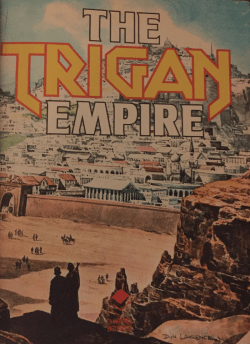
The Trigan Empire written by Mike Butterworth & artwork by Don Lawrence Chartwell Publishers, 1978 (inside title page)
Without further ado, I present my long lost childhood memory:
The Trigan Empire, written by Mike Butterworth with artwork by Don Lawrence.
This is definitely the book my siblings and I read as kids. As fragmentary as my memories of it are, I was shocked at how familiar it felt to read through it again as an adult. I found that I remembered almost every page as it was revealed to me. And I was delighted to discover that the copy I received via ILL came from a public library in my home state. Seems appropriate.
The Trigan Empire was a comic that ran from 1965 to 1982, published in Britain by Fleetway, with Butterworth and Lawrence as the primary writer and artist. It ran as a serial installment in an educational magazine focused on science. The hardbound novel-length book my siblings and I read was an omnibus collection of the earliest stories from the comic, published in the United States in 1978 by Chartwell.
When my siblings and I were in early grade school at the beginning of the 1980s, we discovered a strange book in the children’s section of our local public library. It was a heftier tome than we’d ever seen on the shelves, oversized and thick—close to 200 pages. Barring encyclopedias, we’d only seen books this big in the adult section or on our parents’ bookshelves at home.
But the best part was that this strange book was a comic book!
Today we’d call it a graphic novel but we hadn’t heard that term back then. We checked it out, brought it home, and each read through it a couple of times.
My memories of reading this book are difficult to properly describe: fragmentary, dissociative, surreal, and dreamlike all come close. I recall that my in-the-moment experience of reading it as a little kid was similar: surreal, dreamlike, dissociative, fragmentary. I had a difficult time keeping the narrative strung together as a cohesive whole in my head.
It was the most challenging thing I’d read up to that point in my life.
When I was a kid, I was taught the basic virtues: love, honesty, charity, hope, loyalty, modesty, tolerance, temperance, courage. I was taught that these are what we should strive for, as individuals and as a culture.
As a kid, I remember thinking how well these virtues describe a happy, healthy dog. As an adult, it sometimes seems that too many humans have too little of any of these virtues.
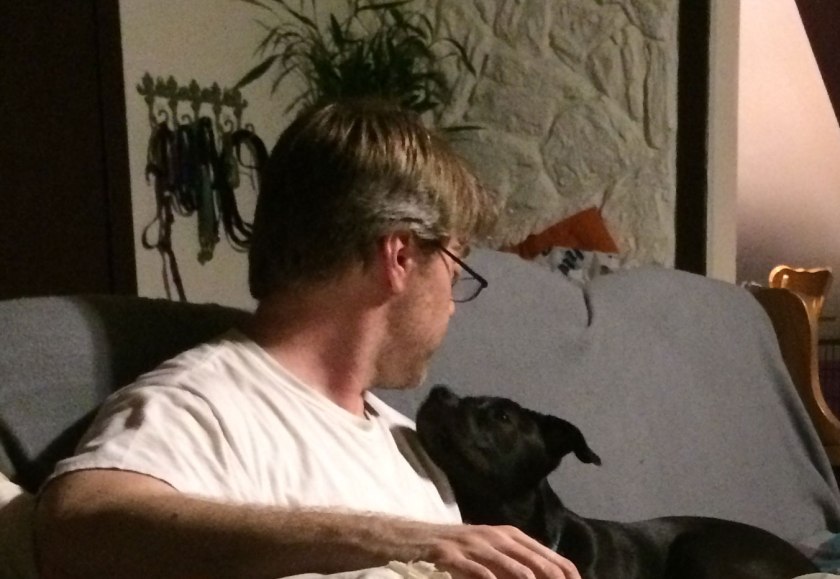
This is a picture of me and our dog.
Addison & me, June 10, 2016
She doesn’t care what color my skin is, what country I come from, what my gender is, who I want to have sex with (or don’t want to have sex with), what god I believe in (or none at all), how much money I make.
None of that matters.
She only knows that we love her as best we can and she loves us. We keep her safe, sheltered, fed. We play with her and show her the world. We’re kind to her and we will never hurt her. And for that, she gives us everything she has.
That’s all that matters. Everything else is just vanity.
Dogs love so easily. There’s never any struggle for them to love unconditionally. It’s their default state.
But they don’t hate. They may learn to fear, they may become conditioned to be distrustful, but their fear is only ever that: fear. It never translates into hatred. Dogs can learn fear and caution through repeated experience but they never hold grudges.
And no matter how damaged or distrustful or fearful a dog may be, they can always be led back to love.
It’s so easy to love each other. Why do we have such a hard time with it?
To commemorate the 400th anniversary of the death of William Shakespeare, the Folger Shakespeare Library is sending 18 original copies of the First Folio on a tour of the United States. First Folio! The Book That Gave Us Shakespeare will exhibit the Folio in each of the 50 states, Washington D.C., and Puerto Rico.
So it’s pretty much all Shakespeare, all the time around here. Being a library, we like to emphasize the influence that Shakespeare’s writing had on the course of literature and language in the English-speaking world.
One fact that lots of people love to cite is that Shakespeare invented over 1,700 words and phrases in the English language. This fact tends to be presented as though he sat down and made them up out of whole cloth (a la Lewis Carroll).
I find this scenario unlikely. I consider it far more likely that Shakespeare was merely the first (or the first that we know of) to write down many words and phrases that were already being used in his era.
When I set out to participate in National Poetry Writing Month, I didn’t intend to write a poem every day. I just wanted to write two or three each week. I managed that, with quite a few more than two or three during the first full week of it. I hoped to end the month with anything between six and twelve new works. I did a bit better than that.
I confirmed that I do my best writing when I have external prompts to stimulate my creativity. However, I don’t always need to follow the prompts to take advantage of them—with my creative juices flowing, I’m more likely to write unprompted work, as well.
I attempted a wider variety of poetic styles and voices than I’ve done before, with varying levels of success. The challenge also gave me a chance to try a couple of new ideas I had for using modern technological devices to create poetry. I don’t know if this experience will get me to write more poetry overall, but I think it will improve my work when I do.
Now I have a year to decide if I want to do this again next April.
The day I left home, got in the car, and drove,
I swore I would never look back.
I broke this vow less than 10 miles down the road.
But my view out the rearview mirror
Was blocked by all my stuff, boxes and backpacks,
Piled in the back seat. My world shoved into my car,
Every nook and cranny filled. It wasn’t as much
As it looked like, filling up my little hatchback.
My world uprooted, taken on the road,
To find a new home, new soil in which to plant myself
And bloom. They say home is where the heart is.
They say you can’t appreciate home unless you leave it.
That you need to wander for a time, to see the world,
To learn who you are in a new place,
Before you can truly understand your roots.