2025: My Year in Reading

I read 38 books this year. Mostly nonfiction, and proudly representative of my major interests: cosmology, deep time, and human nature. I ended the year with a stack of around 10 books sitting on my end table, most of which I’ve had checked out for several months and I just haven’t bothered to read yet. I keep renewing them from the library but when the time comes, I choose to sit in front of the TV rather than read.

When I have done some reading this year, it’s been in intense spates, several titles all in a row, all in a couple days. A punctuated equilibrium: watching TV is my default state, with quick periods of ravenous reading scattered around.

I’ve been struggling with this for the better part of decade. Peruse any of my past Year in Reading posts and you’ll see me harping on this. I consistently get to the end of each year with a feeling that I didn’t read enough, or didn’t read regularly enough. I have this idea in my head that I’m supposed to be a more dedicated reader than this.

Thing is: I didn’t used to worry about this. I didn’t used to think about it much at all. So why has it been such a major source of pressure and disappointment for me over the past decade? Let’s do some honest accounting of my history as a reader…

Continue reading “2025: My Year in Reading”

Book Review: City of All Seasons by Oliver K. Langmead and Aliya Whiteley

Cover of the book City of All Seasons by Oliver K. Langmead and Aliya Whiteley
City of All Seasons
by Oliver K. Langmead and Aliya Whiteley
Titan, 2025

This review was first published by Booklist on April 1, 2025.

**STARRED REVIEW** This dark fantasia of magical realism is set in a city split in two, one version stuck in perpetual winter, one in unremitting summer, both cut off from the rest of the world. The mystery of how it happened is inextricably knotted up with the conflicts in the town’s most powerful family. Two cousins separated by the split must unravel the mystery, defy authority, and find their way back to each other. This is one of those novels that’s impossible to describe without reducing its magic. It’s strange and eerie, familiar and alien, compelling and off-putting, deeply rendered and mysterious, meditative and unexpectedly comforting. It feels more like a modern fable than contemporary fantasy. It’s an examination of family, conflict, and love, and how people and places imprint on each other, a kaleidoscope of time and atmosphere. The world and characters are equally complex and believable, and both are essential to the story. Readers must be willing to suspend disbelief for the premise and accept that there really isn’t a full explanation for what happens. But if they allow themselves to immerse in it, the experience is quite wonderful. Recommended for fans of Seanan McGuire and Stephen King’s fantasy work.

Book Review: Cosmic Bullsh*t: A Guide to the Galaxy’s Worst Life Hacks by Chris Ferrie

Cover of the book Cosmic Bullsh*t: A Guide to the Galaxy’s Worst Life Hacks by Chris Ferrie
Cosmic Bullsh*t: A Guide to the Galaxy’s Worst Life Hacks
by Chris Ferrie
Sourcebooks, 2025

This review was first published by Booklist on March 11. 2025.

Ferrie’s latest “Bullsh*t” title (after Quantum Bullsh*t, 2023) takes on some of the most pernicious anti-science conspiracy theories with his trademark snark, put-downs, and pop culture references. He confronts stories about the origin of life, astrology, aliens, time travel, and the end of the world, taking readers through various non-scientific beliefs and summarizing the best current understanding science gives us. It has all the ingredients his fans have come to expect. He’s mostly preaching to the choir, as it’s hard to image this will appeal to anyone who doesn’t already agree with him, and he doesn’t really offer any new information on any of these topics. Nevertheless, it’s a solid overview of the real science behind the conspiracies. Perhaps most interesting, and what gives his work real depth, is the nuance with which he treats both science and non-scientific beliefs: despite the damage conspiracy theories can do, they tap into the essential human need for storytelling, and science can too easily become another form of dogma. Both are at their best when we embrace empathy, fascination, and inherent complexity.

Book Review: These Strange New Minds: How AI Learned to Talk and What It Means by Christopher Summerfield

Cover of the book These Strange New Minds: How AI Learned to Talk and What It Means by Christopher Summerfield
These Strange New Minds: How AI Learned to Talk and What It Means
by Christopher Summerfield
Viking, 2025

This review was first published by Booklist on March 1, 2025.

**STARRED REVIEW** Summerfield, neuroscientist and former researcher at Deepmind, offers one of the most balanced and realistic assessments of the current state of AI technology as well as a summary of how AI was first conceived and developed. In doing so, he spends as much time exploring linguistics and neuroscience as he does with technology. Noam Chomsky is as much a part of this as Alan Turing is. Summerfield examines the philosophies of the major players in the AI sphere and spends some time assessing the various hopes and fears people have for it. Amongst the slate of AI-focused, pop-sci books hitting the shelves recently, this one does the best job of explaining for a lay reader how AI is structured and trained. But Summerfield takes it further, comparing the ways AI functions to the workings of the human brain to show not just the potential of AI for true intelligence and creativity but also that AI is fundamentally different from human intelligence. Those differences pose the biggest challenges to the next steps of AI development. This technology contains both tremendous potential and very real danger. Summerfield tackles all this with humor, wit, and candor.

Book Review: Dimming the Sun: The Urgent Case for Geoengineering by Thomas Ramge

Cover of the book Dimming the Sun: The Urgent Case for Geoengineering by Thomas Ramge
Dimming the Sun: The Urgent Case for Geoengineering
by Thomas Ramge
The Experiment, 2025

This review was first published by Booklist on March 1, 2025.

Solar geoengineering—altering the albedo of Earth to reflect more of the sun’s energy and cool down global warming—is an idea that has long floated around the periphery of climate-change-action circles. Ramge argues that it’s an idea whose time has come. It has the potential to make a significant, immediate impact and is easily reversible. It could be accomplished on a large scale with technology that’s commonplace right now. But Ramge also urges caution: it’s not a long-term solution, merely a step that can buy us time to meet necessary carbon-reduction goals. He sees a realistic danger that nonstate actors may take it upon themselves to pursue this path. There’s been very little research into solar geoengineering, so we don’t have a full understanding of the risks and possible consequences. The possibility that someone, somewhere, may turn to this approach creates an urgent need for better understanding and regulatory framework. Dimming the sun is a realistic and potentially powerful option to combat climate change. Ramge believes we should at least explore the possibility.

Saying Farewell to Booklist

I quit reviewing for Booklist. Or, more accurately, I let my editor know I need to take a break from reviewing for an unspecified amount of time.

I’ve been debating this move for a couple years, honestly. I’ve been really struggling to make myself read for a while now. I kept thinking I’d get back into it, that my reading mojo would come back, or at least that I could make myself do it, but it’s just been getting worse. I’ve been turning in my reviews later and later, and it stresses me out. I no longer feel that Booklist can rely on me for this task, which isn’t fair to them, and I no longer enjoy it because it feels like too much pressure.

I need a break. If I don’t feel like reading, I want to be able to just not read and not feel guilty about dropping the ball.

I hope I’ll want to read more if it’s just for fun and not an assignment. In truth, I’ve always had this issue: I didn’t read a single assigned text all through primary school. If you tell me I HAVE to, then I don’t want to! I have a powerful contrarian streak. Reading has always been an indulgent happy place for me. I don’t want it to be work. I’m a little surprised I was able to keep up these reviews successfully for as long as I did.

I’m clearly still coming to terms with this decision. But I feel like it’s the right decision for me right now.

There are a couple reviews I already submitted which haven’t been published yet, so I’ll post those when they are. But then I won’t be doing any new ones.

I’m curious: I used to write long-form book reviews of stuff I read just for fun. But I pretty much completely stopped writing just-for-fun book reviews once I started reviewing for Booklist. I wonder if I’ll go back to it. I prefer being able to analyze things in depth, so maybe this has also been part of my struggle. Working within the strict character limit of Booklist reviews was a fun challenge, it taught me a great deal and made me a better writer, but I’ve never been interested in brevity.

Anyway, that’s a thing I did. If you enjoy my reviews, I feel a bit bad that I’m ending them, but I think I need to. I may take them back up again in the future. We’ll see.

Book Review: The Fourth Consort by Edward Ashton

Cover of the book The Fourth Consort by Edward Ashton
The Fourth Consort
by Edward Ashton
St. Martin’s, 2025

This review was first published by Booklist on February 1, 2025.

Life isn’t going so well when Dalton Greaves gets recruited by the alien Unity coalition to be a “ground pounder”—someone who makes first contact with newly discovered, sentient species. Competition for first contact comes from the Assembly, a different coalition of aliens. When Dalton makes contact with the minarchs—a tentacled, insectoid, predatory species—things don’t go at all to plan. He and his partner end up stranded on the minarch planet along with an Assembly “stickman” and get caught up in local political conflicts. Dalton becomes the fourth consort of the minarch queen, forms an unexpected truce with his Assembly enemy, and lands in a fight for his life. Ashton (Mal Goes to War, 2024) excels at creating compelling characters. Especially impressive is how believable his different alien races are: each has its own culture and motivations, and they all make sense. The conflicts that drive the action arise from the miscommunications between them. Speculative fiction is a lens for us to reflect upon ourselves in interesting ways, and this is ultimately a delightful examination of what it means to be human.

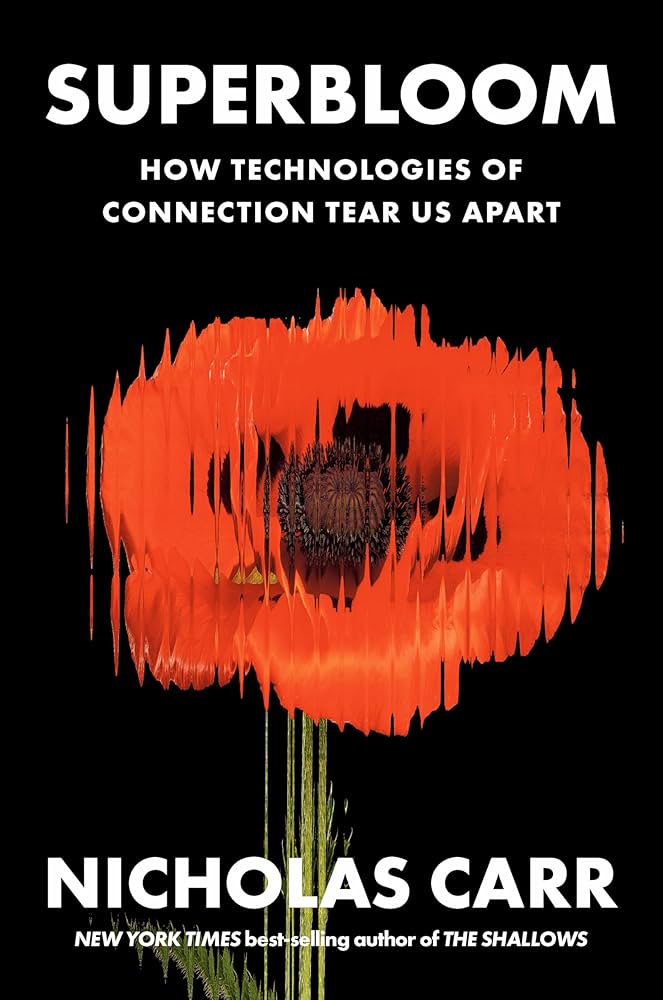
Book Review: Superbloom: How Technologies of Connection Tear Us Apart by Nicholas Carr

Cover of the book Superbloom: How Technologies of Connection Tear Us Apart by Nicholas Carr
Superbloom: How Technologies of Connection Tear Us Apart
by Nicholas Carr
Norton, 2025

This review was first published by Booklist on January 1, 2025.

**STARRED REVIEW** Carr (The Shallows, 2010) does a deep dive into the history of social media and examines the damage it’s doing to modern society. Our craze for communications technology began with the invention of the telegraph, when people predicted that our expanded ability to communicate would put an end to wars. This echoes language we hear today from tech moguls who believe social-media platforms will bring about unprecedented freedom and democratic ideals. But it never turns out that way. Carr considers what we know about human communication and psychology and argues that modern social media is ideally suited to increase intolerance, anxiety, and factionalism. Turns out, more communication isn’t automatically better. Quality matters more than quantity; efficiency is anathema to deep understanding. He examines the history of how governments have regulated communication media over the years and the ramifications of deregulating both news media and the internet. We sacrificed accountability to the public good for the sake of innovation and convenience. Far from empowering all people, social media has accelerated the concentration of wealth and power into the hands of only a few. As always, Carr’s perspective is urgent and bracing, a necessary challenge to idealistic visions of a democratic internet.

2024: My Year in Reading

My reading this year was pretty sporadic. I had some trouble concentrating off and on throughout the year, so I spent long stretches of time vegging out watching YouTube instead of sitting with a book. I’ve noticed, though, that I sleep better and I’m overall more content when I prioritize reading over watching TV. I need and benefit from both, but the balance was off this year. This seems to be a recurring theme for the past few years, honestly.

I still managed to get through a goodly number of titles, methinks: 46 total, 29 nonfiction (63%) and 17 fiction (37%). This continues my nonfiction-heavy habit of the past few years. I read 20 titles for Booklist this year, accounting for 43.5% of my total. Most of what I read this year was very good, so quality makes up for quantity.

Despite going long stretches without reading anything, I continued to impulsively check out books from the library as they caught my fancy. This resulted in very tall stacks of books sitting on my end table for months, as I renewed them over and over, or had to turn them back in and put them back on hold, because I just wasn’t reading them. By mid-November, I got sick of them sitting there, so I plowed through 12 titles all in the last month and half of the year (9 in less than two weeks, which I think is a personal record for me!)

I became shockingly lax about turning in my book reviews on time, trying the patience of my Booklist editor far more than she deserves. I should make a resolution for next year to be more on top of these.

I read several books about the development of artificial intelligence, which have made me both more and less concerned about this technology and how it’s evolving (see my list of Tech Books for People Who Don’t Trust Tech). I continued to seek out a diversity of perspectives and experiences of the world. I also read a handful of titles about professional leadership, and reassessing our culture’s deeply unhealthy and inhumane relationship to work.

I think next year I want to go back to mostly fiction. I’ll still get a decent amount of nonfic from Booklist, but I think it’s easier for me to want to read more if I’m reading fiction.

For a list of my favorite books I read this year, go here >

Continue reading “2024: My Year in Reading”

Book Review: Dengue Boy by Michel Nieva

Cover of the book Dengue Boy by Michel Nieva, tr. by Rahul Bery
Dengue Boy
by Michel Nieva, tr. by Rahul Bery
Astra, 2025

This review was first published by Booklist on November 1, 2024.

**STARRED REVIEW** Nieva’s debut expands his O’Henry award-winning short story into a full novel. The result is a dystopian fever dream that’s equal parts poetic and profane, beautiful and splattered with gore. In the year 2272, the polar ice caps have melted, Patagonia is a tropical archipelago, Antarctica is the new Caribbean, terraforming technology is used to create paradises only for the rich, and global corporations make fortunes off of pandemics. Dengue Boy is a mutant mosquito, born to a human mother, who is ostracized as child and grows up to wreak destruction. His foil is El Dulce, an entirely self-centered tween who helps smuggle contraband through Patagonia, whose only real interest is getting his hands on a prime video game console, and who comes face-to-face with a primordial force beyond reckoning. Furthermore, there’s a hallucinogenic video game that breaks the concept of time and causation. Dengue Boy is a trip. It’s a cry of rage against the inhumanity of corporate greed, a mourning for the destruction of our climate, a warning of the dangers we’re unlocking from the thawing ground, and a heartbreaking loss of hope for the future of mankind. It’s a pessimistic and transformative experience that is powerful, challenging, rewarding, and difficult to sit with.