2024: My Year in Reading

My reading this year was pretty sporadic. I had some trouble concentrating off and on throughout the year, so I spent long stretches of time vegging out watching YouTube instead of sitting with a book. I’ve noticed, though, that I sleep better and I’m overall more content when I prioritize reading over watching TV. I need and benefit from both, but the balance was off this year. This seems to be a recurring theme for the past few years, honestly.

I still managed to get through a goodly number of titles, methinks: 46 total, 29 nonfiction (63%) and 17 fiction (37%). This continues my nonfiction-heavy habit of the past few years. I read 20 titles for Booklist this year, accounting for 43.5% of my total. Most of what I read this year was very good, so quality makes up for quantity.

Despite going long stretches without reading anything, I continued to impulsively check out books from the library as they caught my fancy. This resulted in very tall stacks of books sitting on my end table for months, as I renewed them over and over, or had to turn them back in and put them back on hold, because I just wasn’t reading them. By mid-November, I got sick of them sitting there, so I plowed through 12 titles all in the last month and half of the year (9 in less than two weeks, which I think is a personal record for me!)

I became shockingly lax about turning in my book reviews on time, trying the patience of my Booklist editor far more than she deserves. I should make a resolution for next year to be more on top of these.

I read several books about the development of artificial intelligence, which have made me both more and less concerned about this technology and how it’s evolving (see my list of Tech Books for People Who Don’t Trust Tech). I continued to seek out a diversity of perspectives and experiences of the world. I also read a handful of titles about professional leadership, and reassessing our culture’s deeply unhealthy and inhumane relationship to work.

I think next year I want to go back to mostly fiction. I’ll still get a decent amount of nonfic from Booklist, but I think it’s easier for me to want to read more if I’m reading fiction.

For a list of my favorite books I read this year, go here >

Continue reading “2024: My Year in Reading”
Book Review: Dengue Boy by Michel Nieva

Cover of the book Dengue Boy by Michel Nieva, tr. by Rahul Bery
Dengue Boy
by Michel Nieva, tr. by Rahul Bery
Astra, 2025

This review was first published by Booklist on November 1, 2024.

**STARRED REVIEW** Nieva’s debut expands his O’Henry award-winning short story into a full novel. The result is a dystopian fever dream that’s equal parts poetic and profane, beautiful and splattered with gore. In the year 2272, the polar ice caps have melted, Patagonia is a tropical archipelago, Antarctica is the new Caribbean, terraforming technology is used to create paradises only for the rich, and global corporations make fortunes off of pandemics. Dengue Boy is a mutant mosquito, born to a human mother, who is ostracized as child and grows up to wreak destruction. His foil is El Dulce, an entirely self-centered tween who helps smuggle contraband through Patagonia, whose only real interest is getting his hands on a prime video game console, and who comes face-to-face with a primordial force beyond reckoning. Furthermore, there’s a hallucinogenic video game that breaks the concept of time and causation. Dengue Boy is a trip. It’s a cry of rage against the inhumanity of corporate greed, a mourning for the destruction of our climate, a warning of the dangers we’re unlocking from the thawing ground, and a heartbreaking loss of hope for the future of mankind. It’s a pessimistic and transformative experience that is powerful, challenging, rewarding, and difficult to sit with.

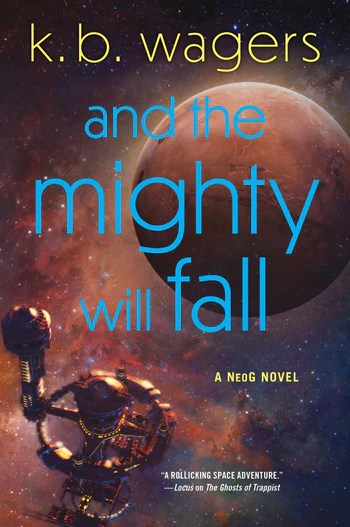
Book Review: And the Mighty Will Fall by K. B. Wagers

Cover of the book And the Mighty Will Fall by K. B. Wagers
And the Mighty Will Fall
by K. B. Wagers
Harper Voyager, 2024

This review was first published by Booklist on November 1, 2024.

The NeoG is set to hand control of the Mars Orbital Station to local Martians—a major step in granting Mars independence. Maxine Carmichael is on site to supervise when the station is hijacked by a group with unclear motives, sowing discord between the NeoG and the Free Mars activists. With Max, Sahib, and several civilians taken hostage, Nika leads a team on the ground to figure out what’s going on, avert disaster, and bring their people back alive. What ensues is a violent fight for survival amidst political intrigue. Wagers refers to this newest NeoG novel (after The Ghosts of Trappist, 2023) as “Die Hard in space.” This is accurate, though it sells the story short. There are deep themes explored here: the brutality of long-standing conflict where everyone is harmed and the psychological cost of violence. The novel is weightier and darker than its predecessors, notably more grim while retaining innate hopefulness. As always, the heart of the story is the emotional support and vulnerability the characters grant one another. It’s the only thing that can heal wounds this deep.

Book Review: Chain Reactions: The Hopeful History of Uranium by Lucy Jane Santos

Cover of the book Chain Reactions: The Hopeful History of Uranium by Lucy Jane Santos
Chain Reactions: The Hopeful History of Uranium
by Lucy Jane Santos
Pegasus, 2024

This review was first published by Booklist on October 11, 2024.

Santos’ second offering on the history of radioactivity (after Half Lives, 2021) takes readers through the history of uranium and its by-products. The earliest use of uranium was as a colorant for glass and ceramics, a use which continued into the twentieth century. Supposed medicinal uses spurred a rush to locate and mine uranium deposits, with devastating consequences for Native populations across the world. Most famously, uranium fueled the development of nuclear weapons and has been controversial as a power source. But nuclear power has a safety record surpassed only by solar, and radioactivity isn’t as dangerous as we once believed. Santos argues nuclear power deserves reassessment and another chance, especially in light of the urgent need to wean society off fossil fuels. Some of this content will be familiar to readers of Santos’ previous work, and the use of uranium in nuclear weapons and power is widely understood, so this book offers fewer surprises than its predecessor. Nonetheless, it is well researched and engaging and an important corrective to the misinformation and paranoia that surround uranium.

Book Review: The Last Dangerous Visions by Harlan Ellison and others. Ed. by Harlan Ellison

Cover of the book The Last Dangerous Visions by Harlan Ellison and others. Ed. by Harlan Ellison
The Last Dangerous Visions
by Harlan Ellison and others. Ed. by Harlan Ellison
Blackstone, 2024

This review was first published by Booklist on October 1, 2024.

**STARRED REVIEW** After more than 50 years, it’s finally here: the concluding volume of Ellison’s groundbreaking speculative-fiction anthology (which began with 1967’s Dangerous Visions). While credited to Ellison, it was completed by J. Michael Straczynski, close friend and executor of the Ellison estate, based on Ellison’s wishes. Most of the stories were solicited and purchased by Ellison over the years, including works from such luminaries as Edward Bryant, A. E. Van Vogt, and Robert Sheckley, and a terrifyingly prescient story by Dan Simmons. Straczynski solicited the rest in order to bring contemporary voices into the mix, including Max Brooks, Cory Doctorow, Adrian Tchaikovsky, a remarkable entry from first-time author Kayo Hartenbaum, and a story from James S. A. Corey potentially so controversial Straczynski questioned whether to even include it. What’s most remarkable is how seamlessly the old and new fit together. It’s a testament to the universality of the themes, ideas, concerns, and experiences they explore. This is deep, daring, and inventive storytelling. Of particular value are Straczynski’s “Ellison Exegesis,” in which he shares his perspective on why Ellison never could finish this work, and “Tetelestai!” where he explains his process for selecting the stories he included. A worthy capstone to Ellison’s monumental legacy.

Book Review: Nether Station by Kevin J. Anderson

Cover of the book Nether Station by Kevin J. Anderson
Nether Station
by Kevin J. Anderson
Blackstone, 2024

This review was first published by Booklist on September 15, 2024.

Nether Station is an experiment in genre mash-ups: space adventure meets cosmic horror. A wormhole is discovered in the Kuiper Belt, and an ultrarich tech mogul funds an expedition to explore it. After a series of eerie and unsettling experiences, the crew find themselves fighting for survival against an ancient and eldritch threat. In Anderson’s (Persephone, 2024, with Jeffrey Morris) experienced hands, this combination of genres is certainly fun. The book features a neurodivergent lead who brings a different perspective to a type of story so often dominated by neurotypical adventure heroes, adding a welcome new dynamic to the proceedings. The tech mogul is an obvious reference to Elon Musk, but Anderson doesn’t allow him to become an easy caricature; he’s fully fleshed out and multifaceted. The remaining cast is no less unique, and it’s satisfying to see how they all rise to the occasion. Anderson’s world building remains top-notch, and the pacing is propulsive. All in all, a successful experiment.

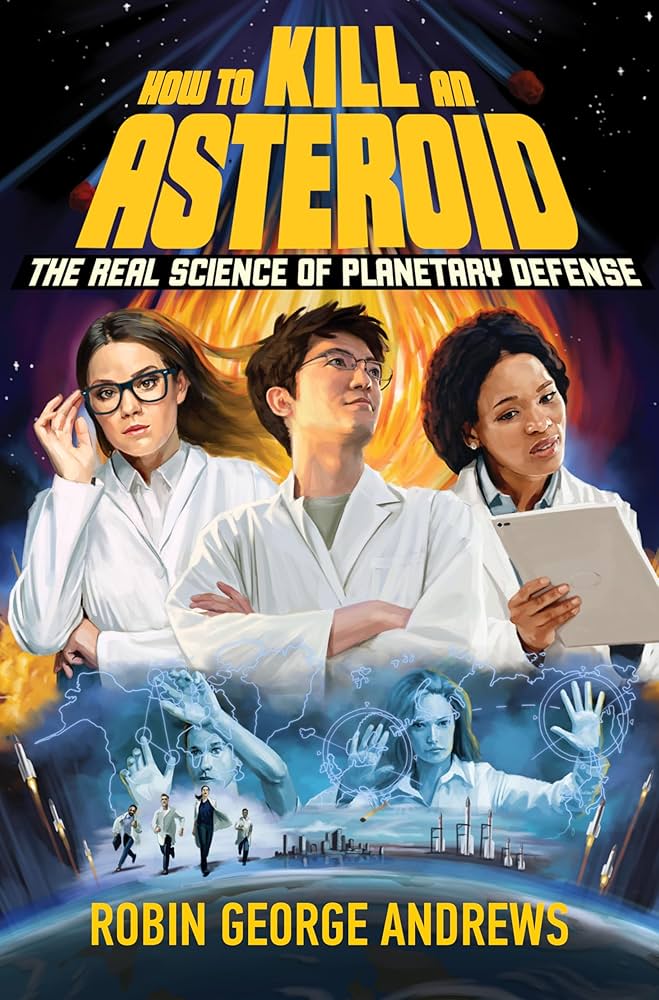
Book Review: How to Kill an Asteroid: The Real Science of Planetary Defense by Robin George Andrews

Cover of the book How to Kill an Asteroid: The Real Science of Planetary Defense by Robin George Andrews
How to Kill an Asteroid: The Real Science of Planetary Defense
by Robin George Andrews
Norton, 2024

This review was first published by Booklist on September 1, 2024.

**STARRED REVIEW** It’s impossible to prevent most natural disasters. The exceptions to this are asteroid and comet strikes—stopping cosmic impacts is possible and could save literally billions of lives. Framed around an account of NASA’s recent DART mission (Double Asteroid Redirection Test), Andrews takes readers on an exciting tour of how the science of planetary defense was born and where scientists are hoping to take it from here. He interviewed several of the most prominent people involved in planetary defense, sharing their firsthand accounts of their work and motivations, which provide compelling insight into this growing field. We know how to stop asteroids and comets from hitting Earth, using everything from deflecting them with fast rockets to disintegrating them with nuclear bombs. The challenge is mostly in how we detect these threats, especially smaller “city killers,” and Andrews offers compelling arguments for the need to build a stronger detection network. Andrews’ writing style is funny, wry, passionate, and deeply informed. How to Kill an Asteroid is one of the most entertaining pop-science reads of the year.

Book Review: Supremacy: AI, ChatGPT, and the Race That Will Change the World by Parmy Olson

Cover of the book Supremacy: AI, ChatGPT, and the Race That Will Change the World by Parmy Olson
Supremacy: AI, ChatGPT, and the Race That Will Change the World
by Parmy Olson
St. Martin’s, 2024

This review was first published by Booklist on September 1, 2024.

**STARRED REVIEW** The current ascendancy of artificial intelligence has been driven mostly by two men: Sam Altman, creator of ChatGPT, and Demis Hassabis, creator of DeepMind. Both idealists, Altman and Hassabis are driven by a conviction that AI can solve society’s deepest problems and make things better for humankind. Both men set out to ensure AI would be developed responsibly and kept out of the hands of profit-driven Big Tech corporations, and both men soon enough sold control of their creations to Microsoft and Google. This is a tale of competitive nature run amok, where the need to be first led to the abandonment of cautious plans in favor of rapid development and poorly planned deployment. It’s a frankly terrifying exposé of the dangers posed by the current, unregulated technology market. Perhaps most importantly, Olson warns against our popular obsession over the existential threat AI poses to humanity at the cost of ignoring real harms AI is already causing: it perpetuates bias and fuels polarization in society and removes human oversight from crucial decisions that affect people’s lives. Olson’s warning is clear; we’re losing control over our own creation. Add this to the growing stack of recent books sounding the alarm about unchecked tech.

Book Review: Devil in the Stack: Searching for the Soul of the New Machine by Andrew Smith

Cover of the book Devil in the Stack: Searching for the Soul of the New Machine by Andrew Smith
Devil in the Stack: Searching for the Soul of the New Machine
by Andrew Smith
Grove, 2024

This review was first published by Booklist in August 2024.

**STARRED REVIEW** Many of us have a sense that modern technology, especially social media, is damaging human society and relationships. Smith was curious to understand if that’s true and, if so, why. Here, he takes a deep dive into the culture of computer coders: he learned to code, attended coding conferences, and interviewed some of the most eminent persons of the coding world. Along the way, he offers a course in the history of the creation and development of computers and code, a necessary context to understand how we got to where we are today. He explores the nature of coding itself: is it more math or language, science or art, and how do human brains process it? He also calls our attention to the divisive, often counterintuitive history of diversity in tech. Smith believes modern technology is doing harm to society and ultimately suggests a well-reasoned argument for why, with suggestions to address the damage. But technology also offers tremendous potential to do good, and much of the culture around tech is deep with creativity, imagination, and hope. Devil in the Stack is a humane, nuanced, humorous, insightful work and a much-needed call for greater due diligence around some of the most impactful innovations in human history.

Book Review: The Mercy of Gods by James S. A. Corey

Cover of the book The Mercy of the Gods by James S. A. Corey
The Mercy of the Gods
by James S. A. Corey
Orbit, 2024

This review was first published by Booklist on July 15, 2024.

**STARRED REVIEW** No one remembers how humanity came to live on the planet Anjiin. Then the alien Carryx arrive to enslave mankind. Caught up in an age-old conflict they had no idea was even happening, and thrust into a far wider galactic community of aliens, the survivors from Anjiin must figure out how to navigate their subjugation and maybe even find a path back to freedom. Writing duo Corey (Memory’s Legion, 2022) once again does a masterful job of populating their settings with deeply drawn, unique characters. The settings are immersive and interesting, and the history of the Carryx provides compelling depth to the grand conflict of the story. The Carryx are an insectoid villain race, but Corey explores their worldview, mindset, and culture more deeply than is typical, making them more believable and interesting than the usual genre stereotype. They’re the most well-developed insectoid baddies since Orson Scott Card’s original Ender Trilogy. The Mercy of Gods starts in an unspecified part of the galaxy, assumed to be far from Earth, at an unspecified, far-future time, giving it a more speculative, fantastical feel compared to Corey’s Expanse series. This is old-fashioned space opera on a grand scale and a promising start for an epic new series.