InterWorld by Neil Gaiman & Michael Reaves
HarperCollins, 2007I admit: the only reason I checked out InterWorld is because it has Neil Gaiman’s name on it and it was available at my local library. I was waiting for a copy of a different book that I wanted to read, and I needed something to fill the time while I waited. I admit, as well, that I hadn’t paid any attention to the fact that InterWorld is a YA novel.
I wish I knew how much of InterWorld comes from Mr. Gaiman and how much is from the coauthor, Michael Reaves. I hope this is mostly Mr. Reaves book because, otherwise, I have to accept that Mr. Gaiman finally wrote something that disappointed me.
I’m not saying InterWorld is a bad book. It’s not. It’s smart and funny and fast-paced. It’s entertaining, with a delightful cast of characters.
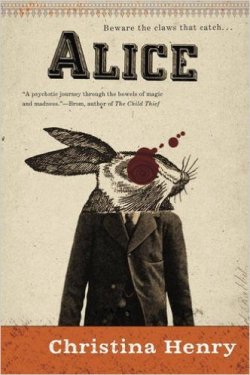
Alice by Christina Henry is… interesting. Compelling. Artful. There’s a poetry to the writing, the dialog is spare and evocative. The author’s vision of a violent Victorian world, shaped by sharp caste divisions and twisted by strange magic, is deeply rendered and believable.
We meet Alice in an insane asylum, suffering from post-traumatic stress after a violent encounter ten years prior which she can’t fully remember. She’s from the wealthy part of town but her family has abandoned her. Her only friend is the man in the adjacent cell, who, if anything, is even more insane than Alice and also suffering from memory loss. He knows about a monster trapped in the basement.
There’s a fire, they escape, and thus begins a quest through the darkest parts of the City’s underworld, which returns their memories and brings Alice into her own as a Magician in a world where magic has been banned.
All of the data that follows was collected by me using a combination of Google Sheets and Google Calendar. Once again, I elected not to track pages read—too much discrepancy between formats to generate meaningful comparisons.
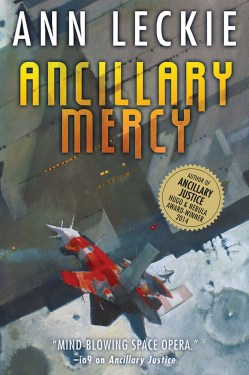
Ancillary Mercy by Ann Leckie Orbit, 2015 Cover art by John Harris
Ancillary Mercy by Ann Leckie satisfies my hopes for her Imperial Radch series. It’s a worthy conclusion to the story of Breq Mianaai / Justice of Toren One Esk Nineteen.
I admit I had reservations going into this third book of the series. The first novel showed so much promise but the second was strangely limited and left much to be desired. I really couldn’t get a sense of where the concluding volume would go.
Ancillary Mercy is a well-balanced amalgam of its predecessors. It takes place in the same location as Ancillary Sword but brings back the galactic scope of Ancillary Justice. It presents an ending which manages to be believable and appropriate, but also unexpected and compellingly unresolved.
Library of Souls by Ransom Riggs Quirk Books, 2015
Overall, I’m very happy with Library of Souls, the final novel in Ransom Riggs’ Miss Peregrine’s Peculiar Children series. It starts out at a dead run and doesn’t slow down until the end. It builds to a truly gigantic climax of staggering proportion.
It’s exciting, a surprising and worthy conclusion to the story.
It’s also laugh-out-loud funny at several points. There’s an unexpected influence of Monty Python at work in this installment and it’s very effective. It allows the ridiculous to coexist seamlessly with the horror and constant danger, which is ultimately what empowers the reader to go along for the ride.
Part of Our Lives: A People’s History of the American Public Library by Wayne A. Wiegand Oxford University Press, 2015
I recently read the book, Part of Our Lives: A People’s History of the American Public Library by Wayne A. Wiegand. Rather than write a typical review of it, I want to share a letter that I sent the author.
(TL;DR version: This book is wonderful and every public librarian and public library user should read it. I think it’s important.)
Dear Dr. Wiegand,
I’d like to thank you for writing Part of Our Lives: A People’s History of the American Public Library. Before I proceed to explain why I want to thank you, I need to spend some time voicing a complaint about something you wrote in your introduction. Bear with me—the extent of my gratitude for your work won’t be clear without this context.
Cherokee Medicine, Colonial Germs: An Indigenous Nation’s Fight against Smallpox, 1518–1824 by Paul Kelton University of Oklahoma Press, 2015
Cherokee Medicine, Colonial Germs by Paul Kelton is an essential challenge to the “virgin soil” thesis that has governed the standard historical narrative of the European colonization of the New World. Dr. Kelton argues that this narrative is too simplistic, and largely fails to comprehend or address the complexity of Native cultures during that period. Moreover, the “virgin soil” thesis is based entirely on the testaments left behind by European colonialists—who misunderstood Native actions and behaviors more often than not—and incorporates no significant input from Native Americans’ own historical knowledge.
Worse yet, the “virgin soil” thesis whitewashes the effects of the violence and oppression inherent in the colonization of the New World.
Dr. Kelton uses the Cherokee as an example of how the traditional narrative of colonization falls apart when asked to answer to the historical resources of a Native people. Moreover, he points out that even the reliable documentary evidence we have from the European colonists themselves doesn’t support the “virgin soil” thesis.
If you liked Guns, Germs, and Steel, this book will make you see things in a very different light. This is exactly what good history is supposed to do.
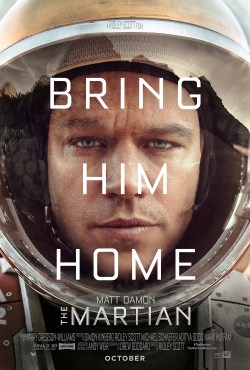
The Martian, directed by Ridley Scott Screenplay by Drew Goddard Twentieth Century Fox, 2015
I finally got around to seeing the movie of The Martian. (Yeah, I know—it took me way too long to make this happen.)
I’m so happy with it!
I think it stands as one of the best book-to-movie adaptations ever. More than that—I think it’s one of the best movies about space ever made. I love it. I think the filmmakers did a fantastic job deciding what to leave in and what to leave out. They capture the essence of the story nicely.
The big screen creates a powerful visual layer for the narrative. The panoramas of Mars are breathtaking. It’s shocking to see how his time on Mars affects Mark Watney physically. The filmmakers take full advantage of their visual medium to tell this tale.
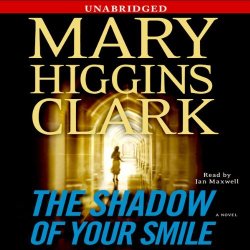
The Shadow of Your Smile by Mary Higgins Clark Simon & Schuster Audio, 2010 Read by Jan Maxwell
The Shadow of Your Smile is the first Mary Higgins Clark novel I’ve ever read.
Of course I’ve heard of Mary Higgins Clark. Her name has been all over bestseller lists for years, and she occupies quite a lot of shelf space in public libraries and bookstores across the country. But she’s not an author I was ever interested in reading. So I wasn’t sure how I would react when I ended up listening to the audiobook of The Shadow of Your Smile on a recent road trip.
Reading other reviews of The Shadow of Your Smile, I realize this probably isn’t the best book Ms. Clark has written. Consensus appears to place this novel on the low end of quality for her output. Perhaps it’s regrettable it became my first Mary Higgins Clark novel.
Kim Stanley Robinson has come up a couple of times on this blog lately. I recently reviewed his latest novel, Aurora, and of course his Mars Trilogy came up in my thoughts about The Martian by Andy Weir. The Mars Trilogy was at the back of my mind the whole time I was reading the short story anthology Old Mars—I wasn’t sure how I’d react to retro Planetary Romance-style stories about the Red Planet in a post-Robinson world.





 John the Librarian