The Connection Between Libraries and Theaters

People tend to be surprised when I tell them how many former theater people end up going into libraries as a second career. But it’s true—I know several former costumers and stage managers, even a sound guy and a dramaturg or two, who left theater to pursue new careers as librarians or archivists. I estimate fully one third of my class in my Masters of Library and Information Science program were former theater people.

(Interestingly, I don’t personally know any actors, designers, or directors who left theater for libraries. None of the creative side, just us backstage folk.)

Thing is, theaters and libraries are a natural fit.

Continue reading “The Connection Between Libraries and Theaters”

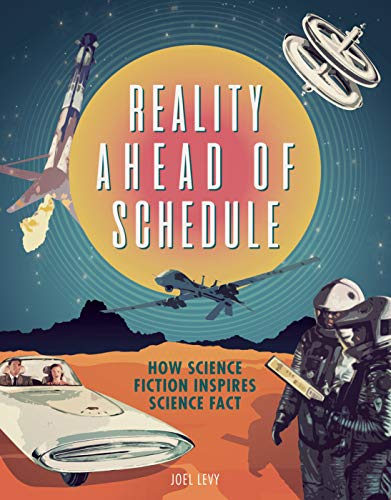
Book Review: Reality ahead of Schedule: How Science Fiction Inspires Science Fact by Joel Levy

Cover of the book Reality ahead of Schedule: How Science Fiction Inspires Science Fact by Joel Levy
Reality ahead of Schedule: How Science Fiction Inspires Science Fact
by Joel Levy
Smithsonian, 2019

This review was first published by Booklist on September 15, 2019.

Science fiction starts with science and extrapolates possibilities. But how, and how often, does science fiction influence the course of science and technology? Levy does an admirable job of teasing apart this relationship by exploring the history of science fiction and tracing the origins of many ideas which came to dominate science over the years: H.G. Wells envisioned the atom bomb and tanks, for example; credit cards were predicted in a work written in 1888; and Star Trek gave us ideas for 3D printing, telecommunications, and health apps. In some cases, science fiction explores scientific ideas before they enter the mainstream. In others, people who grew up on science fiction work to make those stories a reality. Much of what Levy illuminates is already well-known but there are some surprising connections here, too. Most notably, he argues that telepresence (as portrayed in the movie Avatar) belongs to the evolution of videophones. He presents information in an accessible and engrossing way, highlighting many forgotten classic works of science fiction. This work should appeal to anyone who’s interested in the history of science, technology, and science fiction.

This title has been recommended for young adult readers:

YA/S – special interest: High school and even advanced middle school readers with an interest in science fiction and technology will appreciate this accessible book.

Book Review: The Science of Monsters: The Truth about Zombies, Witches, Werewolves, Vampires, and Other Legendary Creatures by Meg Hafdahl and Kelly Florence

Cover of the book The Science of Monsters: The Truth about Zombies, Witches, Werewolves, Vampires, and Other Legendary Creatures by Meg Hafdahl and Kelly Florence
The Science of Monsters: The Truth about Zombies, Witches, Werewolves, Vampires, and Other Legendary Creatures
by Meg Hafdahl and Kelly Florence
Skyhorse, 2019

This review was first published by Booklist on September 1, 2019.

Hafdahl and Florence, cohosts of the popular podcast, Horror Rewind, explore some of the real-world, factual basis for 30 popular horror films from the early days of Hollywood to today. The authors don’t offer specific analyses of each film so much as use the movies as jumping off points to explore ideas that arise from them. In some cases, the ideas are directly related to a specific kind of movie: slashers based on the psychology of real-life serial killers, rare physical conditions that inspired movie monsters. In other chapters, the ideas are only tenuously connected; for example, the chapter on Alien discusses dark matter and neutrinos, which have nothing to do with the movie. But this is part of the book’s appeal. It’s fascinating how these films can inspire curiosity about a wide range of topics. The chapters are all brief, and none go into any depth, but brevity makes this a quick and fun read. If readers want to know more about the topics explored, there are good end notes to direct further research.

This title has been recommended for young adult readers:

YA/General Interest: Pop-culture hooks make for easy entry into scientific topics. —Julia Smith

Book Review: Sisters of the Vast Black by Lina Rather

Cover of the book Sisters of the Vast Black by Lina Rather
Sisters of the Vast Black
by Lina Rather
Tor, 2019

This review was first published by Booklist on September 1, 2019.

An order of nuns ministering to colony worlds in the outer reaches of human settled space. A living spaceship that might have a will of its own. Conflict between Earth and the outer systems. A controlling church. A deadly plague and a conspiracy with galaxy-spanning consequences. Sisters of the Vast Black uses these elements to explore questions of faith and free will, the conflicts that arise between obedience and conscience, complicity and refusal, and how people move on from tragic pasts. It offers a compelling blend of religious and moral challenges, science and politics. Awfully heady stuff to tackle in a novella, but Rather succeeds with intelligence and empathy. Her world building is exceptional, especially in her descriptions of the little details on the sisters’ living ship. Her characters are authentic and developed with compelling back stories. What stands out the most is Rather’s lyrical and assured style. Her language invites the reader in and sustains a sense of wonder within a challenging world. This is a beautifully written work.

Transformational Ideation vs. Original Ideatation

Or: Why ’80s Pop Bowie Is Better than ’70s Glam Bowie

David Bowie is one of the most important musicians in my personal pantheon. And I’ve always liked the pop music he made in the 1980s better than the glam rock that made him famous in the 1970s.

I’ve spent a lot of time trying to define why I like ’80s Bowie better than I ever liked ’70s Bowie. Part of it is because I’m a child of the ’80s and that’s the pop music I grew up on. But there’s more to it than just that. And it leads me to an interesting insight into the nature of ideational work.

Our modern culture prioritizes innovation to the point of fetishizing it. Because of this, we assign the greatest value to people who can come up with new ideas. This is an immensely valuable skill.

But it’s not the only skill necessary for us to do our best ideation work.

I’ve known people who weren’t any good at coming up with new ideas but who were brilliant at exploring the ideas of others. They can take your idea and discover potential in it you never saw. They can develop your idea into something better than you ever envisioned.

I’ve known people who were geniuses at connecting ideas together. They can take your idea and match it to some other idea you never would have thought related, and together these ideas become better than anything you imagined.

To borrow from the language of copyright law: There’s original work and transformative work. Some people are brilliant at doing the transformative work even if they’re not skilled at doing original work.

This sort of exploration and development work is as important as the work of coming up with new ideas. This is the work that transforms ideas into their best possible versions.

Continue reading “Transformational Ideation vs. Original Ideatation”

Book Review: The Best of Greg Egan by Greg Egan

Cover of the book The Best of Greg Egan by Greg Egan
The Best of Greg Egan
by Greg Egan
Subterranean, 2019

This review was first published by Booklist in August 2019.

**STARRED REVIEW** Egan (Perihelion Summer, 2019), a master of short form science fiction, has collected twenty of what he considers the best of his short works from the past thirty years. By presenting these works in chronological order, the collection highlights the growth of his skill as a writer: readers see his style become more elegant and subtle, his characters more nuanced and empathetic, his stories more incisive. As satisfying as each story is on its own, the greatest reward of this collection is witnessing Egan’s development as a storyteller. It also brings his obsessions front-and-center: the workings of the human mind (“Axiomatic,” “Reasons to Be Cheerful”), reason and identity (“Learning to Be Me,” “Closer,” “Uncanny Valley”), humanity’s relationship to technology (“Appropriate Love,” “Bit Players”), artificial intelligence (“Singleton,” “Crystal Nights”), the relationship between science and faith (“Oracle,” “Oceanic”), and his deep fascination with mathematics (“Luminous,” “Dark Integers”). This retrospective is sure to be treasured by Egan’s many fans, and it presents an excellent doorway for new readers to discover and explore his work for the first time.

Book Review: The Cruel Stars by John Birmingham

Cover of the book The Cruel Stars by John Birmingham
The Cruel Stars
by John Birmingham
Del Rey, 2019

This review was first published by Booklist in August 2019.

There is a rift among the humans who have spread throughout the galaxy: a divide between those who embrace genetic and technological enhancements to their bodies and those who reject them. The unenhanced lost a war and were exiled into the depths of space. Centuries later, they’re back and intent on destroying those who would pollute human purity. Now the fate of humanity depends on a new military officer with something to prove, a pirate and her crew, a plucky princess, a condemned criminal, and an obnoxious living legend and his companion AI. Birmingham’s series starter has everything going for it: interesting characters, immersive world building, a believable backstory, high-stakes conflict, visceral action, and credible villains. It’s exciting and funny with just the right amount of tension and violence. This is what military space opera should be. Even the slightly contrived climax does not take away from the satisfying conclusion. The Cruel Stars is sure to be popular with military-science-fiction readers and fans of James S. A. Corey’s The Expanse series.

The Star Wars Expanded Universe, from a Certain Point of View

Star Wars: From a Certain Point of View book cover
Star Wars: From a Certain Point of View
Del Rey, 2017

I finally got around to reading From a Certain Point of View, a collection of short stories written by a Who’s-Who roster of big name SF authors, all from the perspectives of side- and background characters in the original Star Wars movie. Most of them offer backstory or imagine what happened leading up to various scenes in the movie. Some imagine what was happening elsewhere in the universe.

This collection is a gimmick and it reads like one. The stories are all pretty good (some are excellent, none are bad) but very few of them would stand on their own merits. It’s an entertaining read, certainly, but mostly forgettable.

But it did get me thinking more about the Star Wars Expanded Universe and my ambivalence toward it. I love the movies but I’ve never bothered about the EU. There are a couple reasons why.

Continue reading “The Star Wars Expanded Universe, from a Certain Point of View”

Reasons for My Depression

But I had no way of casting off the gloom and feeling what I wanted to feel. My only freedom came down to a choice between hunting for reasons to justify my sadness…
“Reasons to be Cheerful” by Greg Egan. Interzone #118, April 1997

When I first read this in a story by Greg Egan, it struck me hard. This is a powerful description of what it’s like to have clinical depression. The inability to feel the way you know you should, the desperate need to find a reason for what you’re feeling. It’s an aspect of the experience I struggle to articulate. The way you react to things when you’re depressed is unreasonable. You don’t make sense even to yourself.

I suffered from clinical depression when I was in college and through much of my 20s. And I knew why I was depressed. I knew the reason for it.

Continue reading “Reasons for My Depression”

Book Review: Tyger Burning by T. C. McCarthy

Cover of the book Tyger Burning by T. C. McCarthy
Tyger Burning
by T. C. McCarthy
Baen, 2019

This review was first published by Booklist in July 2019.

Tyger Burning begins what promises to be a sweeping new military-sf series. The Sommen, a war-obsessed alien race, arrived in Earth’s solar system but then mysteriously disappeared, though they promised to return in 100 years. Maung is the last Dream Warrior, a cybernetically enhanced soldier in the Myanmarese army who fought for the Chinese against America and its allies in the last war. He has been in hiding, hunted by those who killed all of his compatriots. When he stumbles upon a secret, it sends him on a journey across the solar system, far from his family, to discover that nothing is as it seems. McCarthy is building a reputation as an author of compelling and believable military sf, and this latest outing proves his reputation is deserved. Focusing the story on characters from Myanmar gives it a unique twist. There are many threads established here to set up the rest of the series, resulting in an exciting if occasionally jumbled narrative which will leave readers awaiting the next installment.