Book Review: Take Us to Your Chief and Other Stories by Drew Hayden Taylor

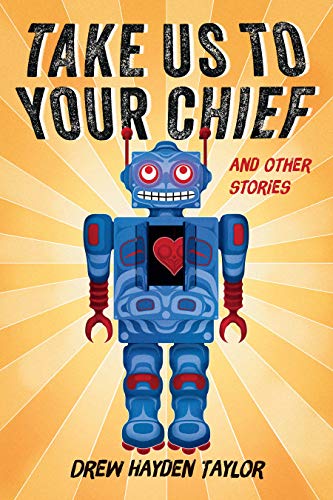
Cover of the book Take Us to Your Chief and Other Stories by Drew Hayden Taylor
Take Us to Your Chief and Other Stories
by Drew Hayden Taylor
Douglas & McIntyre, 2017

This review was first published by Booklist on March 3, 2017.

Taylor is on a mission to create science fiction written by indigenous First Nations authors. That alone makes his collection of short stories important. These nine stories are highly entertaining, the quality is high, and his range of tone is impressive. The First Nations perspective gives an interesting take on the “first contact” theme, paralleling the arrival of Europeans to the Americas. Most of these stories are humorous, but there are a couple serious ones thrown in. Many have a 1950s, Silver Era, silly pop-movie feel, which lends them a nostalgic patina. Unfortunately, the retro feel of these stories is at odds with the progressive goal of the author, coming across a tad dated and frivolous. The collection is a fun and quick read, but as entertaining as these stories are, such a slim volume isn’t quite enough to satisfy. Still, readers will be looking for more to come from Taylor.

Book Review: Avengers of the Moon by Allen Steele

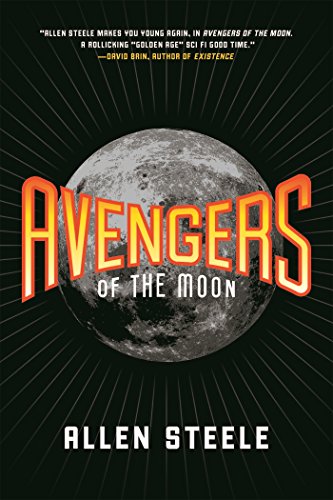
Cover of the book Avengers of the Moon by Allen Steele
Avengers of the Moon
by Allen Steele
Tor, 2017

This review was first published by Booklist on March 3, 2017.

In Avengers of the Moon, Steele resurrects Captain Future, a hero of classic pulp serials created by Edmond Hamilton, and retcons him for the twenty-first century. This all-new origin story introduces Captain Future and his crew to a new audience, pits him against his archnemesis, and sets up a continuing series. It’s a classic rollicking adventure story—exciting and entertaining, with enough callbacks to the original to appeal to existing fans. Steele states in his afterword that his intent is to recapture the magic of old pulp SF, but he doesn’t completely succeed. This isn’t the fault of the book—it’s well written, appropriately pulpy, and fun to read. It’s just that pulp doesn’t necessarily work with a modern audience. The pulp era grew out of a sense of wonder; audiences then possessed a wide-eyed credulity. Modern readers aren’t that credulous anymore. Without that innocence and idealism, pulp SF is an awkward fit. Still, this book is worth reading for the fun of it.

Book Review: Everything I Need to Know I Learned in The Twilight Zone by Mark Dawidziak

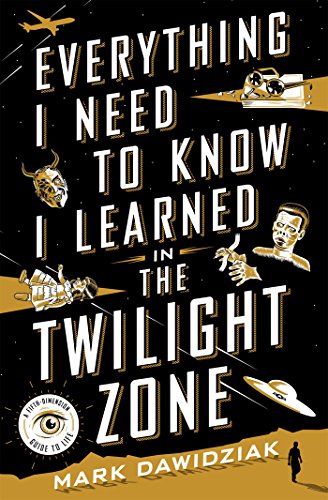
Cover of the book Everything I Need to Know I Learned in The Twilight Zone by Mark Dawidziak
Everything I Need to Know I Learned in The Twilight Zone
by Mark Dawidziak
St. Martin’s/Thomas Dunne, 2017

This review was first published by Booklist on March 3, 2017.

This book is a delightful love letter to the original The Twilight Zone television series, the primary writers of the show, and its creator, Rod Serling. The narrative is presented as a lighthearted guide to life, as Dawidziak sets forth 50 “life lessons” that can be found in various episodes. Some of the lessons are a bit on the nose, but make no mistake—as humorous as this book is, these lessons are substantial. The Twilight Zone episodes functioned as mini-morality plays, after all, steeped in Serling’s belief in the fundamental dignity of individuals. One could do worse than try to live by the book’s precepts. The book reminds us, too, of how revolutionary and brilliant the show was. Dawidziak includes statements from a variety of showbiz movers and shakers about why The Twilight Zone was important and the influence it had on them. This book won’t stand as a scholarly work, but that’s not the point: it’s a joyful celebration of being a fan. If nothing else, it will make readers want to rewatch the show—and that’s surely a welcome thing.

Book Review: Jerusalem by Alan Moore

Jerusalem by Alan Moore
Liverlight, 2016
Cover art © Alan Moore

The greatest challenge about reviewing Jerusalem by Alan Moore is summarizing what it’s about. This isn’t a traditional novel and it doesn’t deliver a normal story. The plot is meandering, almost vestigial in some sections. Setting is paramount—language, tone, atmosphere, characters: all of these matter far more than mere plot.

I’ve come to think of this book as being akin to the Bayeux Tapestry—a sprawling and artistically audacious account of a place and its people. It’s a love letter to a neighborhood as only Moore can write it.

In general terms, it’s a quasi-fictional history of the Boroughs—the poverty-stricken Northampton neighborhood in England where Alan Moore was born, raised, and still lives—from ancient times through the near future, not told in chronological order, and actively eschewing the concept of linear narrative. It’s the story of a unique family who lives there through several generations, and various persons associated with them. It’s a story of the afterlife and eternity and the Universe. It’s a story about life and death, art and work, obligation and free will, ghosts and angles and builders and demons. Visions and dreams are as real in this world as reality.

If I had to categorize this book, I’d probably call it fantastical realism. Everyone is going to shelve it in their SF sections. But it’s more than just these—it’s philosophical, historical, political, religious.

It’s holy and profane, poetic and pedestrian, beautiful and gritty. It’s deeply human. It’s hard to explain. You really need to read it.

Continue reading “Book Review: Jerusalem by Alan Moore”

More Potential of Ebooks

Read my earlier posts about the potential of ebooks:


I look forward to authors exploring the ebook format as something more than just a different package for print books. Ebooks are a format, distinct from print, and can do things that print can’t, tell stories in ways that print could never accomplish.

It’s more than the obvious idea of integrating multimedia elements (but how cool would Rigg’s “Peculiar Children” books be if the images were subtle animated GIFs?). Ebooks aren’t ink on paper, which means the text doesn’t have to be permanent. The words themselves could be made changeable.

Continue reading “More Potential of Ebooks”

Why Tech Can’t Replace Manufacturing

[Author’s Note: This is adapted from a tweetstorm I posted recently.]

Many people yearn for the return of American manufacturing. Other people correctly point out that manufacturing is never coming back. The latter argue that we need to focus on creating new jobs, new kinds of jobs, and they point to the modern tech industry for this.

But the tech industry isn’t a present-day equivalent of our bygone manufacturing economy. It can’t replace it.

Consider: In the ’50s, a man who never finished high school could get a job working a factory line, and that job paid enough for them to raise a family and own a home. Nothing much, no frills, but a decent quality of life. They could learn new skills on the job and advance to more skilled positions. They could have a career and retire in some comfort.

Name one job in today’s tech industry that you can get without a high school diploma. Name one tech job that you can get without a college degree.

Continue reading “Why Tech Can’t Replace Manufacturing”

This Is Why I Love Libraries

In my post about hatred the other day, I mentioned my life motto: “I am human: nothing human is alien to me.” (In the Latin, “Homo sum, humani nihil a me alienum puto.”)

And all at once it strikes me—this is why I have always loved libraries.

Libraries give me access to the full depth and breadth of humanity. All of our thoughts and ideas, our hopes and dreams, our fears, our creativity and cultures, our histories, our plethora of worldviews and philosophies and beliefs.

All our stories.

I can access all of this through my library. If my library doesn’t have it on the shelf, they can find it and get it for me.

Libraries are where I go to learn how to be human, in all our myriad aspects.

The Mystery of Hatred

“I am human: nothing human is alien to me.”

I first read this in a book by Isaac Asimov when I was in grade school. It wasn’t until college that I learned that this is an English translation of the Roman writer Terence. It remains one of the most powerful sentences I’ve read. If any single idea serves as my deepest moral code, it’s this.

I even made it the subtitle of this blog.

To me, this statement defines my responsibility to try and understand. All human feeling, all human thought and action, should be comprehensible to me. If human nature is capable of encompassing it, I should be able to relate to it. No matter how dark or twisted, no matter how bright or saintly—if it’s human, then by definition it shouldn’t be alien to me.

Continue reading “The Mystery of Hatred”

Movie Review: Rogue One: A Star Wars Story

Rogue One: A Star Wars Story, directed by Gareth Edwards
Rogue One: A Star Wars Story
Directed by Gareth Edwards
Screenplay by Chris Weitz & Tony Gilroy
Story by John Knoll & Gary Whitta
Produced by Lucasfilm, Ltd.
Distributed by Walt Disney Studios, 2016

I finally saw Rogue One: A Star Wars Story this weekend and I’m very happy with it. I enjoyed it immensely and I have many thoughts about it now.

I should point out that I never had much to do with the Expanded Universe—I read a couple of the novels but I never paid much attention to it. I’ve also never watched any of the animated series (“Star Wars: The Clone Wars” or “Star Wars: Rebels”). My reactions to Rogue One come purely from the perspective of how well it fits in with the other movies.

**WARNING: SPOILERS**

Continue reading “Movie Review: Rogue One: A Star Wars Story

Book Review: The Wrong Dead Guy by Richard Kadrey

Cover of the book The Wrong Dead Guy by Richard Kadrey
The Wrong Dead Guy
by Richard Kadrey
Harper/Voyager, 2017

This review was first published by Booklist on January 9, 2017.

Coop and company are back for their second supernatural adventure (after The Everything Box, 2016). This time, they’re facing a reanimated mummy bent on world domination (and finding his old girlfriend) while Coop gets acclimated to his new role in DOPS. There are inept suburban animal-rights activists, a crooked used-car salesman, machinating DOPS agents, a possessed museum guard, crooked old mystics, a professor transformed into a cat trapped in a television mounted on a tentacled robot, a forgotten department in the bowels of DOPS with a strange box in it . . . Kadrey fans have plenty of his signature ridiculousness to sink their teeth into: Douglas Adams meets Clive Barker in a James Ellroy setting. This is smart, witty, and biting comedy. There’s a bit of a sophomore slump: the stakes of the conflict are lower than its predecessor, and the side characters feel somewhat perfunctory. Still, all the elements come together and work well, and Kadrey at slightly less than his best remains one of the best out there. This new series remains worthwhile.