Book Review: Exit Strategy by Martha Wells

Cover of the book Exit Strategy by Martha Wells
Exit Strategy
by Martha Wells
Tor, 2018

This review was first published by Booklist in August, 2018.

After finding evidence proving that the GrayCris Corporation engaged in illegal activities, Murderbot heads out to hand the case over to Dr. Mensah, its former owner. But Dr. Mensah has disappeared, and Murderbot must track her down—straight into the heart of enemy territory. Saving its mentor and taking down GrayCris are just the beginning of its challenges—Murderbot also has to figure out who it is, where it fits in society, and just how it is supposed to relate to all these people. The fourth installment of Wells’ Murderbot Diaries (after Rogue Protocol, 2018) will satisfy readers’ hopes for this series finale. It follows the same basic structural formula as its predecessors, so it has all the action fans expect. Exit Strategy tones down the humor a bit but adds depth to Murderbot’s introspection as it wrestles with questions of identity that it has been avoiding, and the story leaves it to decide its own future. Everything comes full circle while remaining appropriately open ended. Wells gives us a worthy conclusion to one of the best series in recent memory.
Book Review: The Million by Karl Schroeder

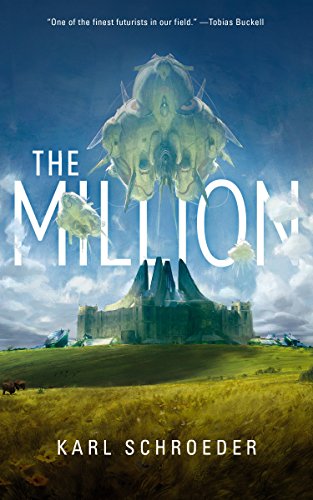
Cover of the book The Million by Karl Schroeder
The Million
by Karl Schroeder
Tor, 2018

This review was first published by Booklist on July 18, 2018.

Schroeder (Lockstep​, 2014) presents an engrossing and unique vision of the future. Most humans have moved off world, and the population of Earth is kept at one million. The Million is made up of families who are custodians of the land and resources, responsible for preserving historic skills and culture, and they’re all incredibly wealthy. Meanwhile, 10 billion people lay in cryogenic hibernation underground, waking for one month every 30 years to overrun the planet. Gavin is a young man who doesn’t belong: he is a visitor secretly adopted by one of the Million. When a rival dies, Gavin takes his place in the Academy, a training school for the elite police force charged with tracking down outcasts like him. What he discovers there is a conspiracy that could tear apart the very fabric of society. Schroeder develops a rich setting for such a short book, slightly strained but elegantly rendered, and it makes the juicy intrigue plausible. His characters are believable and the stakes are high. It’s an exciting start to what should be an addicting series.

This title has been recommended for young adult readers:

YA/General Interest: With young protagonists in a school setting dealing with the machinations of adults in authority, The Million ticks all the right boxes for older teen sf fans.

Book Review: A Voice in the Night by Jack McDevitt

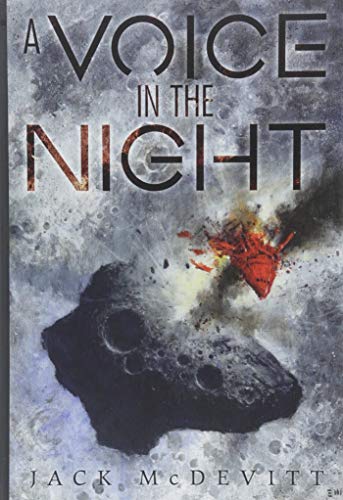
Cover of the book A Voice in the Night by Jack McDevitt
A Voice in the Night
by Jack McDevitt
Subterranean, 2018

This review was first published by Booklist on July 5, 2018.

A Voice in the Night brings together 24 short stories by McDevitt (The Long Sunset​, 2018)—tales of space exploration and artificial intelligence, even a couple of alternate-history yarns. Many highlight McDevitt’s concerns about the future of space travel and the unlikelihood of encountering other intelligent life in the universe, as well as worries about the future of our planet. Most of the stories in this collection were published in the past two decades, with a handful from the previous millennium, so it’s not a complete retrospective. Two stories are award-worthy: “Good Intentions” was a Nebula nominee in 1998, and “Ships in the Night” was an International SF winner in 1993. Of particular interest to McDevitt’s readers are two stories from his well-known Academy series, detailing Priscilla Hutchins’ qualification flight when she first became a starship pilot, in addition to several other stories set in the Academy universe. McDevitt’s fans will welcome this collection.

Book Review: Apocalypse Nyx by Kameron Hurley

Cover of the book Apocalypse Nyx by Kameron Hurley
Apocalypse Nyx
by Kameron Hurley
Tachyon, 2018

This review was first published by Booklist on July 5, 2018.

Hurley’s collection revisits the world of the Bel Dame Apocrypha (beginning with God’s War, 2011) with five stories featuring intergalactic bounty hunter Nyxnissa so Dasheem (aka Nyx) and her crew on some of their dangerous jobs. The plots are taut, thrilling, gritty, violent, profane, magical—everything Hurley’s readers expect. New readers will not feel lost in this world—Hurley has created one of the most engrossing environments in modern sf—but fans will delight in learning how Nix meets Khos and the first time she hires Anneke. Though there is not much personal growth, all of the characters are well realized, even in the short story format, and each story covers familiar interpersonal conflicts and emotional highs and lows. These stories were previously published online, but fans of sf adventure stories with lots of political intrigue will welcome them in print.

Book Review: Rogue Protocol by Martha Wells

Cover of the book Rogue Protocol by Martha Wells
Rogue Protocol
by Martha Wells
Tor, 2018

This review was first published by Booklist on May 29, 2018.

In Rogue Protocol, the third (after Artificial Condition, 2018) of Wells’ Murderbot Diaries, Murderbot is on a mission to find evidence to bring down the GrayCris Corporation for good. Their journey takes them beyond the Corporate Rim to a derelict terraforming station that hides a secret. Once again, they must protect a human crew, and when their secret identity as a rogue SecUnit is threatened, they have to decide whom they can trust. As always, the story is fast-paced and action-packed, colored by Murderbot’s acerbic commentary throughout. Though the main character remains as appealing as ever, this entry in the series feels less substantial, less happens, the plot and secondary characters are less complex, and there’s more exposition filling the pages. It’s clear the primary purpose of this book is to set the stage for the next one. On its own merits, Rogue Protocol doesn’t quite live up to the first two books in the series, but readers will be thrumming with excitement for what comes next.

Book Review: Arthur C. Clarke by Gary Westfahl

Cover of the book Arthur C. Clarke by Gary Westfahl
Arthur C. Clarke
by Gary Westfahl
Univ. of Illinois, 2018

This review was first published by Booklist on May 22, 2018.

Westfahl (Science Fiction Quotations, 2005) offers a well-considered reevaluation of Arthur C. Clarke’s legacy, tracing broad topics and contradicting some commonly held beliefs. For example, although many separate Clarke’s technical sf from his quasi-mystical imaginings, Westfahl shows it to all be of a piece: near-future technology is relatively comprehensible to modern readers, whereas far-future technology would be so far beyond our comprehension as to appear magical—a logical conclusion. His analysis is most valuable in its scope, ranging beyond Clarke’s major works and considering his myriad stories, his less successful novels, his nonfiction, and even his juvenilia. Where this book fails is in its attempts to grapple with Clarke as a person. Clarke was a deeply private man, and there’s little evidence to consider about his life beyond his published works. Westfahl tries too hard to read too much significance into what little evidence there is. It’s a bit abstruse for anyone unfamiliar with Clarke’s work, and it verges on hagiography at times. Still, a worthy analysis of an important sf writer.

Book Review: The Robots of Gotham by Todd McAulty

Cover of the book The Robots of Gotham by Todd McAulty
The Robots of Gotham
by Todd McAulty
HMH/John Joseph Adams, 2018

This review was first published by Booklist on May 15, 2018.

**STARRED REVIEW** Machine intelligences rule most of the world, human governments are rapidly losing their power, a war-ravaged U.S. is on the brink of descending into chaos, and a mysterious new plague is on the loose. In Chicago, one man finds himself at the nexus of a complex web of secrets that threatens to upend the world as we know it. This debut novel beautifully combines a postapocalyptic man-versus-machine conflict and a medical thriller. The world is immersive and detailed, the characters have depth, the writing is assured, the plotting intelligent, and the pacing about perfect. McAulty’s take on how AI might evolve gives the premise a unique twist. The story is action-packed, starting with a boom (literally) and driving you along from one crisis to the next. The action rarely lets up, yet it never becomes tiresome. The exposition gets a bit heavy-handed at times, but not enough to slow things down. There are intriguing details of this world that McAulty teases but never fully reveals, and that builds anticipation for his next books. This is thrilling, epic sf.

Book Review: Artificial Condition by Martha Wells

Cover of the book Artificial Condition by Martha Wells
Artificial Condition
by Martha Wells
Tor, 2018

This review was first published by Booklist on April 15, 2018.

Everyone’s favorite Murderbot is back. The second installment in Wells’ Murderbot Diaries picks up where All Systems Red (2017) left off, with the series’ titular character seeking answers to its origin by traveling back to where it first went rogue to learn what really happened. Along the way, it makes friends with an intelligent research transport ship and agrees to protect a group of naive researchers whose discoveries make them a target for murder. Murderbot is one of the most delightful characters in current science fiction: a killing machine who chooses to be a good person, a robot who suffers from crippling social anxiety, a sarcastic misanthrope who really just wants to be left alone to watch TV. The relationship between Murderbot and ART (the intelligent ship) adds an entertaining The Odd Couple element to the story. Like the first book, this one is a fast, fun, exciting read, and the series keeps getting funnier. Perfect entertainment for a quiet evening. Although Artificial Condition can be read as a stand-alone, readers will prefer reading the series in order.

Book Review: The Long Sunset by Jack McDevitt

Cover of the book The Long Sunset by Jack McDevitt
The Long Sunset
by Jack McDevitt
Saga, 2018

This review was first published by Booklist on March 15, 2018.

Priscilla Hutchins is the captain of an interstellar crew sent to explore the origin of a mysterious signal from another planet. But there’s resistance to the mission, as many believe continued interstellar exploration has become too dangerous. Hutch takes off despite opposition and embarks upon a journey that will lead her to discover new artifacts, alien life, and a looming celestial apocalypse. But this isn’t an adventure story; it’s a story focused mostly on people and how we relate to one another. McDevitt (Time Travelers Never Die, 2009) offers a unique take on aliens and how civilizations might arise on other planets, an unexpected and interesting choice in the realm of space-based science fiction. The active conflict of the story is political; unfortunately, McDevitt doesn’t delve as deeply into this aspect of the story as he could. But his unique vision, the way his imagination plays across a galactic stage, and the inherent tension of an unavoidable disaster make up for it. He also introduces important new elements into his ongoing Academy series, making this a worthy read.

Book Review: Phoresis by Greg Egan

Cover of the book Phoresis by Greg Egan
Phoresis
by Greg Egan
Subterranean, 2018

This review was first published by Booklist on March 1, 2018.

**STARRED REVIEW** Tvíbura and Tvíburi: twin planets locked in close orbit. Tvíbura is inhabited, Tvíburi isn’t. When an environmental crisis threatens to render life unsustainable on Tvíbura, the people there undertake a generations-long project to build a bridge to reach their twin planet and save themselves. Phoresis is an elegant, spare, evocative jewel of a novella told in three parts. We see the genesis of the project, its fruition, and the eventual outcome. The title (which means transmission) is both a literal description of the main action of the story and almost poetic in its sound. It’s an appropriate encapsulation of this book. Egan (Incandescence, 2008) offers a master class in world building—he starts with a strong, science-based idea and envisions a unique people with a vibrant culture that inhabit a complex world. It all works together to create an immensely satisfying experience. He recognizes this is a story worth telling but doesn’t try to force it to be a full novel. He tells us everything necessary with nothing extraneous; there’s tremendous depth in his brevity. In a genre dominated by series and lengthy tomes, Phoresis is a refreshing reminder that compelling stories come in all lengths.