Book Review: Black Star Renegades by Michael Moreci

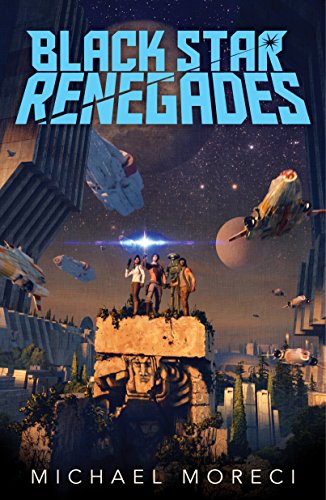
Cover of the book Black Star Renegades by Michael Moreci
Black Star Renegades
by Michael Moreci
St. Martin’s, 2018

This review was first published by Booklist on December 1, 2017.

Rai brothers Cade and Tristan Sura are elite warriors dedicated to keeping peace. Tristan is destined to become the Paragon, wielder of a legendary weapon that can protect civilization from an evil empire threatening to take over the galaxy. But when Tristan dies, Cade is stuck with the weapon—and saving civilization. Problem is, he doesn’t want the job. Moreci’s debut novel is a delightful mash-up of genre tropes: a reluctant hero, swashbuckling space adventure, martial arts, an evil empire, a scrappy band of outcasts, and a sentient killer robot. It’s a loving ode to the science fiction Moreci grew up with. The pacing is fast and exciting, strong on action and generous with humor. Moreci’s writing style could stand to be a bit more sophisticated; he doesn’t fully adapt to prose from his beloved work in comics (Roche Limit, 2015). But he clearly has fun telling this story, and his joy is infectious; fans of his work in comics and the online Star Wars community will be looking for this one.

Book Review: Terminal Alliance by Jim C. Hines

Cover of the book Terminal Alliance by Jim C. Hines
Terminal Alliance
by Jim C. Hines
DAW, 2017

This review was first published by Booklist on November 3, 2017.

A biological attack turns most of the crew of the spaceship Pufferfish into ravening zombies. Only the janitorial crew members survive unscathed. It’s up to them to figure out how to avoid the attackers still hunting them—but first they have to figure out how to fly the ship. Thus begins Terminal Alliance, the first novel in a new series from the author of the Magic Ex Libris series (Revisionary, 2017) that raises the bar for humorous postapocalyptic science fiction with charming underdogs, fascinating alien races, complex intergalactic politics, and a far-reaching conspiracy. With so much serious dystopia on the shelves, a story like this is a genuine pleasure to read: proudly funny and ridiculous. But don’t dismiss this novel as only silly fun. It is also good science fiction: a solid premise, an expansive universe, a compelling history, a strong and varied cast of characters, pulse-pounding action, and a galactic crisis with high stakes. The fact that it’s funny is icing on a rich and delicious cake. Clever, and should appeal to fans of Douglas Adams and John Scalzi.

Book Review: Tropic of Kansas by Christopher Brown

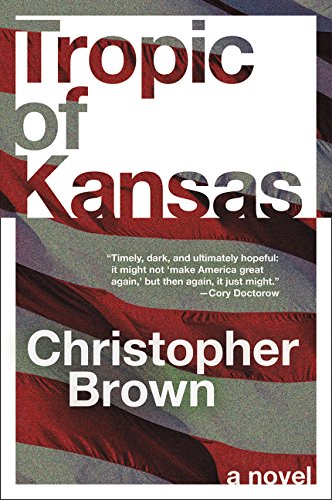
Cover of the book Tropic of Kansas by Christopher Brown
Tropic of Kansas
by Christopher Brown
Harper/Voyager, 2017

This review was first published by Booklist on September 27, 2017.

In the near future, the U.S. is broken apart into warring territories, the president is a tyrant, and rebellion rends the land. Immigration across all borders is restricted. Sig, a feral and fugitive young man, and Tania, a lawyer working for the government and daughter of a revolutionary, are connected by their past, and both get caught up in the burgeoning rebellion. They journey into the Tropic of Kansas, through the broken heartland of America to a flooded New Orleans, a world populated by smugglers, militia bands, monolithic corporations, and revolutionaries. Confronted by unreliable alliances and uncertain trust, they both must decide where their loyalties lie. This vision of the future is violent, unforgiving, and bleak: Cormac McCarthy meets Philip K. Dick. It’s disturbing because of how believable it is. The novel’s structure is fractured: chapters are short, with frequent jumps between characters. This gives the work an uncertain and unsettled feel and captures the fractured nature of the world these people inhabit. It’s remarkably effective. Recommended for fans of Paolo Bacigalupi and China Miéville.

Book Review: What the Hell Did I Just Read by David Wong

Cover of the book What the Hell Did I Just Read by David Wong
What the Hell Did I Just Read
by David Wong
St. Martin’s, 2017

This review was first published by Booklist on September 21, 2017.

David, John, and Amy are back in their third adventure (after This Book Is Full of Spiders: Seriously, Dude, Don’t Touch It, 2012), and it’s as snarky, bleak, and funny as one could hope for. The narrative starts with a high-speed car chase and never slows down, racing headlong at a breathtaking pace. Children are being kidnapped; the Big Bad is a shape-shifter; and there’s an abandoned mine, a motorcycle gang, and yet another mysterious black-cloak organization. Our heroes remain hilariously incompetent and incredibly lucky. Then things get really weird. This book is a mind-trip, messing with the characters’ heads and making the reader question reality right alongside them. These are established characters, so readers shouldn’t look for much development. It’s also a bit too fast-paced: it’s easy to miss details that need to be remembered later. Although it’s not the strongest entry in the series, it’s exciting and a great deal of fun, which is really what Wong’s fans want.

Book Review: Artemis by Andy Weir

Cover of the book Artemis by Andy Weir
Artemis
by Andy Weir
Crown, 2017

This review was first published by Booklist on September 1, 2017.

**STARRED REVIEW** Jazz Bashara grew up in Artemis, the only city on the moon. She’s a young, misanthropic, underachieving genius who side-hustles as a smuggler. One day, she takes on a job that proves too dangerous and finds herself wrapped up in murder and an interplanetary struggle for control over a new technology worth billions. This exciting, whip-smart, funny thrill-ride boasts a wonderful cast of characters, a wide cultural milieu, and the appeal of a striking young woman as the main character. It’s one of the best science fiction novels of the year—but to make it clear, Artemis is not The Martian (2011) redux. Tone, characters, structure are all very different. It’s more traditional sf and lacks the cheery novelty that characterized Weir’s famous first novel. The setting is just as detailed and scientifically realistic, but science isn’t the focus this time. Weir’s sarcastic humor is on full display, but Jazz delivers it with an anger that Watney (The Martian‘s protagonist) never had. The Martian appealed to a broad audience beyond regular sf fans, and Weir’s second novel will be in high demand, thanks to that, though it may not be to everyone’s taste.

Book Review: After the Flare by Deji Bryce Olukotun

Cover of the book After the Flare by Deji Bryce Olukotun
After the Flare
by Deji Bryce Olukotun
Unnamed, 2017

This review was first published by Booklist on August 22, 2017.

A solar flare knocks out electrical grids and technology worldwide. Countries along the equator survive best, so Nigeria ends up with the only functional space program on Earth. With the help of a former NASA engineer, the Nigerian astronauts undertake a daring rescue operation to the International Space Station. Meanwhile, terrorists threaten the launch, and excavations unearth an ancient secret. Olukotun weaves together a broad spectrum of subjects: engineering and archaeology, culture and politics, biohacking and cybernetic animal technology, ancient tribal wisdom and magical stones. With such an original premise, the story is well-paced, with compelling characters and a subtle sense of humor. It’s particularly fascinating to witness the culture shock of an African-American man now living in his ancestral homeland. If there’s a weak spot, it’s that the proffered scientific explanation for the more fantastical elements is a bit strained. This is a solidly enjoyable dystopian near-future novel set in Nigeria, with an international cast of characters, written by a Nigerian-American author.

Book Review: The Kill Society by Richard Kadrey

Cover of the book The Kill Society by Richard Kadrey
The Kill Society
by Richard Kadrey
Harper/Voyager, 2017

This review was first published by Booklist on June 7, 2017.

Sandman Slim is dead (for real this time) and abandoned in a desolate part of the Tenebrae, the land of the dead. He’s discovered by a motorized roving gang trailing destruction and death in its wake, led by a religious fanatic looking for an ultimate weapon to kill God. Slim runs into some old friends along the way. It culminates in a fight between angels at the gates of Heaven itself. And Wormwood is up to something, as always. All because Sandman Slim tried to break open Heaven. This is Kadrey’s version of a Mad Max movie laid out as a cautionary tale about religious fanaticism. It’s a fast-paced story and an ideal setting to show off more of his richly imagined hereafter. The ending puts Sandman Slim right where he most wants to be, but in the last position he ever wanted. This entry in the series is plenty entertaining, but there are a few too many coincidences to be believable. Kadrey’s social criticism is much more obvious than usual, and it hits closer to home.

Book Review: Dead on Arrival by Matt Richtel

Cover of the book Dead on Arrival by Matt Richtel
Dead on Arrival
by Matt Richtel
Morrow, 2017

This review was first published by Booklist on May 31, 2017.

The promotional blurbs for Richtel’s latest compare it to Michael Crichton’s thrillers and Stephen King’s The Stand, and these comparisons aren’t without some merit. The story is similar in atmosphere and style to both suggestions, and it’s a cautionary tale about technology and science left unchecked. An airplane lands in a remote town and everyone on the ground appears to be dead. A disgraced doctor on board is the best hope to discover what’s going on. The first half of the novel is split between this mystery and flashbacks to the doctor’s past and his relationship to a particular individual who works for an online technology giant. A twist at the midpoint of the book radically changes the direction of the story, and the second half proceeds as a conventional race-against-the-clock thriller. The pacing is excellent, the science is detailed and believable, and the flashback structure is handled well. Richtel’s writing style is urgent, making this an enjoyable and gripping read.

Book Review: Bit by Bit: How Video Games Transformed Our World by Andrew Ervin

Cover of the book Bit by Bit: How Video Games Transformed Our World by Andrew Ervin
Bit by Bit: How Video Games Transformed Our World
by Andrew Ervin
Basic, 2017

This review was first published by Booklist on April 15, 2017.

It’s unusual for a history of video games to feature multiple quotes from Rilke, references to philosophy and Zen Buddhism, and comparisons to great works of art. But that’s exactly what Ervin serves up to support his compelling argument: video games can be art. They can achieve the same heights of storytelling and social commentary, inspire genuine self-reflection, and promote personal and social progress, like any other creative medium. He examines what he considers the most seminal games, designers, and developments in the short history of video games. This isn’t a comprehensive history and doesn’t pretend to be. It’s a personal list—Ervin focuses on what he considers most important and his own experiences as a lifelong gamer. He’s clear about his personal preferences but does his best to understand the appeal of important games he doesn’t like. Ultimately, this is less about how video games have transformed our world and more about how they can. Ervin’s hopefulness sometimes feels naive, but that doesn’t render his faith in games any less compelling.

Book Review: Move Fast and Break Things: How Facebook, Google, and Amazon Cornered Culture and Undermined Democracy by Jonathan Taplin

Cover of the book Move Fast and Break Things: How Facebook, Google, and Amazon Cornered Culture and Undermined Democracy by Jonathan Taplin
Move Fast and Break Things: How Facebook, Google, and Amazon Cornered Culture and Undermined Democracy
by Jonathan Taplin
Little, Brown, 2017

This review was first published by Booklist on March 3, 2017.

Taplin urges caution in the face of our increasingly connected technology. Facebook, Google, and Amazon seem to be taking over the world. These companies are monopolies, wielding more wealth and power than any companies in history, and are even shaping laws in their own favor. He examines what motivates the men who lead these companies and discovers a frightening landscape of unchecked Randian libertarianism. His conclusion that they represent a threat to democracy itself may be hyperbolic, but it’s valuable to consider—current events may soon show whether he’s correct. Taplin also takes on the state of copyright laws and media distribution in the digital age. Here, his arguments become less nuanced. He shows little awareness of the substance of the myriad counter-arguments in the copyright debate, some of his positions are misinformed, even factually incorrect (such as his condemnation of streaming media services)—and he offers overly simplistic understandings of complex issues. But he does present a necessary challenge to conventional wisdom about modern technology and how it affects all our lives.