Book Review: The Last Dangerous Visions by Harlan Ellison and others. Ed. by Harlan Ellison

Cover of the book The Last Dangerous Visions by Harlan Ellison and others. Ed. by Harlan Ellison
The Last Dangerous Visions
by Harlan Ellison and others. Ed. by Harlan Ellison
Blackstone, 2024

This review was first published by Booklist on October 1, 2024.

**STARRED REVIEW** After more than 50 years, it’s finally here: the concluding volume of Ellison’s groundbreaking speculative-fiction anthology (which began with 1967’s Dangerous Visions). While credited to Ellison, it was completed by J. Michael Straczynski, close friend and executor of the Ellison estate, based on Ellison’s wishes. Most of the stories were solicited and purchased by Ellison over the years, including works from such luminaries as Edward Bryant, A. E. Van Vogt, and Robert Sheckley, and a terrifyingly prescient story by Dan Simmons. Straczynski solicited the rest in order to bring contemporary voices into the mix, including Max Brooks, Cory Doctorow, Adrian Tchaikovsky, a remarkable entry from first-time author Kayo Hartenbaum, and a story from James S. A. Corey potentially so controversial Straczynski questioned whether to even include it. What’s most remarkable is how seamlessly the old and new fit together. It’s a testament to the universality of the themes, ideas, concerns, and experiences they explore. This is deep, daring, and inventive storytelling. Of particular value are Straczynski’s “Ellison Exegesis,” in which he shares his perspective on why Ellison never could finish this work, and “Tetelestai!” where he explains his process for selecting the stories he included. A worthy capstone to Ellison’s monumental legacy.

Book Review: Nether Station by Kevin J. Anderson

Cover of the book Nether Station by Kevin J. Anderson
Nether Station
by Kevin J. Anderson
Blackstone, 2024

This review was first published by Booklist on September 15, 2024.

Nether Station is an experiment in genre mash-ups: space adventure meets cosmic horror. A wormhole is discovered in the Kuiper Belt, and an ultrarich tech mogul funds an expedition to explore it. After a series of eerie and unsettling experiences, the crew find themselves fighting for survival against an ancient and eldritch threat. In Anderson’s (Persephone, 2024, with Jeffrey Morris) experienced hands, this combination of genres is certainly fun. The book features a neurodivergent lead who brings a different perspective to a type of story so often dominated by neurotypical adventure heroes, adding a welcome new dynamic to the proceedings. The tech mogul is an obvious reference to Elon Musk, but Anderson doesn’t allow him to become an easy caricature; he’s fully fleshed out and multifaceted. The remaining cast is no less unique, and it’s satisfying to see how they all rise to the occasion. Anderson’s world building remains top-notch, and the pacing is propulsive. All in all, a successful experiment.

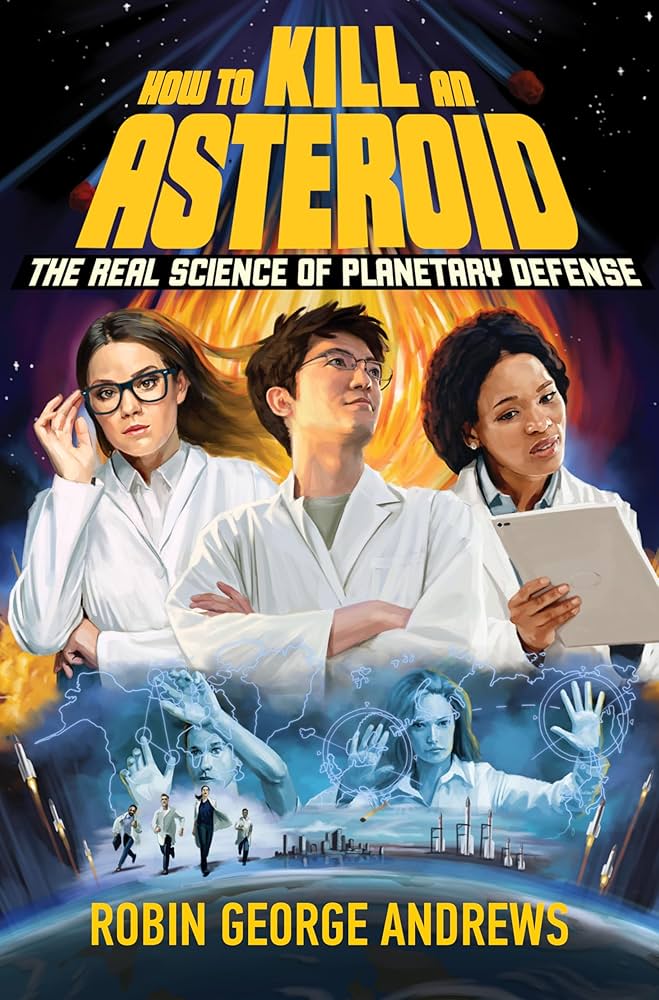
Book Review: How to Kill an Asteroid: The Real Science of Planetary Defense by Robin George Andrews

Cover of the book How to Kill an Asteroid: The Real Science of Planetary Defense by Robin George Andrews
How to Kill an Asteroid: The Real Science of Planetary Defense
by Robin George Andrews
Norton, 2024

This review was first published by Booklist on September 1, 2024.

**STARRED REVIEW** It’s impossible to prevent most natural disasters. The exceptions to this are asteroid and comet strikes—stopping cosmic impacts is possible and could save literally billions of lives. Framed around an account of NASA’s recent DART mission (Double Asteroid Redirection Test), Andrews takes readers on an exciting tour of how the science of planetary defense was born and where scientists are hoping to take it from here. He interviewed several of the most prominent people involved in planetary defense, sharing their firsthand accounts of their work and motivations, which provide compelling insight into this growing field. We know how to stop asteroids and comets from hitting Earth, using everything from deflecting them with fast rockets to disintegrating them with nuclear bombs. The challenge is mostly in how we detect these threats, especially smaller “city killers,” and Andrews offers compelling arguments for the need to build a stronger detection network. Andrews’ writing style is funny, wry, passionate, and deeply informed. How to Kill an Asteroid is one of the most entertaining pop-science reads of the year.

Book Review: Supremacy: AI, ChatGPT, and the Race That Will Change the World by Parmy Olson

Cover of the book Supremacy: AI, ChatGPT, and the Race That Will Change the World by Parmy Olson
Supremacy: AI, ChatGPT, and the Race That Will Change the World
by Parmy Olson
St. Martin’s, 2024

This review was first published by Booklist on September 1, 2024.

**STARRED REVIEW** The current ascendancy of artificial intelligence has been driven mostly by two men: Sam Altman, creator of ChatGPT, and Demis Hassabis, creator of DeepMind. Both idealists, Altman and Hassabis are driven by a conviction that AI can solve society’s deepest problems and make things better for humankind. Both men set out to ensure AI would be developed responsibly and kept out of the hands of profit-driven Big Tech corporations, and both men soon enough sold control of their creations to Microsoft and Google. This is a tale of competitive nature run amok, where the need to be first led to the abandonment of cautious plans in favor of rapid development and poorly planned deployment. It’s a frankly terrifying exposé of the dangers posed by the current, unregulated technology market. Perhaps most importantly, Olson warns against our popular obsession over the existential threat AI poses to humanity at the cost of ignoring real harms AI is already causing: it perpetuates bias and fuels polarization in society and removes human oversight from crucial decisions that affect people’s lives. Olson’s warning is clear; we’re losing control over our own creation. Add this to the growing stack of recent books sounding the alarm about unchecked tech.

Book Review: Devil in the Stack: Searching for the Soul of the New Machine by Andrew Smith

Cover of the book Devil in the Stack: Searching for the Soul of the New Machine by Andrew Smith
Devil in the Stack: Searching for the Soul of the New Machine
by Andrew Smith
Grove, 2024

This review was first published by Booklist in August 2024.

**STARRED REVIEW** Many of us have a sense that modern technology, especially social media, is damaging human society and relationships. Smith was curious to understand if that’s true and, if so, why. Here, he takes a deep dive into the culture of computer coders: he learned to code, attended coding conferences, and interviewed some of the most eminent persons of the coding world. Along the way, he offers a course in the history of the creation and development of computers and code, a necessary context to understand how we got to where we are today. He explores the nature of coding itself: is it more math or language, science or art, and how do human brains process it? He also calls our attention to the divisive, often counterintuitive history of diversity in tech. Smith believes modern technology is doing harm to society and ultimately suggests a well-reasoned argument for why, with suggestions to address the damage. But technology also offers tremendous potential to do good, and much of the culture around tech is deep with creativity, imagination, and hope. Devil in the Stack is a humane, nuanced, humorous, insightful work and a much-needed call for greater due diligence around some of the most impactful innovations in human history.

Book Review: The Mercy of Gods by James S. A. Corey

Cover of the book The Mercy of the Gods by James S. A. Corey
The Mercy of the Gods
by James S. A. Corey
Orbit, 2024

This review was first published by Booklist on July 15, 2024.

**STARRED REVIEW** No one remembers how humanity came to live on the planet Anjiin. Then the alien Carryx arrive to enslave mankind. Caught up in an age-old conflict they had no idea was even happening, and thrust into a far wider galactic community of aliens, the survivors from Anjiin must figure out how to navigate their subjugation and maybe even find a path back to freedom. Writing duo Corey (Memory’s Legion, 2022) once again does a masterful job of populating their settings with deeply drawn, unique characters. The settings are immersive and interesting, and the history of the Carryx provides compelling depth to the grand conflict of the story. The Carryx are an insectoid villain race, but Corey explores their worldview, mindset, and culture more deeply than is typical, making them more believable and interesting than the usual genre stereotype. They’re the most well-developed insectoid baddies since Orson Scott Card’s original Ender Trilogy. The Mercy of Gods starts in an unspecified part of the galaxy, assumed to be far from Earth, at an unspecified, far-future time, giving it a more speculative, fantastical feel compared to Corey’s Expanse series. This is old-fashioned space opera on a grand scale and a promising start for an epic new series.

Book Review: Ka-Boom! The Science of Extremes by David Darling

Cover of the book Ka-Boom! The Science of Extremes by David Darling
Ka-Boom! The Science of Extremes
by David Darling
Oneworld, 2024

This review was first published by Booklist on June 14, 2024.

People are perennially fascinated by extremes. What’s the most massive object we know of? The fastest computer? The loudest sound? The longest-lived being? The coldest temperature? The biggest explosion? Darling serves up a fun, informative, and quirky overview of some fascinating science facts. He surveys physics, space, materials, technology, and the natural world, offering myriad examples of the extremes we’ve discovered in the course of our exploration of our universe. There’s something for everyone in this quick and engaging read. There may not be much new information here for existing science aficionados, he repeats a few examples in different subject sections, and he doesn’t go into much depth on any of them, but his delight in exploring this material is invigorating. Even inveterate science geeks should enjoy this time spent with fascinating facts. Ka-Boom! is most valuable as an ideal introduction to the science of extremes for people just starting out on their journey into the vast realms of scientific knowledge.

Book Review: The Book of Elsewhere by Keanu Reeves and China Miéville

Cover of the book The Book of Elsewhere by Keanu Reeves and China Miéville
The Book of Elsewhere
by Keanu Reeves and China Mi&eacuteville
Del Rey, 2024

This review was first published by Booklist on June 1, 2024.

A warrior who can’t be killed and who doesn’t understand why. A government agency studying him. Ancient powers who worship him and seek to destroy him. And an immortal deer-pig. A novel cowritten by beloved sf movie star Reeves and beloved sf author Miéville (The Last Days of New Paris, 2016) doesn’t disappoint, but it may not be quite what anyone expects. Set in the same universe as Reeves’ BRZRKR graphic novel series, the nature of the narrative is revealed somewhat slowly, and the writing style is oddly anachronistic and very erudite. It’s stylistically daring, combining sf, fantasy, parascience, history, and action. It’s violent, propulsive, and introspective, ultimately offering a philosophical exploration of identity and the meaning of mortality, chaos, and entropy. The Book of Elsewhere gets under your skin and into your mind and revels in a pervasive sense of mystery. Or it could just be a weird riff on some of the most popular Reeves internet memes. Whatever it is, it works.

HIGH-DEMAND BACKSTORY: Reeves and Miéville each have their own legions of fans, and their collaboration is bound to draw both groups in.

Book Review: Rogue Sequence by Zac Topping

Cover of the book Rogue Sequence by Zac Topping
Rogue Sequence
by Zac Topping
Tor, 2024

This review was first published by Booklist on May 1, 2024.

Ander Rade is a genetically modified and psychologically conditioned corporate soldier-for-hire. Imprisoned after a failed mission, he’s released by a new U.S. government agency to help stop a terrorist attacking corporate sites—a terrorist who used to be a member of Rade’s squad. Set in a near-future, reshaped United States, this taut, violent, race-against-time thriller is a tale of one man coming to terms with the evils of his past and exploring the possibility of redemption. It’s also a stark warning about the dangers of unchecked corporate power and government corruption. Topping (Wake of War, 2022) refuses to make simplistic judgements about his characters. While it’s clear who the good and bad guys are, they all have understandable reasons for what they do, and they’re all caught up in the larger machinations of powerful corporate and government interests. Topping’s military experience shines in the vivid fight scenes and his descriptions of the characters’ surroundings. It makes the action more believable and compelling. Recommended for fans of espionage thrillers, as well as military sf readers.

Book Review: Math-ish: Finding Creativity, Diversity, and Meaning in Mathematics by Jo Boaler

Cover of the book Math-ish: Finding Creativity, Diversity, and Meaning in Mathematics by Jo Boaler
Math-ish: Finding Creativity, Diversity, and Meaning in Mathematics
by Jo Boaler
HarperOne, 2024

This review was first published by Booklist on May 1, 2024.

Math-ish is an invigorating call to reform how we teach mathematics. Math can be creative and beautiful, but you’d never know that from the way it is normally taught. Professional mathematicians report that what is taught in schools has little bearing on the math we need to drive innovation in the real world. Mathematics achievement in U.S. schools has been plummeting since the mid-twentieth century. The traditional methods of rote learning and prescribed formulae don’t work and exclude far too many people. These exclusionary methods cost us by keeping different perspectives and ideas out of STEM careers that require advanced mathematics education. Boaler, an education specialist at Stanford University, draws on evidence from educational pedagogy, neuroscience, and psychology to build strong, evidence-based arguments for how we should transform mathematics education and the benefits we could reap. Math should allow for multiple approaches to problem-solving, embrace sensory methods for interacting with concepts, and celebrate the learning that happens when people make mistakes. She presents a future for mathematics that’s more creative, diverse, and successful.