My Twitter Year

One of my goals this year is to participate more in professional conversations and debates. For me, this means getting more active on Twitter. That’s where I keep track of most of my professional connections.

This past week saw my first forays in that direction.


There’s a quote from Donny Miller that has become ubiquitous among information professionals:

“In the age of information, ignorance is a choice.”

Continue reading “My Twitter Year”

Hate Speech in Libraries

There have been several reports over the last few weeks identifying a rise in incidents of hate speech, racist graffiti and slogans, and acts of violence toward members of various minority groups throughout the country. Several libraries have been targeted—books and buildings have been defaced with swastikas, racist, sexist, homo- and transphobic epithets, explicit threats of violence toward minority groups, etc.

Libraries are targets because we stand at the vanguard of promoting inclusion and diversity. We seek to empower the disempowered, to give voice and provide access to all individuals and groups within our community. We hold as a core value that no one be excluded from the tools and services we offer, that no one be silenced or impeded from equal participation in our community. Libraries function as a safe space for anyone who needs it.

Libraries pose a great threat to those who seek to exclude all those who are different from them.

Libraries hold a resolute belief in the freedom of speech and expression. This is fundamental to everything we do. How, then, are libraries supposed to handle incidents of hate speech?

Continue reading “Hate Speech in Libraries”

Diverse Books for My Kids

The Snowy Day by Ezra Jack Keats
Viking Press, 1962

Please read this article from Rumaan Alam. What he has to say is essential.

We Don’t Only Need More Diverse Books. We Need More Diverse Books Like The Snowy Day.
by Rumaan Alam (published by Slate, August 2, 2016)

We need diverse books to be sure, but those must be part of a literature that reflects our reality, books in which little black boys push one another on the swings, in which little black girls daydream about working in the zoo, in which kids of every color do what kids of every color do every day: tromp through the woods, obsess about trucks, love their parents, refuse to eat dinner. We need more books in which our kids are simply themselves, and in which that is enough.

Continue reading “Diverse Books for My Kids”

Conversations about Libraries, Conversations about Privilege

A couple of years ago, I had a conversation with a gentleman who insisted that public libraries are going to disappear soon. He voiced the standard arguments about how everything is online now, and how ebooks are going to replace print entirely. His conclusion: libraries are irrelevant in the modern digital age.

Like so many people who take this position, this gentleman personally loves libraries and sees their inevitable passing as a loss to society. It makes him sad to think that there won’t be any more neighborhood libraries (even though he freely admits that it’s been years since he last set foot in his local library).

Of course, I spoke up to correct him. The stats make it very clear that libraries are as relevant to their communities as ever. Public library usage has actually increased with the advent of the digital information age, increased yet more during the recent economic crisis, and popular approval ratings are as high as they’ve ever been and holding steady. I shared all these stats with him. I shared multiple calculations of the economic impact of libraries and the ROI for every tax dollar invested—libraries are the single best public investment most communities can make. I talked about how libraries bolster and expand educational opportunities for kids and adults, citizens and immigrants, and the illiterate. I talked about how libraries can function as neutral gathering places during times of community upheaval. I talked about the library’s role in upholding the freedom of information and expression in our society. I talked about our computer labs and maker spaces and coding sessions and 3D printers and recording studios, our creative writing groups, our book groups, and our art spaces. I talked about our public programming and community discussion forums.

It was so clear to me that this gentleman would be happy to know that libraries are doing very well, adapting more-or-less adeptly to changing circumstances as they’ve always done, and they remain well-used and beloved by their communities.

That’s not what happened.

Continue reading “Conversations about Libraries, Conversations about Privilege”

How Libraries & Librarians Can Promote Community Health

This is the first post in my effort to tell the story of my recent health journey.

April Roy is the branch manager at the Lucile H. Bluford Branch of the Kansas City Public Library. April is a 2015 winner of the “I Love My Librarian Award” from the American Library Association in recognition for her work at Bluford.

You can read an article about her work here:

KC librarian honored for transforming branch, community
by Donna Pitman (KMBC, January 20, 2016)

April and her staff are amazing librarians and they’ve done incredible things for their neighborhood. I’m exceedingly proud to be a part of the same library system.

Continue reading “How Libraries & Librarians Can Promote Community Health”

Internet Access as Public, Social & Cultural Space

In his book, Part of Our Lives: A People’s History of the American Public Library, Dr. Wayne Wiegand groups library services into three major categories:

  • Information access
  • Reading materials
  • Public space

These categories clarify a nagging issue I have with the language we use to talk about the importance of internet access in libraries. The following quote from a recent article by Larra Clark is a good example:

Continue reading “Internet Access as Public, Social & Cultural Space”

Bridging the Digital Divide: A Matter of Equality

I spoke to a gentleman recently about the efforts of public libraries to bridge the Digital Divide, both in terms of offering broadband internet access to those who otherwise don’t have it, and teaching digital and information literacy to those who need it.

This gentleman told me that he thinks the internet is useless. He’s been online, tried the social media thing, wandered around the web, and he sees no value in any of it. He concluded that it’s all just a flood of unreliable, unverified information, and people being mean and wasting time. He believes that we’d all be better off without it.

He told me that he can’t understand why we work so hard to provide access to something that people don’t need and shouldn’t be using in the first place. I don’t believe this man was intentionally exclusionary or prejudiced—he sincerely couldn’t understand why anyone would value something which, to him, is so obviously value-less.

Rather than argue with this gentleman’s opinions regarding the supposed value of the internet, I responded:

Continue reading “Bridging the Digital Divide: A Matter of Equality”

Do Public Libraries Promote Democracy?

In his book, Part of Our Lives: A People’s History of the American Public Library, Dr. Wiegand challenges the traditional theory that public libraries are institutions which promote an informed democracy. He correctly points out that it’s “hard to prove that American public libraries are essential to democracy.” I’m certain it’s difficult, just as it’s difficult to prove many of the intangible benefits that libraries present their patrons.

Public libraries were conceptualized in large part to provide citizens access to information and “useful knowledge” which would help them to become more informed voters and civic actors. This theoretical framework is a political version of Ben Franklin’s ideal of the “self-made man”.

But historical data of public library usage makes it abundantly clear that very few people use their library this way. The maintenance of an informed democracy via access to “useful knowledge” isn’t something our patrons are all that interested in.

So it’s appropriate and useful to question this orthodoxy.

Continue reading “Do Public Libraries Promote Democracy?”

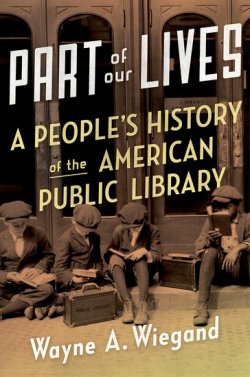
Book Review: Part of Our Lives by Wayne A. Wiegand

Part of Our Lives by Wayne A. Wiegand
Part of Our Lives: A People’s History of the American Public Library by Wayne A. Wiegand
Oxford University Press, 2015

I recently read the book, Part of Our Lives: A People’s History of the American Public Library by Wayne A. Wiegand. Rather than write a typical review of it, I want to share a letter that I sent the author.

(TL;DR version: This book is wonderful and every public librarian and public library user should read it. I think it’s important.)


Dear Dr. Wiegand,

I’d like to thank you for writing Part of Our Lives: A People’s History of the American Public Library. Before I proceed to explain why I want to thank you, I need to spend some time voicing a complaint about something you wrote in your introduction. Bear with me—the extent of my gratitude for your work won’t be clear without this context.

Continue reading “Book Review: Part of Our Lives by Wayne A. Wiegand”

Diverse Books for White Dudes

On the last day of the KLA/MLA joint conference last week, I attended a session titled “Why We Need Diverse Books.” I believe the #WeNeedDiverseBooks initiative is one of the most important social movements going on right now. I believe diversity is the most important frontier for collection development in libraries.

The session presenters recommended a variety of publishers who are good sources of diverse titles and gave examples of successful diversity programming they had done at their own libraries. For me, the most interesting point raised was the need for foreign language titles in a diverse collection. Language is an essential facet of cultural diversity, and yet our diversity collections are still predominantly written in English. A truly diverse collection which serves a truly diverse community should have resources in a multiplicity of languages. Too often, this gets overlooked in collection development efforts. I think this is a point well-made.

I walked out of this session asking myself another question which sometimes gets neglected in our discussions about diverse books:

How do we get white dudes to start reading diverse books?

Continue reading “Diverse Books for White Dudes”