Book Review: Platform Decay by Martha Wells

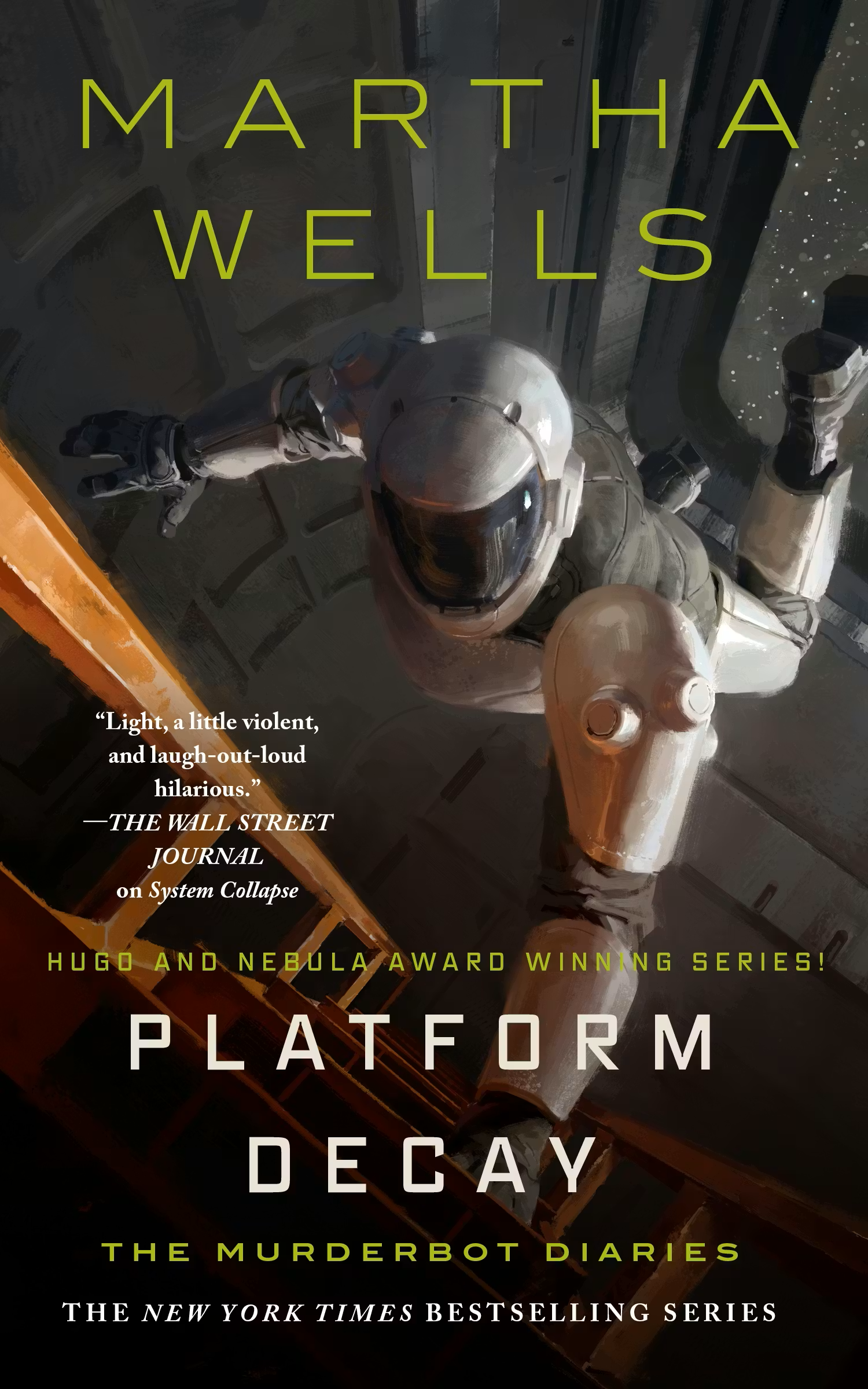
Cover of the book Platform Decay by Martha Wells
Platform Decay
by Martha Wells
Tor, 2026

This review was first published by Booklist on March 1, 2026.

**STARRED REVIEW** The newest Murderbot novel (after System Collapse, 2023) has our titular (not really an anti) hero aided by Three, the newest rogue SecUnit, on a stealth mission in a planetary ring habitat to retrieve members of Mensah’s family, who’ve been kidnapped by the Barish Estranza Corporation in retaliation for her role on the plague planet. Along the way, an unexpected ally complicates the mission, and somehow the corporate mercs seem to know they’re coming. The plot starts off in the middle of the action and doesn’t let up until the very end. It’s an incredibly satisfying ride, and one of the funniest installments in the series: After their false memory issues, Murderbot installed an “emotion check” subroutine and it’s a perfect vehicle for the sarcastic, cynical humor readers crave. Perhaps most intriguing is a small side plot that teases a change with potentially huge implications. Wells returns to form with this one, offering a setting and cast that feels smaller and more intimate, more like her earlier novellas. At the same time, she sets up exciting possibilities for where this universe could go next. The family dynamic adds real poignancy, providing one of the most emotionally resonant Murderbot tales yet.

HIGH-DEMAND BACKSTORY: The success of the Apple TV series only adds to Murderbot’s popularity, and readers have patiently waited several years for the next installment in the series.
Book Review: The Faith of Beasts by James S. A. Corey

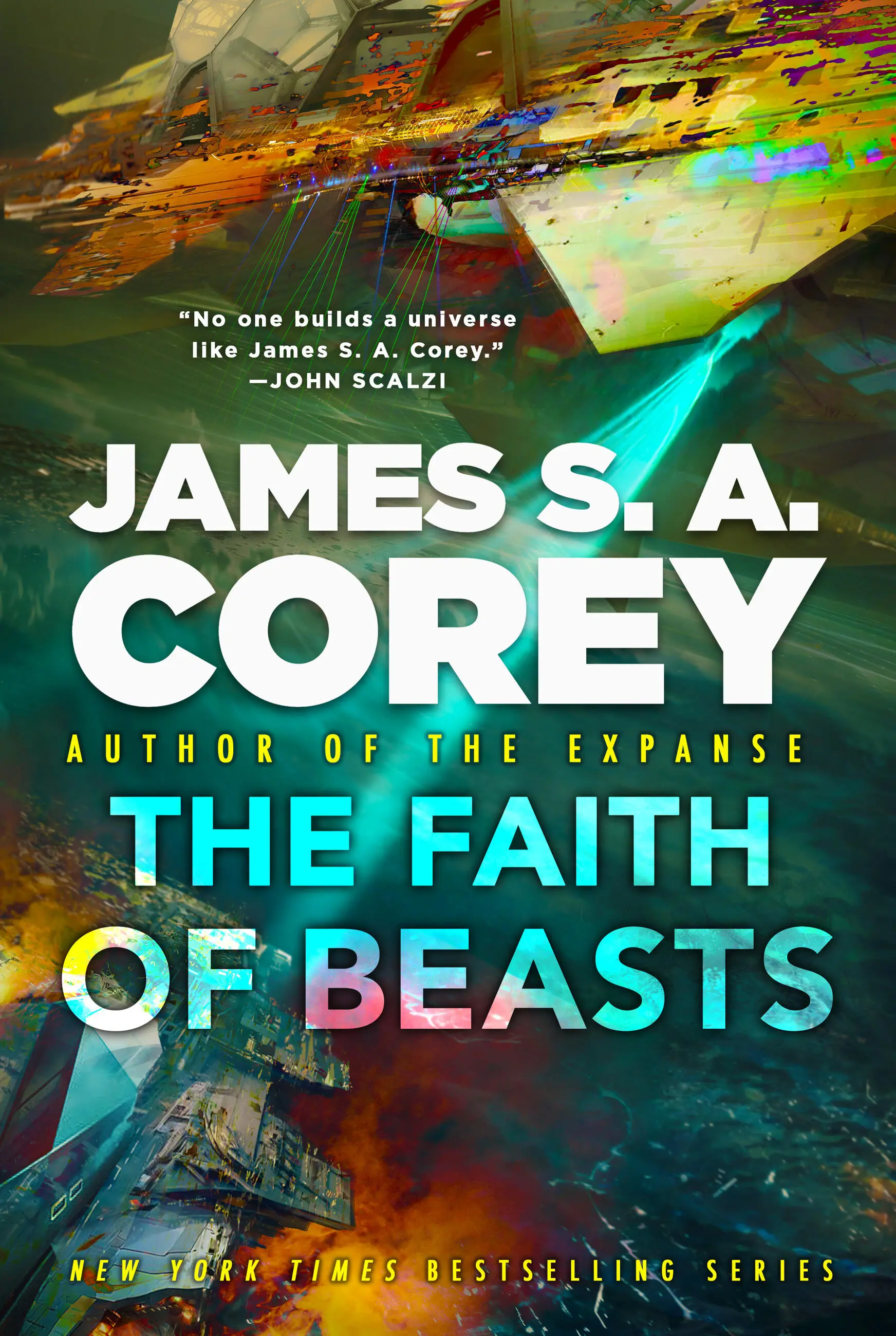
Cover of the book The Faith of Beasts by James S. A. Corey
The Faith of Beasts
by James S. A. Corey
Orbit, 2026

This review was first published by Booklist on March 1, 2026.

The human moiety (last seen in The Mercy of Gods, 2024) has adapted surprisingly well to their imprisonment on the Carryx world, proving their usefulness and even making their prison something like a home. The conspirators continue to wait for the right moment, and potential new allies are revealed. A handful of humans sent out into the wider galaxy make discoveries that radically alter their understanding of what underlies the never-ending galactic conflict. This entry in the Captive’s War series feels more intimate than its predecessor. With less world building to do, the focus has shifted more toward exploring the characters, including their relationships and complexity, as well as the ways they adjust to their new circumstances, offering an examination of how people acclimate even during horrific upheaval. Readers also learn more details about the society of the Carryx. While it’s somewhat less propulsive than The Mercy of Gods, The Faith of Beasts is a wonderful set-up for whatever is next. Fans of the series should be satisfied here and excited for the next installment.

2025: My Year in Reading

I read 38 books this year. Mostly nonfiction, and proudly representative of my major interests: cosmology, deep time, and human nature. I ended the year with a stack of around 10 books sitting on my end table, most of which I’ve had checked out for several months and I just haven’t bothered to read yet. I keep renewing them from the library but when the time comes, I choose to sit in front of the TV rather than read.

When I have done some reading this year, it’s been in intense spates, several titles all in a row, all in a couple days. A punctuated equilibrium: watching TV is my default state, with quick periods of ravenous reading scattered around.

I’ve been struggling with this for the better part of decade. Peruse any of my past Year in Reading posts and you’ll see me harping on this. I consistently get to the end of each year with a feeling that I didn’t read enough, or didn’t read regularly enough. I have this idea in my head that I’m supposed to be a more dedicated reader than this.

Thing is: I didn’t used to worry about this. I didn’t used to think about it much at all. So why has it been such a major source of pressure and disappointment for me over the past decade? Let’s do some honest accounting of my history as a reader…

Continue reading “2025: My Year in Reading”

Book Review: City of All Seasons by Oliver K. Langmead and Aliya Whiteley

Cover of the book City of All Seasons by Oliver K. Langmead and Aliya Whiteley
City of All Seasons
by Oliver K. Langmead and Aliya Whiteley
Titan, 2025

This review was first published by Booklist on April 1, 2025.

**STARRED REVIEW** This dark fantasia of magical realism is set in a city split in two, one version stuck in perpetual winter, one in unremitting summer, both cut off from the rest of the world. The mystery of how it happened is inextricably knotted up with the conflicts in the town’s most powerful family. Two cousins separated by the split must unravel the mystery, defy authority, and find their way back to each other. This is one of those novels that’s impossible to describe without reducing its magic. It’s strange and eerie, familiar and alien, compelling and off-putting, deeply rendered and mysterious, meditative and unexpectedly comforting. It feels more like a modern fable than contemporary fantasy. It’s an examination of family, conflict, and love, and how people and places imprint on each other, a kaleidoscope of time and atmosphere. The world and characters are equally complex and believable, and both are essential to the story. Readers must be willing to suspend disbelief for the premise and accept that there really isn’t a full explanation for what happens. But if they allow themselves to immerse in it, the experience is quite wonderful. Recommended for fans of Seanan McGuire and Stephen King’s fantasy work.

Book Review: The Fourth Consort by Edward Ashton

Cover of the book The Fourth Consort by Edward Ashton
The Fourth Consort
by Edward Ashton
St. Martin’s, 2025

This review was first published by Booklist on February 1, 2025.

Life isn’t going so well when Dalton Greaves gets recruited by the alien Unity coalition to be a “ground pounder”—someone who makes first contact with newly discovered, sentient species. Competition for first contact comes from the Assembly, a different coalition of aliens. When Dalton makes contact with the minarchs—a tentacled, insectoid, predatory species—things don’t go at all to plan. He and his partner end up stranded on the minarch planet along with an Assembly “stickman” and get caught up in local political conflicts. Dalton becomes the fourth consort of the minarch queen, forms an unexpected truce with his Assembly enemy, and lands in a fight for his life. Ashton (Mal Goes to War, 2024) excels at creating compelling characters. Especially impressive is how believable his different alien races are: each has its own culture and motivations, and they all make sense. The conflicts that drive the action arise from the miscommunications between them. Speculative fiction is a lens for us to reflect upon ourselves in interesting ways, and this is ultimately a delightful examination of what it means to be human.

2024: My Year in Reading

My reading this year was pretty sporadic. I had some trouble concentrating off and on throughout the year, so I spent long stretches of time vegging out watching YouTube instead of sitting with a book. I’ve noticed, though, that I sleep better and I’m overall more content when I prioritize reading over watching TV. I need and benefit from both, but the balance was off this year. This seems to be a recurring theme for the past few years, honestly.

I still managed to get through a goodly number of titles, methinks: 46 total, 29 nonfiction (63%) and 17 fiction (37%). This continues my nonfiction-heavy habit of the past few years. I read 20 titles for Booklist this year, accounting for 43.5% of my total. Most of what I read this year was very good, so quality makes up for quantity.

Despite going long stretches without reading anything, I continued to impulsively check out books from the library as they caught my fancy. This resulted in very tall stacks of books sitting on my end table for months, as I renewed them over and over, or had to turn them back in and put them back on hold, because I just wasn’t reading them. By mid-November, I got sick of them sitting there, so I plowed through 12 titles all in the last month and half of the year (9 in less than two weeks, which I think is a personal record for me!)

I became shockingly lax about turning in my book reviews on time, trying the patience of my Booklist editor far more than she deserves. I should make a resolution for next year to be more on top of these.

I read several books about the development of artificial intelligence, which have made me both more and less concerned about this technology and how it’s evolving (see my list of Tech Books for People Who Don’t Trust Tech). I continued to seek out a diversity of perspectives and experiences of the world. I also read a handful of titles about professional leadership, and reassessing our culture’s deeply unhealthy and inhumane relationship to work.

I think next year I want to go back to mostly fiction. I’ll still get a decent amount of nonfic from Booklist, but I think it’s easier for me to want to read more if I’m reading fiction.

For a list of my favorite books I read this year, go here >

Continue reading “2024: My Year in Reading”

Book Review: Dengue Boy by Michel Nieva

Cover of the book Dengue Boy by Michel Nieva, tr. by Rahul Bery
Dengue Boy
by Michel Nieva, tr. by Rahul Bery
Astra, 2025

This review was first published by Booklist on November 1, 2024.

**STARRED REVIEW** Nieva’s debut expands his O’Henry award-winning short story into a full novel. The result is a dystopian fever dream that’s equal parts poetic and profane, beautiful and splattered with gore. In the year 2272, the polar ice caps have melted, Patagonia is a tropical archipelago, Antarctica is the new Caribbean, terraforming technology is used to create paradises only for the rich, and global corporations make fortunes off of pandemics. Dengue Boy is a mutant mosquito, born to a human mother, who is ostracized as child and grows up to wreak destruction. His foil is El Dulce, an entirely self-centered tween who helps smuggle contraband through Patagonia, whose only real interest is getting his hands on a prime video game console, and who comes face-to-face with a primordial force beyond reckoning. Furthermore, there’s a hallucinogenic video game that breaks the concept of time and causation. Dengue Boy is a trip. It’s a cry of rage against the inhumanity of corporate greed, a mourning for the destruction of our climate, a warning of the dangers we’re unlocking from the thawing ground, and a heartbreaking loss of hope for the future of mankind. It’s a pessimistic and transformative experience that is powerful, challenging, rewarding, and difficult to sit with.

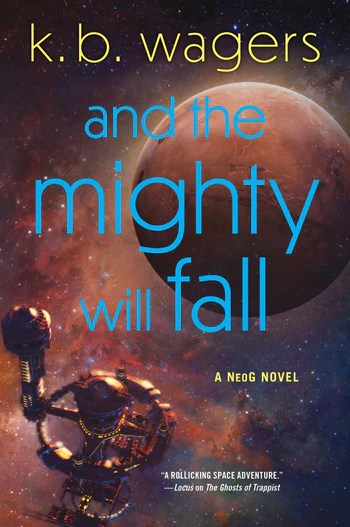
Book Review: And the Mighty Will Fall by K. B. Wagers

Cover of the book And the Mighty Will Fall by K. B. Wagers
And the Mighty Will Fall
by K. B. Wagers
Harper Voyager, 2024

This review was first published by Booklist on November 1, 2024.

The NeoG is set to hand control of the Mars Orbital Station to local Martians—a major step in granting Mars independence. Maxine Carmichael is on site to supervise when the station is hijacked by a group with unclear motives, sowing discord between the NeoG and the Free Mars activists. With Max, Sahib, and several civilians taken hostage, Nika leads a team on the ground to figure out what’s going on, avert disaster, and bring their people back alive. What ensues is a violent fight for survival amidst political intrigue. Wagers refers to this newest NeoG novel (after The Ghosts of Trappist, 2023) as “Die Hard in space.” This is accurate, though it sells the story short. There are deep themes explored here: the brutality of long-standing conflict where everyone is harmed and the psychological cost of violence. The novel is weightier and darker than its predecessors, notably more grim while retaining innate hopefulness. As always, the heart of the story is the emotional support and vulnerability the characters grant one another. It’s the only thing that can heal wounds this deep.

Book Review: The Last Dangerous Visions by Harlan Ellison and others. Ed. by Harlan Ellison

Cover of the book The Last Dangerous Visions by Harlan Ellison and others. Ed. by Harlan Ellison
The Last Dangerous Visions
by Harlan Ellison and others. Ed. by Harlan Ellison
Blackstone, 2024

This review was first published by Booklist on October 1, 2024.

**STARRED REVIEW** After more than 50 years, it’s finally here: the concluding volume of Ellison’s groundbreaking speculative-fiction anthology (which began with 1967’s Dangerous Visions). While credited to Ellison, it was completed by J. Michael Straczynski, close friend and executor of the Ellison estate, based on Ellison’s wishes. Most of the stories were solicited and purchased by Ellison over the years, including works from such luminaries as Edward Bryant, A. E. Van Vogt, and Robert Sheckley, and a terrifyingly prescient story by Dan Simmons. Straczynski solicited the rest in order to bring contemporary voices into the mix, including Max Brooks, Cory Doctorow, Adrian Tchaikovsky, a remarkable entry from first-time author Kayo Hartenbaum, and a story from James S. A. Corey potentially so controversial Straczynski questioned whether to even include it. What’s most remarkable is how seamlessly the old and new fit together. It’s a testament to the universality of the themes, ideas, concerns, and experiences they explore. This is deep, daring, and inventive storytelling. Of particular value are Straczynski’s “Ellison Exegesis,” in which he shares his perspective on why Ellison never could finish this work, and “Tetelestai!” where he explains his process for selecting the stories he included. A worthy capstone to Ellison’s monumental legacy.

Book Review: Nether Station by Kevin J. Anderson

Cover of the book Nether Station by Kevin J. Anderson
Nether Station
by Kevin J. Anderson
Blackstone, 2024

This review was first published by Booklist on September 15, 2024.

Nether Station is an experiment in genre mash-ups: space adventure meets cosmic horror. A wormhole is discovered in the Kuiper Belt, and an ultrarich tech mogul funds an expedition to explore it. After a series of eerie and unsettling experiences, the crew find themselves fighting for survival against an ancient and eldritch threat. In Anderson’s (Persephone, 2024, with Jeffrey Morris) experienced hands, this combination of genres is certainly fun. The book features a neurodivergent lead who brings a different perspective to a type of story so often dominated by neurotypical adventure heroes, adding a welcome new dynamic to the proceedings. The tech mogul is an obvious reference to Elon Musk, but Anderson doesn’t allow him to become an easy caricature; he’s fully fleshed out and multifaceted. The remaining cast is no less unique, and it’s satisfying to see how they all rise to the occasion. Anderson’s world building remains top-notch, and the pacing is propulsive. All in all, a successful experiment.