2019: My Year in Reading

All of the data that follows was collected by me throughout the year using a combination of Google Sheets and Google Calendar. This year, I analyzed my reading using both the start and finished dates for each title: for example, I totaled how many books I started reading each month and also how many I finished each month. I calculated separate averages for both and found the overall totals work out the same either way. Average days to read titles are based on the number of days actually spent reading each title, and not necessarily the full span from starting date to finished date.

A complete list of all the books I read in 2019 is at the bottom of this post.


For a list of my favorite books I read this year, go here >

I participated in #LibFaves19 on Twitter. See my selections here >

I didn’t create a “Least Favorites” list this year. I started to but then realized I enjoyed even my least favorite books too much to justify such a list. It was a good year for reading!
Continue reading “2019: My Year in Reading”

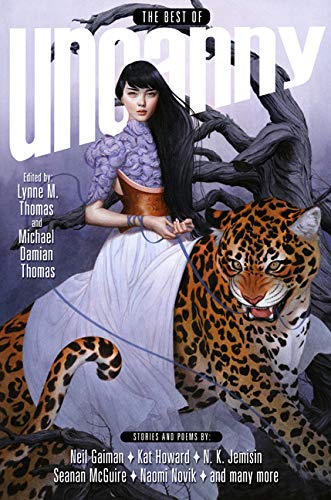
Book Review: The Best of Uncanny edited by Lynne M. Thomas and Michael Damian Thomas

Cover of the book The Best of Uncanny edited by Lynne M. Thomas and Michael Damian Thomas
The Best of Uncanny
edited by Lynne M. Thomas and Michael Damian Thomas
Subterranean, 2019

This review was first published by Booklist on November 1, 2019.

**STARRED REVIEW** Multi-award-winning Uncanny Magazine has been the preeminent publisher of speculative short fiction, poetry, and nonfiction since 2014, and is renowned for offering its contributors tremendous creative freedom. Authors published by Uncanny are a roster of the greatest sf writers of the present era: Neil Gaiman, N. K. Jemisin, Charlie Jane Anders, Seanan McGuire, Naomi Novik, and many, many more. The works in this anthology are the best of the best in the genre, from science fiction to fantasy to weird tales to poetry, representing a stunning diversity of styles and perspectives, from the Hugo award-winning “Folding Beijing,” by Hao Jingfang to a female empowerment parable, “Monster Girls Don’t Cry,” by A. Merc Rustad. Language and family tie into technology and posterity in “Restore the Heart to Love,” by John Chu; “Clearly Lettered in a Mostly Steady Hand,” by Fran Wilde visits a nightmarish circus freak show; “And Then There Were (N-One),” by Sarah Pinsker is what happens when Being John Malkovich meets Agatha Christie. This anthology contains a gluttonous surfeit of narrative riches. The works in this collection are inventive, gorgeous, occasionally difficult, and immensely rewarding. Truly, the best of Uncanny.

Book Review: Sisters of the Vast Black by Lina Rather

Cover of the book Sisters of the Vast Black by Lina Rather
Sisters of the Vast Black
by Lina Rather
Tor, 2019

This review was first published by Booklist on September 1, 2019.

An order of nuns ministering to colony worlds in the outer reaches of human settled space. A living spaceship that might have a will of its own. Conflict between Earth and the outer systems. A controlling church. A deadly plague and a conspiracy with galaxy-spanning consequences. Sisters of the Vast Black uses these elements to explore questions of faith and free will, the conflicts that arise between obedience and conscience, complicity and refusal, and how people move on from tragic pasts. It offers a compelling blend of religious and moral challenges, science and politics. Awfully heady stuff to tackle in a novella, but Rather succeeds with intelligence and empathy. Her world building is exceptional, especially in her descriptions of the little details on the sisters’ living ship. Her characters are authentic and developed with compelling back stories. What stands out the most is Rather’s lyrical and assured style. Her language invites the reader in and sustains a sense of wonder within a challenging world. This is a beautifully written work.

Book Review: The Best of Greg Egan by Greg Egan

Cover of the book The Best of Greg Egan by Greg Egan
The Best of Greg Egan
by Greg Egan
Subterranean, 2019

This review was first published by Booklist in August 2019.

**STARRED REVIEW** Egan (Perihelion Summer, 2019), a master of short form science fiction, has collected twenty of what he considers the best of his short works from the past thirty years. By presenting these works in chronological order, the collection highlights the growth of his skill as a writer: readers see his style become more elegant and subtle, his characters more nuanced and empathetic, his stories more incisive. As satisfying as each story is on its own, the greatest reward of this collection is witnessing Egan’s development as a storyteller. It also brings his obsessions front-and-center: the workings of the human mind (“Axiomatic,” “Reasons to Be Cheerful”), reason and identity (“Learning to Be Me,” “Closer,” “Uncanny Valley”), humanity’s relationship to technology (“Appropriate Love,” “Bit Players”), artificial intelligence (“Singleton,” “Crystal Nights”), the relationship between science and faith (“Oracle,” “Oceanic”), and his deep fascination with mathematics (“Luminous,” “Dark Integers”). This retrospective is sure to be treasured by Egan’s many fans, and it presents an excellent doorway for new readers to discover and explore his work for the first time.

Book Review: The Cruel Stars by John Birmingham

Cover of the book The Cruel Stars by John Birmingham
The Cruel Stars
by John Birmingham
Del Rey, 2019

This review was first published by Booklist in August 2019.

There is a rift among the humans who have spread throughout the galaxy: a divide between those who embrace genetic and technological enhancements to their bodies and those who reject them. The unenhanced lost a war and were exiled into the depths of space. Centuries later, they’re back and intent on destroying those who would pollute human purity. Now the fate of humanity depends on a new military officer with something to prove, a pirate and her crew, a plucky princess, a condemned criminal, and an obnoxious living legend and his companion AI. Birmingham’s series starter has everything going for it: interesting characters, immersive world building, a believable backstory, high-stakes conflict, visceral action, and credible villains. It’s exciting and funny with just the right amount of tension and violence. This is what military space opera should be. Even the slightly contrived climax does not take away from the satisfying conclusion. The Cruel Stars is sure to be popular with military-science-fiction readers and fans of James S. A. Corey’s The Expanse series.

The Star Wars Expanded Universe, from a Certain Point of View

Star Wars: From a Certain Point of View book cover
Star Wars: From a Certain Point of View
Del Rey, 2017

I finally got around to reading From a Certain Point of View, a collection of short stories written by a Who’s-Who roster of big name SF authors, all from the perspectives of side- and background characters in the original Star Wars movie. Most of them offer backstory or imagine what happened leading up to various scenes in the movie. Some imagine what was happening elsewhere in the universe.

This collection is a gimmick and it reads like one. The stories are all pretty good (some are excellent, none are bad) but very few of them would stand on their own merits. It’s an entertaining read, certainly, but mostly forgettable.

But it did get me thinking more about the Star Wars Expanded Universe and my ambivalence toward it. I love the movies but I’ve never bothered about the EU. There are a couple reasons why.

Continue reading “The Star Wars Expanded Universe, from a Certain Point of View”

Book Review: Tyger Burning by T. C. McCarthy

Cover of the book Tyger Burning by T. C. McCarthy
Tyger Burning
by T. C. McCarthy
Baen, 2019

This review was first published by Booklist in July 2019.

Tyger Burning begins what promises to be a sweeping new military-sf series. The Sommen, a war-obsessed alien race, arrived in Earth’s solar system but then mysteriously disappeared, though they promised to return in 100 years. Maung is the last Dream Warrior, a cybernetically enhanced soldier in the Myanmarese army who fought for the Chinese against America and its allies in the last war. He has been in hiding, hunted by those who killed all of his compatriots. When he stumbles upon a secret, it sends him on a journey across the solar system, far from his family, to discover that nothing is as it seems. McCarthy is building a reputation as an author of compelling and believable military sf, and this latest outing proves his reputation is deserved. Focusing the story on characters from Myanmar gives it a unique twist. There are many threads established here to set up the rest of the series, resulting in an exciting if occasionally jumbled narrative which will leave readers awaiting the next installment.

Book Review: Meet Me in the Future by Kameron Hurley

Cover of the book Meet Me in the Future by Kameron Hurley
Meet Me in the Future
by Kameron Hurley
Tachyon, 2019

This review was first published by Booklist on June 1, 2019.

**STARRED REVIEW** In her introduction, Hurley (The Light Brigade, 2019) admits that short stories aren’t her typical fare: her heart belongs to novels. And yet, she has produced one of the best story collections of the past few years. Hurley imagines brutal worlds, and her work is typically violent and vulgar. But as these stories make clear, her visions offer much more than shock value: these tales are emotionally powerful, lyrical, occasionally hopeful, and flirt with the profound. She creates worlds and characters as full and fascinating in a dozen pages as any she offers in her longer works. They throw into stark relief the core themes of her larger body of work: physical and linguistic expressions of gender or bodies fraught with illness (“Elephants and Corpses,” “Tumbledown,” “The Plague Givers”); war and the cycle of violence (“The Red Secretary,” “Garda,” “The War of Heroes”); storytelling as a medium for both social control and individual freedom (“Sinners on Solid Ground,” “The Corpse Archives”). What makes Hurley’s stories unique is her focus on what comes after: after war, after plague, after the collapse of civilization. These are stories that pack a punch. Highly recommended for existing fans and as an introduction for new readers.

Book Review: Reentry by Peter Cawdron

Cover of the book Reentry by Peter Cawdron
Reentry
by Peter Cawdron
HMH/John Joseph Adams, 2019

This review was first published by Booklist on May 17, 2019.

After defeating the artificial intelligence on Mars, Liz Anderson and two other survivors arrive back on Earth, but not to the welcome they expect. Earth is in turmoil after the devastation of nuclear war, and paranoia and hatred of AIs run rampant. The astronauts return with the remnants of the Martian AI, which contains the uploaded consciousness of Liz’s dead lover. Or does it? It turns out the AIs aren’t done with her yet, and all is not as it seems. Targeted by the U.S. government and aided by AI sympathizers, Liz must figure out whom to trust. In Cawdron’s follow-up to Retrograde (2016), he develops his ideas about artificial intelligence and the nature of life in complex and interesting ways. The political ramifications that drive the action are entirely believable. Reentry is a worthy sequel. Though it lacks the novelty of its predecessor, this series entry develops this world more broadly and leaves open the possibility of future stories. Fans will be satisfied.

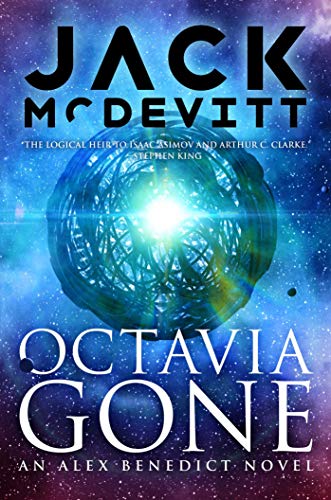
Book Review: Octavia Gone by Jack McDevitt

Cover of the book Octavia Gone by Jack McDevitt
Octavia Gone
by Jack McDevitt
Saga, 2019

This review was first published by Booklist on May 17, 2019.

Octavia Gone, the eighth entry in McDevitt’s Alex Benedict series (after Coming Home, 2014), brings back long-missing character Gabe, while Alex and crew tackle the tandem mysteries of a disappeared research station and a possibly alien artifact. What the crew discovers entails a moral conundrum that forces them to make difficult choices to find a resolution. As always, McDevitt’s story is well-structured and paced. His characters are relatable and it’s interesting to see how they react to Gabe’s reappearance. One of McDevitt’s hallmarks is his focus on external conflicts—solving the mystery and navigating its implications—but there’s little conflict between the characters; people in McDevitt’s worlds are reasonable and resolve their interpersonal issues without much ado. While the two mysteries tie together in the end, for much of the book they seem oddly unrelated. This book offers what McDevitt’s fans are looking for, but new readers will want to start with earlier books in the series.