This Is Why Libraries Are Important: A Reminder

When I got to work this morning, I had an email from a co-worker sitting in my Inbox. He’d sent it to all staff in our Library. It was a link to the following video interview:

Father’s Pride, Support Brings 10-Year-Old Son To Tears During Emotional Interview [VIDEO] (posted by NewsOne on June 9, 2013)

My co-worker’s message to go along with this video was simple and powerful:

I hope this message finds everyone in good spirits. I am sharing this video link because, every once in a while, I think we all need a reminder of why we decided to enter the world of literature and education.

[This is] a link as to why we as a library system are so vital in the 21st century. … I hope your takeaway is the one I had as to why all of our jobs are so important.

Scroll down in the article to watch the video. For some sense of the part libraries play in the lives of children everywhere, the power we have to contribute to the transformative process of education, see how they talk about the role of of reading at 2:30 and again at 3:00.

This is a message we need to hear and it’s one that we need to communicate to our communities. This is the role we play in people’s lives.
Another Librarian’s Response to "What’s a Library?"

I love Rita Meade’s (@ScrewyDecimal) reaction piece to Michael Rosenblum’s op-ed “What’s a Library?” that was posted by the Huffington Post on May 8, 2013.

A Librarian’s Response to “What’s a Library?” (posted on Book Riot on May 13, 2013)

[With apologies for plagiarizing her title.]

Let’s be kind – let’s give Mr. Rosenblum the benefit of the doubt and assume he was honestly trying to critique the current state of libraries in some kind of difficult to discern attempt to help.

He still failed.
Continue reading “Another Librarian’s Response to "What’s a Library?"”

Why Libraries Are Relevant in the Google Age

This is simply one of the best summaries I’ve read of the importance of libraries:

Libraries are uniquely positioned to make sense of today’s tsunami-like exposure to information, to allow people to transform facts into knowledge and to move knowledge along divergent paths of practical relevance and unbridled inspiration.

Libraries are uniquely positioned to do this for an audience of all ages and status — children, college students, community members, university scholars, researchers and just plain folks who are just plain curious. From princes to paupers, libraries are a great equalizer and emancipator. In this new environment, we are all students. Libraries — both physical and virtual — are the places where we learn, discover old truths and synthesize new knowledge.

… [L]ibraries have moved beyond being mere repositories for shelf after shelf of printed materials, as valuable as that function is. They are gateways to a dynamic world of information and the manner in which that information is collected, presented and used is as important as the information itself.

(From Why libraries are relevant in the Google age by Patricia Iannuzzi, posted in the Las Vegas Sun on April 15, 2013)

Again with the Ebooks & Online Library Services & Patron Privacy

Defining a Less Polarizing Position

I was talking to my wife about my concerns over patron privacy and library ebook lending for Kindles, and she presented me with an argument that pretty well demolished my entire principled stance on this issue:

Ebook services for libraries don’t carry any really controversial or potentially dangerous stuff anyway. Ereaders are for fluff – all the data shows that pretty much no one uses them for serious reading or scholarship. There’s no real danger in exposing ebook lending records because there’s nothing there to get patrons in trouble in the first place.
Continue reading “Again with the Ebooks & Online Library Services & Patron Privacy”

Ebook Lending for Kindles & Patron Privacy

Back in November, I wrote about some serious concerns I have regarding library-based social sharing platforms and patron privacy. More recently, I find myself harboring similar concerns about ebook lending for Kindles.

I’ve never actually checked out an ebook from my library. So the other week, when I was asked to help a patron check out an ebook for her Kindle, I was taken aback when we reached the step where she was required to sign in to Amazon using her personal Amazon ID. This step raises an important question:

What happens to the record of this transaction in Amazon’s database?
Continue reading “Ebook Lending for Kindles & Patron Privacy”

Data Handling in Electronic Systems – Inspiration for a Paradigm Reassessment

At my library, we’re currently working on a project in conjunction with several other regional knowledge institutions to put online our full collection of historical documents regarding the Civil War in Missouri and Kansas. One piece of functionality we’re creating is a way to visually represent the relationships between people, places, and things within this pool of data. These visualizations are based on a relationship database that we constructed, using a basic semantic structure: “Object A [relationship] Object B” and we can verify this relationship with “Document X”. Thus, for example:

Iskabibble Jones is married to Bridgette Jones and we know this because of information contained in Bridgette’s letter dated …

Only, instead of statements, we represent this all graphically with links to images and documents. It’s a pretty nifty function!

The way we’re building the database for this relationship visualization tool is representative of how online data gets handled in general. It illustrates the fundamental paradigm that has governed computer development from the beginning – and, indeed, the development of mechanized data handling even before the advent of computers.
Continue reading “Data Handling in Electronic Systems – Inspiration for a Paradigm Reassessment”

Collection Development in a Digital Age

One of my current obsessions is the changing nature of our relationship to information. I keep coming back to this topic. We’re currently witnessing the greatest change in how we use and value information since the advent of printing – and maybe even since the invention of writing.

(Yes, I’m being overly dramatic about it but I actually do believe this.)

I’m curious to see how collection development for libraries evolves in the Digital Information Age. Not just in terms of format and access changes, but more essentially – how will the Digital Information Age affect the techniques we use to determine what our patrons need in the first place?
Continue reading “Collection Development in a Digital Age”

Search Amazon – Go to Your Library

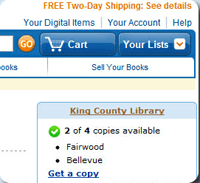
Amazon's Library ExtensionI think this is wonderful! I can’t wait until this extension is available for all browsers…

Browser Extension Encourages Amazon Searchers to Head to Their Library by Matt Ennis (published online by Library Journal on Jan. 2, 2013)

It reminds me of an idea I had when I was in grad school for a location-based mobile app that would integrate nearby library holdings and databases with online search results – so that whatever you’re searching for, you’d see what’s online side-by-side with the resources are close by in the nearest library.

Conveying Authority

When I was in school to get my MLIS, I had an assignment in my Reference class to observe reference librarians in real-world situations. I sat in at the reference desk at my local branch of the Chicago Public Library over the course of several days. I noticed something odd about the way the reference librarians dressed at this branch: sometimes they dressed in more formal professional attire – long-sleeved, button-up shirts and ties for the men; blouses and skirts, or dresses for the women – but at other times they dressed very casually; sometimes the same librarian would be dressed professionally one day, and the next day casually. I saw no rhyme or reason to this.
Continue reading “Conveying Authority”