Book Review: The World of Lore: Monstrous Creatures by Aaron Mahnke

The World of Lore: Monstrous Creatures by Aaron Mahnke
The World of Lore: Monstrous Creatures
by Aaron Mahnke
Del Ray, 2017

Aaron Mahnke’s Lore podcast is one of the more fascinating and informative podcasts available. He explores the world of lore: folktales and legends—usually creepy or macabre—and shares the interesting things he finds. He’s an accomplished and entertaining storyteller.

Podcasts are subject to time constraints: there’s only so much you can fit into each episode. While the stories he shares with his listeners are clearly well researched, he doesn’t go into much depth with them. And that’s OK for a podcast—the point of these stories is to share them and entertain his audience. While he occasionally asks the Big Questions (“Why are we drawn to myths and legends like these? What purpose do they serve?” etc.) he never offers much more than cursory, broad strokes answers. Again, that’s fine for a podcast—he needs to focus each episode on telling the cool stories he finds.

Continue reading “Book Review: The World of Lore: Monstrous Creatures by Aaron Mahnke”

Book Review: Bit by Bit: How Video Games Transformed Our World by Andrew Ervin

Cover of the book Bit by Bit: How Video Games Transformed Our World by Andrew Ervin
Bit by Bit: How Video Games Transformed Our World
by Andrew Ervin
Basic, 2017

This review was first published by Booklist on April 15, 2017.

It’s unusual for a history of video games to feature multiple quotes from Rilke, references to philosophy and Zen Buddhism, and comparisons to great works of art. But that’s exactly what Ervin serves up to support his compelling argument: video games can be art. They can achieve the same heights of storytelling and social commentary, inspire genuine self-reflection, and promote personal and social progress, like any other creative medium. He examines what he considers the most seminal games, designers, and developments in the short history of video games. This isn’t a comprehensive history and doesn’t pretend to be. It’s a personal list—Ervin focuses on what he considers most important and his own experiences as a lifelong gamer. He’s clear about his personal preferences but does his best to understand the appeal of important games he doesn’t like. Ultimately, this is less about how video games have transformed our world and more about how they can. Ervin’s hopefulness sometimes feels naive, but that doesn’t render his faith in games any less compelling.

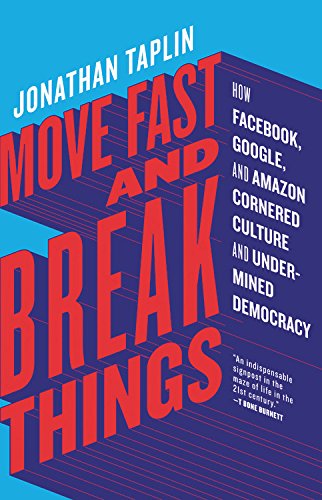
Book Review: Move Fast and Break Things: How Facebook, Google, and Amazon Cornered Culture and Undermined Democracy by Jonathan Taplin

Cover of the book Move Fast and Break Things: How Facebook, Google, and Amazon Cornered Culture and Undermined Democracy by Jonathan Taplin
Move Fast and Break Things: How Facebook, Google, and Amazon Cornered Culture and Undermined Democracy
by Jonathan Taplin
Little, Brown, 2017

This review was first published by Booklist on March 3, 2017.

Taplin urges caution in the face of our increasingly connected technology. Facebook, Google, and Amazon seem to be taking over the world. These companies are monopolies, wielding more wealth and power than any companies in history, and are even shaping laws in their own favor. He examines what motivates the men who lead these companies and discovers a frightening landscape of unchecked Randian libertarianism. His conclusion that they represent a threat to democracy itself may be hyperbolic, but it’s valuable to consider—current events may soon show whether he’s correct. Taplin also takes on the state of copyright laws and media distribution in the digital age. Here, his arguments become less nuanced. He shows little awareness of the substance of the myriad counter-arguments in the copyright debate, some of his positions are misinformed, even factually incorrect (such as his condemnation of streaming media services)—and he offers overly simplistic understandings of complex issues. But he does present a necessary challenge to conventional wisdom about modern technology and how it affects all our lives.

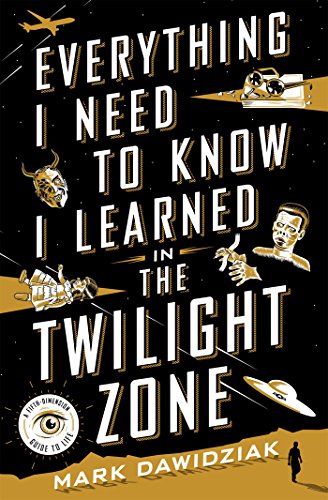
Book Review: Everything I Need to Know I Learned in The Twilight Zone by Mark Dawidziak

Cover of the book Everything I Need to Know I Learned in The Twilight Zone by Mark Dawidziak
Everything I Need to Know I Learned in The Twilight Zone
by Mark Dawidziak
St. Martin’s/Thomas Dunne, 2017

This review was first published by Booklist on March 3, 2017.

This book is a delightful love letter to the original The Twilight Zone television series, the primary writers of the show, and its creator, Rod Serling. The narrative is presented as a lighthearted guide to life, as Dawidziak sets forth 50 “life lessons” that can be found in various episodes. Some of the lessons are a bit on the nose, but make no mistake—as humorous as this book is, these lessons are substantial. The Twilight Zone episodes functioned as mini-morality plays, after all, steeped in Serling’s belief in the fundamental dignity of individuals. One could do worse than try to live by the book’s precepts. The book reminds us, too, of how revolutionary and brilliant the show was. Dawidziak includes statements from a variety of showbiz movers and shakers about why The Twilight Zone was important and the influence it had on them. This book won’t stand as a scholarly work, but that’s not the point: it’s a joyful celebration of being a fan. If nothing else, it will make readers want to rewatch the show—and that’s surely a welcome thing.

2016: My Year in Reading

All of the data that follows was collected by me throughout the year using a combination of Google Sheets and Google Calendar. All seasonal and monthly calculations are based on the date each title was completed. Average days to read titles are based on the number of days actually spent reading each title, and not necessarily the full span from begun date to completed date.

A complete list of all the books I read in 2016 is at the bottom of this post.


I read 70 books in 2016. This year I overwhelmingly read fiction:

Continue reading “2016: My Year in Reading”

Book Review: Cyberbullying and the Wild, Wild Web: What Everyone Needs to Know by J. A. Hitchcock

Cover of the book Cyberbullying and the Wild, Wild Web: What Everyone Needs to Know by J. A. Hitchcock
Cyberbullying and the Wild, Wild Web: What Everyone Needs to Know
by J. A. Hitchcock
Rowman & Littlefield, 2017

This review was first published by Booklist on December 15, 2016.

This book will be a useful resource for anyone who wants to know how to deal with cyberbullying. Chock-full of examples of what cyberbullying is—each chapter opens with the story of a victim—the narrative’s greatest value is the well-informed and practical advice it offers about how to handle cyberbullies and what parents can do if their child is the one doing the bullying. The author also provides insightful analysis of what makes cyberbullying different and why it can be more harmful than other forms of bullying. The work concludes with a comprehensive list of resources and support organizations available to those who need them. Parents will appreciate the guidance. Hitchcock founded one of the first organizations dedicated to combating online abuse and is a recognized expert in the field. She approaches the subject from the perspective of her own experiences, which testifies to her authority on the subject, but at times it comes across as a bit self-promotional. However, she also interviews several other cyberbullying experts and includes their insights, making this a well-rounded resource for parents and educators.

Book Review: Power Play: How Video Games Can Save the World by Asi Burak and Laura Parker

Cover of the book Power Play: How Video Games Can Save the World by Asi Burak and Laura Parker
Power Play: How Video Games Can Save the World
by Asi Burak and Laura Parker
St. Martin’s, 2017

This review was first published by Booklist on December 15, 2016.

This book is a survey of the movement to use video games as tools to educate and empower positive social change. Each chapter dives into a specific game or media company to present the history of this movement through real-world examples. Games can be forces for good—these games have been used to foster empathy and compassion, to illuminate mutual understanding, to promote involvement in civics and science, and even to help the sick deal with illness. Lead author Burak has been a pivotal figure in the Games for Change movement. Just about all of the games profiled in this book were projects that his organization, Games for Change, was involved with in some way. This makes him biased on the subject, certainly, but it also makes him better informed about the state of social-impact games than just about anyone else. This is an insider’s perspective, and the authors make a compelling argument. Games for Change might just change the world someday. It will be exciting to see what comes next.

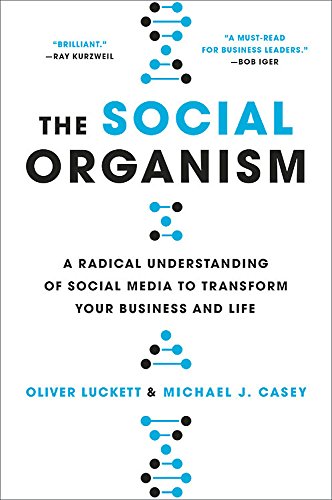
Book Review: The Social Organism: A Radical Understanding of Social Media to Transform Your Business and Life by Oliver Luckett and Michael J. Casey

Cover of the book The Social Organism: A Radical Understanding of Social Media to Transform Your Business and Life by Oliver Luckett and Michael J. Casey
The Social Organism: A Radical Understanding of Social Media to Transform Your Business and Life
by Oliver Luckett and Michael J. Casey
Hachette, 2016

This review was first published by Booklist on November 1, 2016.

Luckett and Casey are established authorities in the world of social media. If anyone can help us understand this digitally connected world, it’s them—and they don’t disappoint. They propose that the best way to comprehend the nature of social media is through the model of the seven characteristics of biological life. The book offers a deeply informed and nuanced portrait of the social-media landscape, supported by numerous examples. Although the outlook is hopeful, the authors clearly recognize the pitfalls and dangers social media presents and argue that we must guide its development if we want to make it better. The title implies that this will be a practical how-to manual for anyone who wants to take advantage of social media. It’s not. This is an overarching theory of social media, spanning disciplines from biology to anthropology to business to computer science. Whether or not you agree with their vision for what social media can be and do, this work offers a compelling model to understand what social media is.

Book Review: Into the Woods: A Five-Act Journey Into Story by John Yorke

Into the Woods: A Five-Act Journey Into Story by John Yorke
The Overlook Press, 2014

Why do stories work the way they do? Why are they structured the way they are?

These questions fascinate me. Storytelling—its nature, how it works, the role it plays in human lives and society—fascinates me. As much as anything, storytelling is what marks human beings as unique among all the animals of Earth. The act of telling stories partakes equally of our capacity for imagination and our need to discern pattern in world around us. We use stories to try and make sense of our experiences and simultaneously celebrate the mysterious and unknowable. It’s both creative and formulaic.

The stories we choose to tell, and the ways we choose to tell them, tell us who we are and how we understand our role in existence.

Continue reading “Book Review: Into the Woods: A Five-Act Journey Into Story by John Yorke”

Book Review: Overcomplicated: Technology at the Limits of Comprehension by Samuel Arbesman

Cover of the book Overcomplicated: Technology at the Limits of Comprehension by Samuel Arbesman
Overcomplicated: Technology at the Limits of Comprehension
by Samuel Arbesman
Current, 2016

This review was first published by Booklist on July 7, 2016.

Modern technology has become so complex that even experts can no longer understand technological systems in all their parts and workings. It frequently feels like we’re losing control of our own technological creations. Technology often behaves in ways that appear mysterious to us, the causes of effects too difficult to tease from the tangle. Arbesman explores this complexity and the limits of our ability to comprehend truly intricate systems and offers a strategy for better understanding. He argues that such complications are inevitable and that the evolution of our technology is best understood as a quasi-biological process. Biological thinking allows us to approach technological complexity in a more useful and holistic way and to accept the limits of our ability to understand it. What stands out most is Arbesman’s compelling hopefulness for the future. Caution in the face of our technology is understandable, but there’s no reason to be afraid of it. Technology can sometimes seem miraculous—yet that’s no reason to worship it. This book aims to offer us a better way forward.