Book Review: Ice: From Mixed Drinks to Skating Rinks–A Cool History of a Hot Commodity by Amy Brady

Cover of the book Ice: From Mixed Drinks to Skating Rinks--A Cool History of a Hot Commodity by Amy Brady
Ice: From Mixed Drinks to Skating Rinks–A Cool History of a Hot Commodity
by Amy Brady
Putnam, 2023

This review was first published by Booklist on May 1, 2023.

Ice is everywhere. We put it in our drinks, use it to numb pain and injuries, and have machines in our kitchen that make it on demand. Given its ubiquity, it’s remarkable how little attention we’ve paid to its history. Environmental historian Brady is on a mission to fill this gap. Ice has played a central role in the evolution of culture, economics, and technology from the sixteenth century on. It revolutionized how we live: what we eat and drink, the sports we play, and how we treat illness. Ice, along with the rise of car culture, led to the invention of convenience stores. Ice even helped elect one the United States’ most popular presidents. But our obsessive pursuit of cold via refrigerators, freezers, and air conditioners is also a major contributor to greenhouse gas emissions and a driver of global warming. Ironically, the growing role of human-made ice in our lives has caused the crucial loss of ice on earth. Brady’s history of ice focuses a fascinating lens on how our modern world came to be.
Book Review: Life Beyond Us ed. by Julie Nováková and others

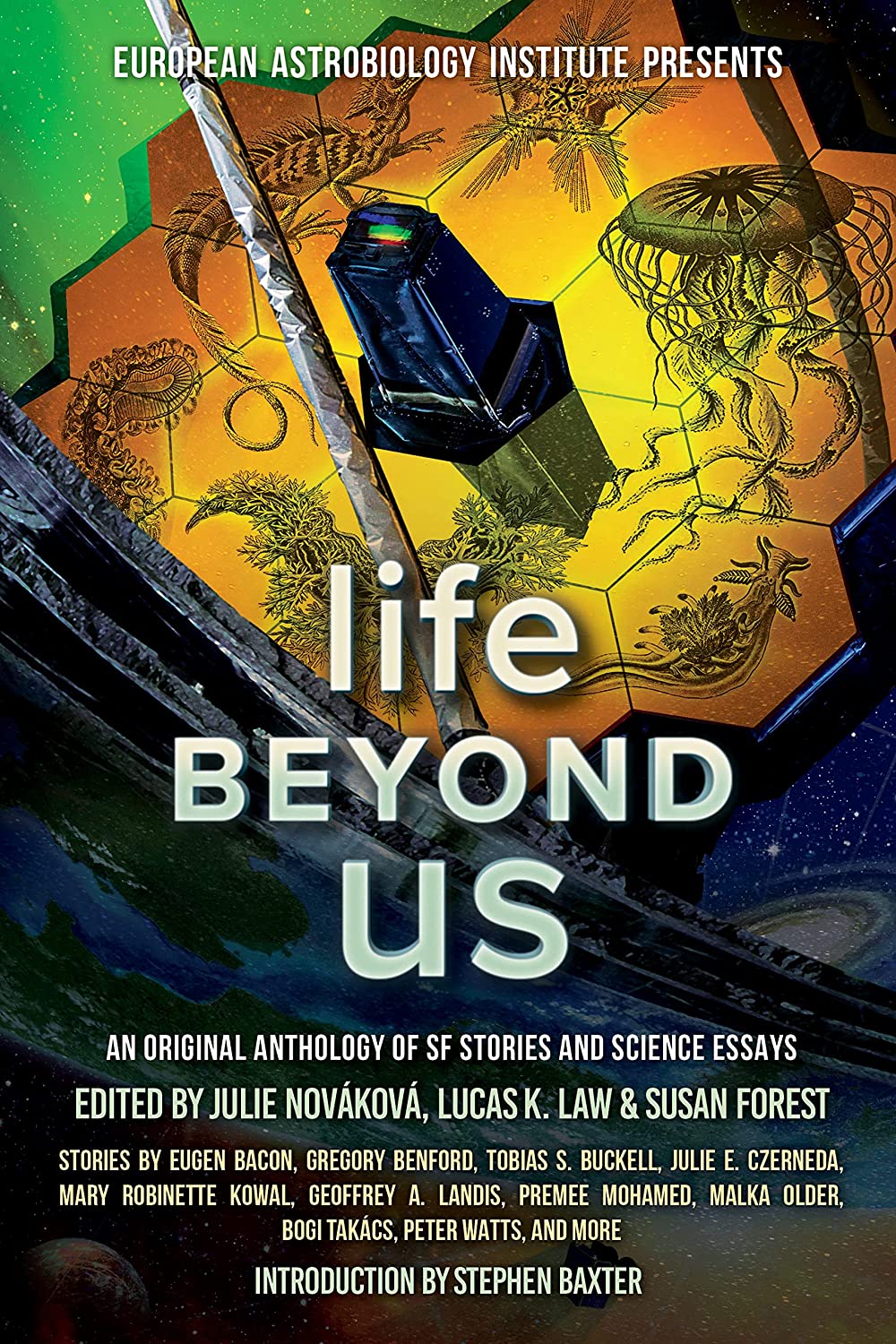
Cover of the book Life Beyond Us ed. by Julie Nováková and others
Life Beyond Us
ed. by Julie Nováková and others
Laksa Media, 2023

This review was first published by Booklist on April 1, 2023.

**STARRED REVIEW** This anthology from the European Astrobiology Institute explores the possibilities of nonhuman life in the cosmos. Each of the 27 short stories is paired with a nonfiction essay examining the concepts explored in the story. These works are written by a diverse group of accomplished authors and scientists from across the world. In them, we meet intelligent aliens on moons and planets, from deserts and forests to worlds in water and ice to interstellar dust and black holes; beings made up of space-time itself, and even nonhuman intelligent life here on Earth. The essays cover a broad range of topics, including what we know about the possible chemistry of nonhuman biology, planetary and stellar formation, semiotics and the anticipated challenges of communication with nonhuman beings, and the ethics of such interactions. It’s incredibly comprehensive. Each story is short enough to be easily digestible, and the essays are similarly focused, but they don’t lack any depth of information. Taken altogether, this is a deep dive into the subject. Pairing fiction stories with nonfiction essays illustrates the deep connections between sf and science, particularly the necessity of imagination and creativity in scientific work. This spectacular collection is a deeply rewarding work.

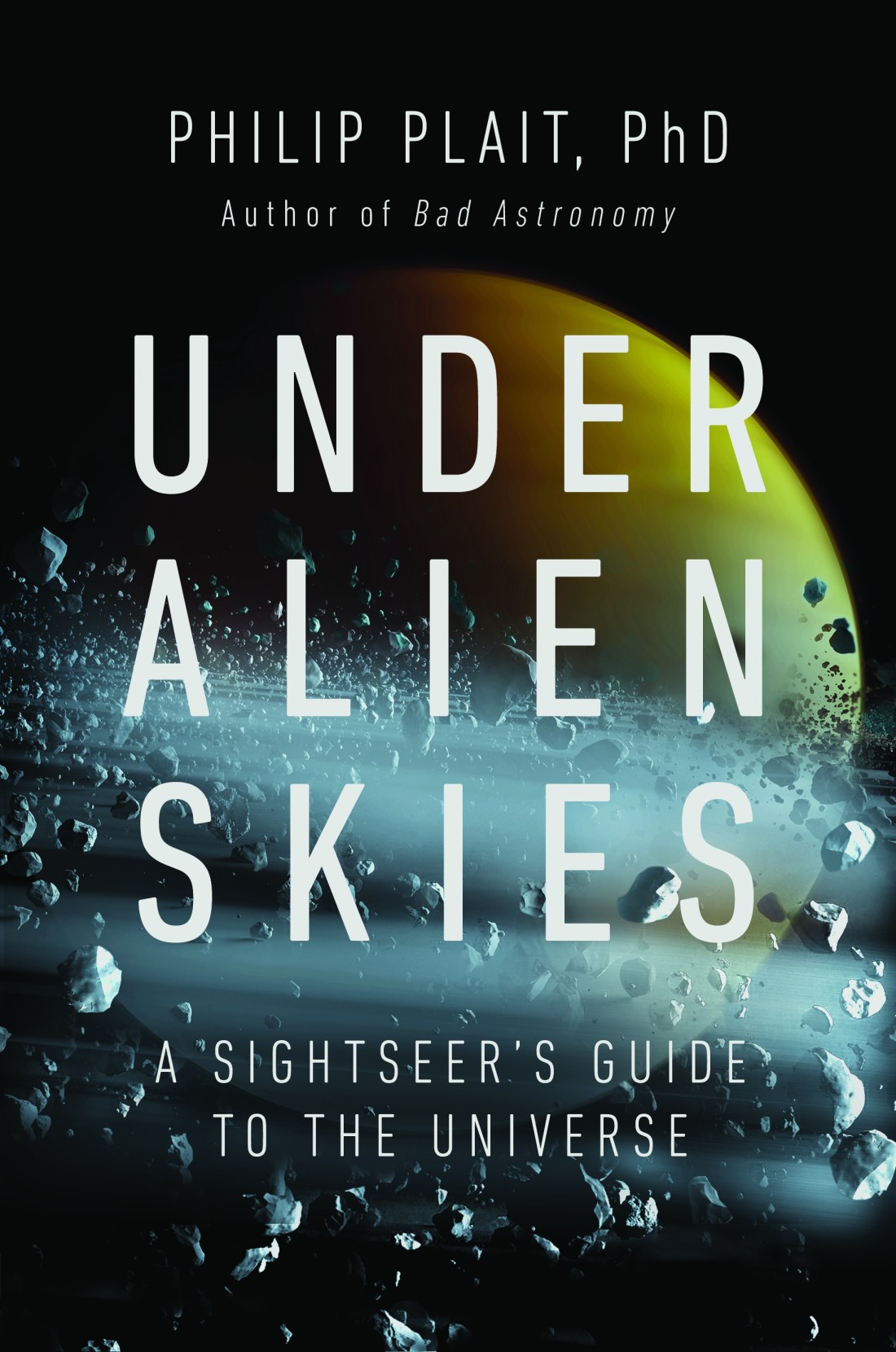
Book Review: Under Alien Skies: A Sightseer’s Guide to the Universe by Philip Plait

Cover of the book Under Alien Skies: A Sightseer's Guide to the Universe by Philip Plait
Under Alien Skies: A Sightseer’s Guide to the Universe
by Philip Plait
Norton, 2023

This review was first published by Booklist on March 15, 2023.

What would it be like to stand on Mars or experience sunset on a world with multiple suns? To visit a stellar nursery or orbit a black hole? What would you see? How would it feel? Plait takes readers on a tour of the cosmos, from the moon to the supermassive black hole at the center of our galaxy, and paints vivid descriptions of what these objects are like, using the best observations and theories we currently have. It’s an effective framing device to explore what we know about the strange and wonderful things we’ve discovered, from exoplanets to nebulae. His realistic depictions, grounded in human senses, awaken a feeling of wanderlust and make the esoteric feel real. What elevates this above similar books about our universe is Plait’s sense of wonder and joy. He clearly never lost his childhood glee for discovery, and it’s refreshing for a scientist to be so open about it. He shows that science requires creativity and imagination and rewards curiosity and the urge to explore. It’s a remarkable journey.

Book Review: The Magick of Physics: Uncovering the Fantastical Phenomena in Everyday Life by Felix Flicker

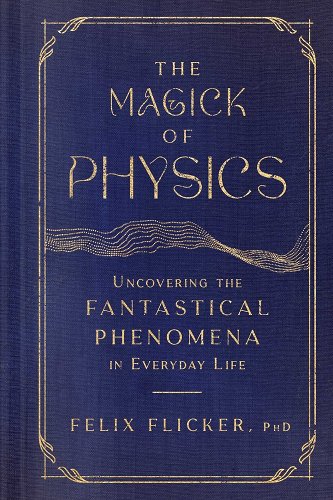
Cover of the book The Magick of Physics: Uncovering the Fantastical Phenomena in Everyday Life by Felix Flicker
The Magick of Physics: Uncovering the Fantastical Phenomena in Everyday Life
by Felix Flicker
Simon & Schuster, 2023

This review was first published by Booklist on March 1, 2023.

Physics is modern magic, and condensed matter physicists are the wizards of the modern world. Condensed matter physics is the study of how matter behaves in the real world, and how we can harness it to improve our daily lives. It’s what gave us steam engines, electric grids, and computers. It’s the single largest branch of physics, yet it’s one of the least discussed, with more glamorous theoretical fields commanding popular attention. Flicker seeks to reveal the wonder and fascination of this work. He walks readers through the history of how the field developed, introducing the major milestones and scientists along the way. He guides us through the different states of matter, thermodynamics, relativity, quantum mechanics, topology, and magnetism, to show us just how enthralling these can be. The joy he has for this work is infectious. Much of the content gets abstruse, but he avoids complex math, and by framing it as modern magic this becomes part of the charm. It’s OK if you don’t understand: it’s magic. You can still enjoy the show.

Book Review: The New Guys: The Historic Class of Astronauts That Broke Barriers and Changed the Face of Space Travel by Meredith Bagby

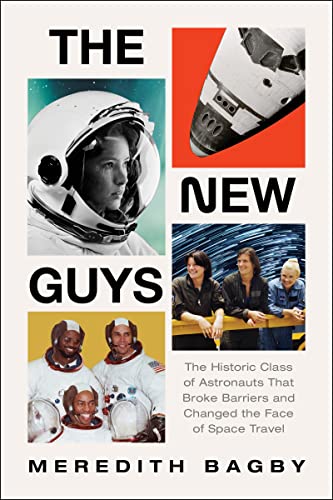
Cover of the book The New Guys: The Historic Class of Astronauts That Broke Barriers and Changed the Face of Space Travel by Meredith Bagby
The New Guys: The Historic Class of Astronauts That Broke Barriers and Changed the Face of Space Travel
by Meredith Bagby
Morrow, 2023

This review was first published by Booklist on January 6, 2023.

In 1978, NASA recruited Astronaut Group 8, the first group of astronaut candidates selected to serve on the space shuttle and the first opportunity open to nonmilitary personnel. This group included the first American women, first African Americans, first Asian American, first married couple, and (unbeknownst at the time) the first gay astronaut to fly into space. NASA recruited scientists, engineers, and medical professionals, not just pilots. Members of this remarkably diverse group—known as the “new guys”—served from the shuttle’s first flight to its final decommissioning. They launched technology (including the Hubble Space Telescope) that fundamentally altered our world and weathered disasters (Bagby covers the loss of the Challenger in significant detail), political maneuvering, and bad press. Their crowning achievement was construction of the International Space Station. Much has already been written about these men and women, their successes and tragedies, and Bagby doesn’t break new ground here. But she brings together a wealth of information and crafts it into a compelling, cohesive, and complete narrative. An excellent choice for anyone interested in the history of space exploration.

Book Review: The Things We Make: The Unknown History of Invention from Cathedrals to Soda Cans by Bill Hammack

Cover of the book The Things We Make: The Unknown History of Invention from Cathedrals to Soda Cans by Bill Hammack
The Things We Make: The Unknown History of Invention from Cathedrals to Soda Cans
by Bill Hammack
Sourcebooks, 2023

This review was first published by Booklist on January 1, 2023.

**STARRED REVIEW** The Things We Make is a heartfelt ode in praise of engineers. Hammack, a long-time engineering educator, argues that far from merely being “applied science,” engineering boasts a robust method all its own, meaningfully separate from science. He offers several compelling examples of how engineering has changed our world and pushes back against the harmful myth of the lone inventor, which too often excludes the work of marginalized individuals, and perpetuates popular misunderstandings of what engineering actually is. The book starts with a description of how, in the Middle Ages, illiterate masons who didn’t know any math managed to build Gothic cathedrals that have stood for centuries. Other examples range from the development of color photography to the creation of designer enzymes, from such marvels as the modern computer chip to the quotidian soda can. He really runs the gamut with his examples, but all of them show how engineering utilizes rules of thumb and compromise solutions to resolve real-world problems.The Engineering Method, as much as the Scientific Method, stands as one of humanity’s greatest achievements. A must-read for anyone interested in engineering or the history of technology and human achievement.

2022: My Year in Reading

For a list of my favorite books I read this year, go here >

I read 54 books in 2022. It felt like a pretty normal year in reading, for the first time in a while. I read when I wanted to, didn’t when I didn’t, and didn’t overthink it either way, other than to reaffirm my intense dislike of Jack McDevitt. I didn’t watch much TV—my desire for visual storytelling has been subsumed by YouTube, where I follow many channels. I finally went back to a movie theater for the first time since the pandemic started. I missed seeing things on the big screen! I saw Black Panther: Wakanda Forever (so good, but it should have been so much better!)

I also purged half of my personal book collection this year, which still sometimes feels a bit like sacrilege, but I remain confident it was the right thing to do and I haven’t regretted it yet.

Continue reading “2022: My Year in Reading”

Book Review: The Alien Perspective: A New View of Humanity and the Cosmos by David Whitehouse

Cover of the book The Alien Perspective: A New View of Humanity and the Cosmos by David Whitehouse
The Alien Perspective: A New View of Humanity and the Cosmos
by David WhitehouseR
Icon, 2022

This review was first published by Booklist on October 15, 2022.

The question of whether we’re alone in the universe is one of the most profound, and one which struggles to be taken seriously in scientific circles. It’s a question that extends beyond science into the realms of religion and philosophy. Evidence of intelligent life elsewhere would upend our understanding of our place in the universe. In his latest, Whitehouse summarizes the efforts we’ve made to search for other life in the universe, from SETI to UFO sightings, and the limitations such efforts must overcome. He assesses what we actually know about the likelihood that anyone else is out there. He also explores possibilities for what alien life might be like, an impossible question to answer, as we only have ourselves as an example, whereas life on other planets could be radically different. Finally, he examines what’s in store for the future of the universe with an eye toward whether or not life might survive. In the end, without definitive contact with extraterrestrials, any searches we make tell us more about ourselves than about life elsewhere.

Book Review: Flush: The Remarkable Science of an Unlikely Treasure by Bryn Nelson

Cover of the book Flush: The Remarkable Science of an Unlikely Treasure by Bryn Nelson
Flush: The Remarkable Science of an Unlikely Treasure
by Bryn Nelson
Grand Central, 2022

This review was first published by Booklist on September 1, 2022.

As a rule, we try not to think too much about our poop. It’s one of the most taboo topics in our society, and our sewer systems are designed to keep it out of sight as much as possible. And yet, poop is a treasure trove of resources that we can use to make the world better. Scat can cure diseases and protect us against several major health concerns, aid in forensic and medical investigations, replenish our soils, and even become a source of energy, precious metals, and clean drinking water. New methods to make better use of our sewage can also help reduce pollution and greenhouse-gas emissions. Poop can help heal our planet. Nelson dives into the science of scat and profiles several examples of how people are using poop in new and innovative ways. Wide ranging and deeply informed, with a wry sense of humor, this is a solid recommendation for fans of Mary Roach, as well as anyone interested in out-of-the-box ideas to help fix some of our most pressing problems.

Book Review: The Skeptics’ Guide to the Future: What Yesterday’s Science and Science Fiction Tell Us About the World of Tomorrow by Steven Novella and others

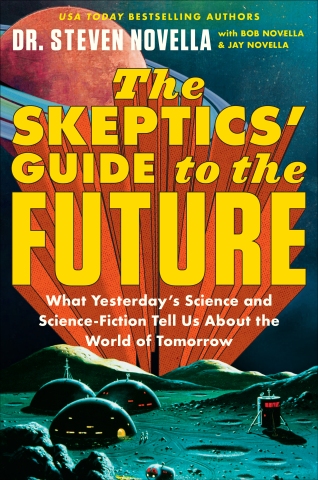
Cover of the book The Skeptics' Guide to the Future: What Yesterday's Science and Science Fiction Tell Us About the World of Tomorrow by Steven Novella and others
The Skeptics’ Guide to the Future: What Yesterday’s Science and Science Fiction Tell Us About the World of Tomorrow
by Steven Novella and others
Grand Central, 2022

This review was first published by Booklist on August 5, 2022.

People have a long history of trying to predict the future, especially with the rise of modern science and science fiction. Several futuristic tropes have become common, such as cyborgs, brain-machine interfaces, robots, artificial intelligence, virtual reality, immortality, space exploration and settlement, energy weapons, faster-than-light travel, flying cars, and more. Novella turns his skeptical eye on futurism, assessing whether any of these predictions are possible, from the likely to the probably impossible. He identifies several common fallacies which plague our attempts at futurism, most notably the tendency to overestimate short term advancement while underestimating long term change, and our insistence on picturing people in the future as just like us. Old technology persists for surprisingly long times, and new disruptive technology can radically alter who we are and our relationship to the world. Predicting the future isn’t an exact science, but skeptical scientific inquiry can help assess the likelihood of our various visions for it. A fun overview of both the current state of modern science and a general survey of the history of futurism.