Book Review: Heroes of the Space Age: Incredible Stories of the Famous and Forgotten Men and Women Who Took Humanity to the Stars by Rod Pyle

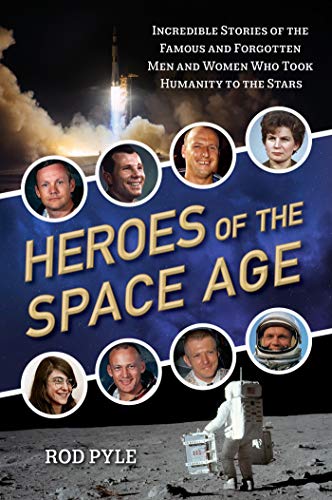
Cover of the book Heroes of the Space Age: Incredible Stories of the Famous and Forgotten Men and Women Who Took Humanity to the Stars by Rod Pyle
Heroes of the Space Age: Incredible Stories of the Famous and Forgotten Men and Women Who Took Humanity to the Stars
by Rod Pyle
Prometheus, 2019

This review was first published by Booklist on May 3, 2019.

Heroes of the Space Age offers profiles of eight individuals who played significant roles in the early days of the Space Age, from the late 1950s to the mid-1970s, including the first men and women in space (Yuri Gagarin, John Glenn, and Valentina Tereshkova), the first men on the moon (Neil Armstrong and Buzz Aldrin), and the first man to occupy a space station (Pete Conrad). Significantly, Pyle (Interplanetary Robots, 2019) includes people in pivotal roles on the ground: Gene Krantz, NASA flight controller during the first moon landing, and Margaret Hamilton, who designed the computer software for the Apollo missions. The author notes he sought to include diversity in these profiles, though the space race at that time was largely homogeneous. Each biography is brief but complete, though of greatest interest are the accounts of the work these individuals did as part of the space program. This is not a comprehensive collection of the hundreds of individuals involved but it’s a solid history of the earliest days of our exploration of space.
Book Review: The Science Fiction Fanzine Reader: Focal Points 1930–1960 edited by Luis Ortiz

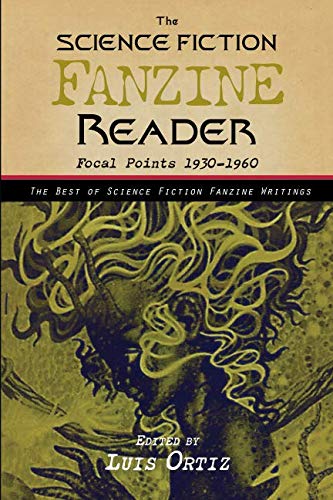
Cover of the book The Science Fiction Fanzine Reader: Focal Points 1930–1960 edited by Luis Ortiz
The Science Fiction Fanzine Reader: Focal Points 1930–1960
edited by Luis Ortiz
IPG/Nonstop, 2019

This review was first published by Booklist on March 15, 2019.

The Science Fiction Fanzine Reader offers a fascinating look into the culture of early science fiction fandom during its first three decades. Given the cheap and ephemeral nature of these fanzines, this book is the culmination of a remarkable research project by Ortiz (Emshwiller, 2007). He collects dozens of articles, editorials, letters, and commentary written by sf fans between 1930 and 1960, as well as a handful of pieces where fans reflect back on their early days in fandom. It’s an engrossing glimpse into the mindset of sf readers in the middle of the twentieth century. This isn’t a straight history—readers need to have a solid knowledge of the history of science fiction and fandom in order to get the most out of it. The selections don’t seem to be in any order—they’re not grouped by theme or chronologically, which obscures broader patterns within the history of fanzines. Still, this book is for committed historians of the sf genre.

Book Review: Reader, Come Home: The Reading Brain in a Digital World by Maryanne Wolf

Reader, Come Home: The Reading Brain in a Digital World by Maryanne Wolf
Reader, Come Home: The Reading Brain in a Digital World
by Maryanne Wolf
Harper, 2018

I picked up this book expecting an exploration of the neuroscience and physiology of the effects of reading on the brain, and how reading in print and digital formats differ. I got that, and so much more.

Wolf presents a balanced account of the different effects of different mediums, both negative and positive, and how we might use this knowledge to do better for our children and ourselves. It’s a welcome perspective.

It’s also a deeply humanist and moral meditation of the capacities of the human mind and the importance of storytelling. It’s a clarion call to fulfill the responsibility we all bear toward our fellow human beings and to the future. This is a work of tremendous empathy and passion.

It may well be one of the most important works of our age.

Continue reading “Book Review: Reader, Come Home: The Reading Brain in a Digital World by Maryanne Wolf”

2018: My Year in Reading

All of the data that follows was collected by me throughout the year using a combination of Google Sheets and Google Calendar. All seasonal and monthly calculations are based on the date each title was begun. Average days to read titles are based on the number of days actually spent reading each title, and not necessarily the full span from begun date to completed date.

A complete list of all the books I read in 2018 is at the bottom of this post.


For a list of my favorite books I read this year, go here >

For a list of my least favorite books of the year, go here >

I participated in #LibFaves18 on Twitter. See my selections here >

Continue reading “2018: My Year in Reading”

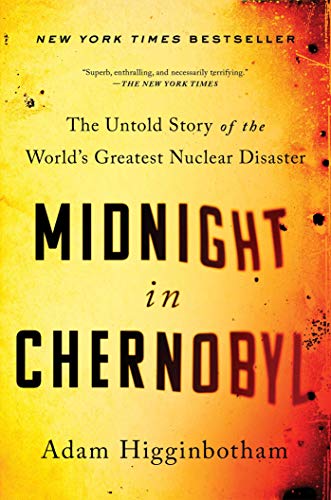
Book Review: Midnight in Chernobyl: The Untold Story of the World’s Greatest Nuclear Disaster by Adam Higginbotham

Cover of the book Midnight in Chernobyl: The Untold Story of the World's Greatest Nuclear Disaster by Adam Higginbotham
Midnight in Chernobyl: The Untold Story of the World’s Greatest Nuclear Disaster
by Adam Higginbotham
Simon & Schuster, 2019

This review was first published by Booklist on January 1, 2019.

**STARRED REVIEW** Midnight in Chernobyl is a top-notch historical narrative: a tense, fast-paced, engrossing, and revelatory product of more than a decade of research. Higginbotham interviewed most of the surviving central participants in the disaster, examined volumes of newly declassified Soviet documents, and surveyed previous research and reportage. The result is a stunningly detailed account of the explosion of Reactor Four at the Chernobyl nuclear-power plant on April 26, 1986. It offers a brief history of the development of the Soviet nuclear-power program leading up to the construction of the plant at Chernobyl, a second-by-second account of the night of the accident, the confluence of causes, the evacuation of the surrounding countryside, the containment and cleanup efforts, and a deep dive into the aftermath: the medical and environmental consequences, the political machinations and missteps, the role Chernobyl played in the downfall of the USSR, and the effect it had on the pursuit of nuclear power worldwide. For all its wealth of information, the work never becomes overwhelming or difficult to follow. Higginbotham humanizes the tale, maintaining a focus on the people involved and the choices, both heroic and not, they made in unimaginable circumstances. This is an essential human tale with global consequences.

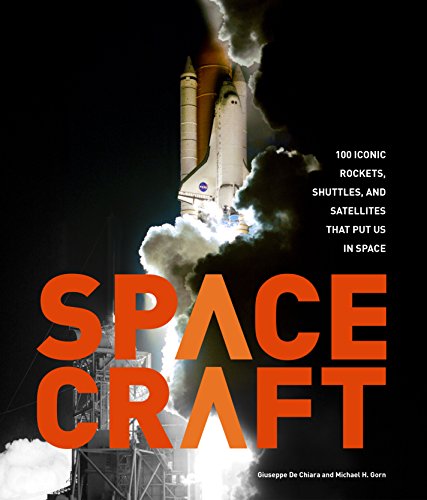
Book Review: Spacecraft: 100 Iconic Rockets, Shuttles, and Satellites That Put Us in Space by Michael H. Gorn

Cover of the book Spacecraft: 100 Iconic Rockets, Shuttles, and Satellites That Put Us in Space by Michael H. Gorn
Spacecraft: 100 Iconic Rockets, Shuttles, and Satellites That Put Us in Space
by Michael H. Gorn
Quarto/Voyageur, 2018

This review was first published by Booklist on December 1, 2018.

Spacecraft profiles 100 craft that are significant in the history of space exploration: rockets, orbiters, spaceplanes, landers, space stations, satellites, and exploratory craft from the U.S., Russia, Europe, China, and more recent private, corporate ventures into space flight. The articles offer thorough physical and technical descriptions of each craft, along with a history of its development and use. The book is organized into 3 main sections, each covering a 20-year span from 1957 through 2017. Articles are further organized by the type of craft, with each country’s being grouped together. It’s not a strictly chronological narrative, but it provides an overall understanding of the history of the development and deployment of spacecraft. Readers can also use the table of contents to flip to any specific article that interests them. The articles are accompanied by numerous full-color drawings by illustrator Giuseppe De Chiara that show the details even better than the photographs do. This work is high quality; an effective hybrid of reference volume and coffee-table book. A solid choice for any public library.

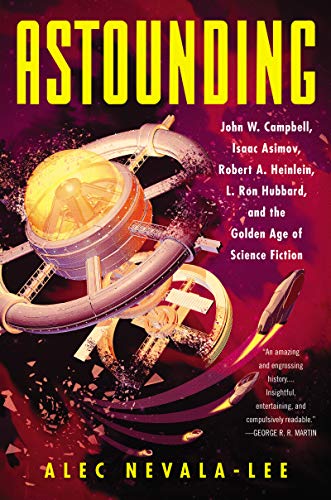
Book Review: Astounding: John W. Campbell, Isaac Asimov, Robert A. Heinlein, L. Ron Hubbard, and the Golden Age of Science Fiction by Alec Nevala-Lee

Cover of the book Astounding: John W. Campbell, Isaac Asimov, Robert A. Heinlein, L. Ron Hubbard, and the Golden Age of Science Fiction by Alec Nevala-Lee
Astounding: John W. Campbell, Isaac Asimov, Robert A. Heinlein, L. Ron Hubbard, and the Golden Age of Science Fiction
by Alec Nevala-Lee
HarperCollins/Dey Street, 2018

This review was first published by Booklist on September 15, 2018.

Nevala-Lee (Eternal Empire, 2013) presents a necessary addition to the history of science fiction: a critical look at the life and work of John W. Campbell, legendary editor of Astounding magazine and the central architect of science fiction’s golden age. This period, and the men most central to it, defined the path that still dominates the genre today. Part biography, part history, Astounding covers Campbell’s relationships with his most important writers (Asimov, Heinlein, and Hubbard); their tumultuous personal lives; the role their wives played in their careers; and the effect WWII and the atomic bomb had on the genre. Campbell and others truly believed science fiction could save the world. Nevala-Lee delves into the development of dianetics and Campbell’s split with Hubbard over Scientology. He also addresses the many biases, prejudices, and personal failings of these eminent men. At times, it feels like Nevala-Lee attempts to accomplish too much, and the mix of history with biography isn’t always comfortable, but it’s all necessary to understand how science fiction became what it is today.

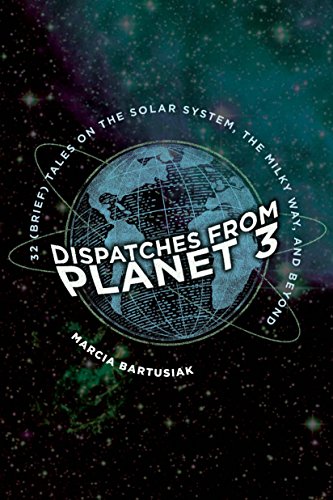
Book Review: Dispatches from Planet 3: 32 (Brief) Tales on the Solar System, the Milky Way, and Beyond by Marcia Bartusiak

Cover of the book Dispatches from Planet 3: 32 (Brief) Tales on the Solar System, the Milky Way, and Beyond by Marcia Bartusiak
Dispatches from Planet 3: 32 (Brief) Tales on the Solar System, the Milky Way, and Beyond
by Marcia Bartusiak
Yale, 2018

This review was first published by Booklist on August 13, 2018.

These 32 short essays cover major events in the history of astronomy and cosmology, ranging from the demotion of Pluto to the status of dwarf planet, the evolution of galaxies, the detection of gravity waves and neutrinos, and the role of time in the Big Bang. Bartusiak’s (The Day We Found the Universe, 2009) goal is to provide historical context for many recent discoveries and a summary of how we got to where we are now in the science of space, offered in easy-to-read, bite-size morsels. Many of these essays cover events from the late 1800s through the mid-1900s, the period when modern cosmology was born, but the collection isn’t arranged chronologically. Rather, the essays are grouped, small to large, by topic, starting from the solar system and working out to the larger universe. Of particular value, several essays focus on women who did significant work, but who historically haven’t gotten credit. This is an informative and rewarding read for anyone interested in our understanding of the universe. Recommended for fans of Amanda Gefter’s Trespassing on Einstein’s Lawn (2014).

Book Review: Arthur C. Clarke by Gary Westfahl

Cover of the book Arthur C. Clarke by Gary Westfahl
Arthur C. Clarke
by Gary Westfahl
Univ. of Illinois, 2018

This review was first published by Booklist on May 22, 2018.

Westfahl (Science Fiction Quotations, 2005) offers a well-considered reevaluation of Arthur C. Clarke’s legacy, tracing broad topics and contradicting some commonly held beliefs. For example, although many separate Clarke’s technical sf from his quasi-mystical imaginings, Westfahl shows it to all be of a piece: near-future technology is relatively comprehensible to modern readers, whereas far-future technology would be so far beyond our comprehension as to appear magical—a logical conclusion. His analysis is most valuable in its scope, ranging beyond Clarke’s major works and considering his myriad stories, his less successful novels, his nonfiction, and even his juvenilia. Where this book fails is in its attempts to grapple with Clarke as a person. Clarke was a deeply private man, and there’s little evidence to consider about his life beyond his published works. Westfahl tries too hard to read too much significance into what little evidence there is. It’s a bit abstruse for anyone unfamiliar with Clarke’s work, and it verges on hagiography at times. Still, a worthy analysis of an important sf writer.

2017: My Year in Reading

All of the data that follows was collected by me throughout the year using a combination of Google Sheets and Google Calendar. All seasonal and monthly calculations are based on the date each title was begun. Average days to read titles are based on the number of days actually spent reading each title, and not necessarily the full span from begun date to completed date.

A complete list of all the books I read in 2017 is at the bottom of this post


First things first: I’m a hypocrite.

In 2016, I wrote a post about the importance of reading more widely in genres I don’t normally read. I even posted lists of titles and swore to spend some amount of time in 2017 reading them.

I didn’t. I didn’t read any of them.

Continue reading “2017: My Year in Reading”