Book Review: Part of Our Lives by Wayne A. Wiegand

Part of Our Lives by Wayne A. Wiegand
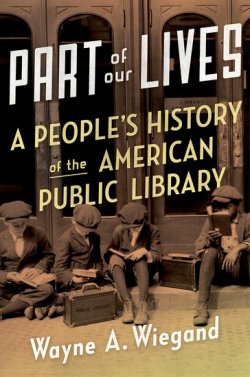
Part of Our Lives: A People’s History of the American Public Library by Wayne A. Wiegand
Oxford University Press, 2015

I recently read the book, Part of Our Lives: A People’s History of the American Public Library by Wayne A. Wiegand. Rather than write a typical review of it, I want to share a letter that I sent the author.

(TL;DR version: This book is wonderful and every public librarian and public library user should read it. I think it’s important.)


Dear Dr. Wiegand,

I’d like to thank you for writing Part of Our Lives: A People’s History of the American Public Library. Before I proceed to explain why I want to thank you, I need to spend some time voicing a complaint about something you wrote in your introduction. Bear with me—the extent of my gratitude for your work won’t be clear without this context.

Continue reading “Book Review: Part of Our Lives by Wayne A. Wiegand”

Another Benefit of Ebooks for Libraries

A friend of mine was recently introduced to a certain genre fiction author who has been writing an ongoing series for the past couple of decades. My friend naturally wanted to start this series at the beginning and read it all the way through, in order. So, my friend turned to their local public library.

Ongoing series pose a difficulty for library collections. The earliest titles stop circulating after so many years, or our copies become worn out and damaged beyond repair. As a result, these items get weeded. Sometimes there’s not enough demand to justify restocking an older title. Sometimes we can’t restock them because we can’t afford the physical shelf space to hold them.

Frequently, publishers stop printing older titles from their catalogs, or distributors stop carrying them, which means libraries often can’t replace these titles in our collections even if we see a need for them. Therefore, it’s not uncommon for libraries to have more recent titles in ongoing fiction series on their shelves but not the earliest ones.

Continue reading “Another Benefit of Ebooks for Libraries”

Libraries Are…

Semi-related follow-up to my last post.

Libraries are uniquely qualified to recognize both the value of current popular titles and also the enduring benefits modern readers can realize when they take the time to explore our ongoing literary heritage.

Libraries celebrate education and entertainment both as necessities of a life well lived.

Libraries are on the front lines of diversifying the stories available to our communities, undertaking the essential work of expanding our cultural consciousness and mutual understanding.

Libraries are where you find yourself and also discover the unknown.

Libraries are where we learn what it means to be human, in all our myriad aspects.

The Transformative Power of Reading

I have a social media friend—you know the type: you’re barely even acquaintances in real life but you have enough mutual friends to be friends online. We’ve been social media friends for some years now.

For the past couple of weeks, I’ve been watching her life transformed by the power of reading. That sounds cheesy and dramatic, I know, but it’s literally true.

My social media friend is currently in her early 30s. She’s Hispanic Latina, born into a fairly poor family, raised in a fairly poor neighborhood, with all the disadvantages inherent to such a background in this country. She had her first child when she was still in high school and married the father when she turned 18. They had a couple more kids over the next few years. She didn’t go to college. She went straight from high school to being a working mother, raising her children and holding down a series of part-time, low skilled, hourly wage jobs. A few years ago, she and her husband got divorced, so she took her kids and moved back in with her parents.

She decided to change the course of her life and she enrolled in a community college to get a degree in nursing. This is where her current transformation begins…

Continue reading “The Transformative Power of Reading”

This Is Why Books Are Dangerous

I recently finished reading The Meaning of the Library: A Cultural History, edited by Alice Crawford (Princeton University Press, 2015). Several passages from the concluding essay, “The Modern Library and Global Democracy” by James H. Billington, stood out:

Books are our guardians of memory, tutors in language, pathways to reason, and our golden gate to the royal road of imagination. Books take us to new places where boundaries are not set by someone else … . Books help us to pose the unimagined question and to accept the unwelcome answer. Books convince rather than coerce. They are oases of coherence where things are put together rather than just taken apart. Good books take us away from the bumper cars of emotion and polemics in the media into trains of thought that can lead us into place we might not otherwise ever discover. (p. 263)

This is why some people are afraid of books. This is why some people see certain books as a threat. Books are transformative, books empower—books encourage independence of thought. This is why some people seek to control them.

Libraries are antidotes to fanaticism. They are temples of pluralism, where books that contradict one another sit peacefully side by side on the shelves just as intellectual antagonists work peacefully next to each other … . (p. 263)

This is why some people are afraid of libraries. This is why some people see libraries as a threat. This is why some people seek to control them. Pluralism is anathema to control and dominance.

My favorite quote, though, and the best conclusion we can come to, is this:

Reading can balance our noisy, hurry-up, present-minded world with what Keats called “silence and slow time.” Whatever else you do in life, do not fail to experience the simple pleasure of being alone with a good book on a rainy day. (p. 265)

Libraries Should Be About Books

It’s de rigueur nowadays for people to criticize libraries for being “too much about books.” The idea being that too many libraries are still stuck in the past, in outmoded service models, and failing to adapt to new technologies, trends, etc.

There is some truth in the criticism—although I also find that too many of these critics fail to be critical enough of new trends and tend too often to promote faddishness.

It makes me want to ask the obvious question:

What’s wrong with libraries being about books?

Books mean reading. Books are still the best, most valuable tool of a reading life. This makes books timelessly important—beyond fads, more enduring than ever-changing technology.

Books matter. Still and always. Because reading matters.

Continue reading “Libraries Should Be About Books”

Public Library Reference: An Unscientific Test

I debated for several weeks about writing this post. Some of what I want to talk about I already discussed in my post, The Pain of Bad Reference Interactions. I think there’s more to say, though.

My concern is that I have some strong criticisms of the reference interactions I’ve had with some public libraries in the United States. I use no names and I leave out all identifying details—but it’s still possible that some of these libraries, or even some of their librarians, will be able to recognize themselves if they read this.

I have no desire to shame anyone with this post. I find online public shaming culture abhorrent and I refuse to participate in it.

I believe that criticism is necessary for improvement. I offer all criticisms in the sincere hope that it will help us all to serve our communities even better than we already do, and in my desire to help define the best path forward for public libraries in the Digital Information Age.

Continue reading “Public Library Reference: An Unscientific Test”

The Relevance of Libraries

On April 10, 2015, KCUR’s “Up to Date” program interviewed Prof. John Palfrey about the future of libraries in the Digital Age, the day after he gave a talk on the subject at the Kansas City Public Library. During the interview, KCUR tweeted a question meant to provoke discussion about the future of libraries:

Prof. Palfrey offers an optimistic and robust vision for the future of libraries, but even he frames the discussion in a way that implicitly fuels the fire for those who question their relevance.

I’ve spent a lot of time looking at the data and I have to say—I can’t understand how the relevance of libraries has come into question in the first place. It bothers me that we’ve allowed this question to define the discussion about their future. I can’t think of any other public or civic institution or service that can boast the kind of numbers that libraries do. I tweet-stormed some of the most powerful:

Continue reading “The Relevance of Libraries”

The Role of Fiction in the Democratic Process

I talk a lot about the democratic mission of public libraries. I believe in it deeply.

However, if we believe that the core purpose of a library is to promote a well-informed democracy, it leads to an essential—and rather uncomfortable—question:

Why do we spend so much time and money maintaining popular entertainment collections if our duty is to provide materials that support our patrons’ involvement in our processes of governance?

What exactly does a library’s popular fiction collection have to do with promoting informed democratic elections? How does easy access to movies and TV shows serve to educate voters? *

Continue reading “The Role of Fiction in the Democratic Process”