The Transformative Power of Reading

I have a social media friend—you know the type: you’re barely even acquaintances in real life but you have enough mutual friends to be friends online. We’ve been social media friends for some years now.

For the past couple of weeks, I’ve been watching her life transformed by the power of reading. That sounds cheesy and dramatic, I know, but it’s literally true.

My social media friend is currently in her early 30s. She’s Hispanic Latina, born into a fairly poor family, raised in a fairly poor neighborhood, with all the disadvantages inherent to such a background in this country. She had her first child when she was still in high school and married the father when she turned 18. They had a couple more kids over the next few years. She didn’t go to college. She went straight from high school to being a working mother, raising her children and holding down a series of part-time, low skilled, hourly wage jobs. A few years ago, she and her husband got divorced, so she took her kids and moved back in with her parents.

She decided to change the course of her life and she enrolled in a community college to get a degree in nursing. This is where her current transformation begins…

Continue reading “The Transformative Power of Reading”

This Is Why Books Are Dangerous

I recently finished reading The Meaning of the Library: A Cultural History, edited by Alice Crawford (Princeton University Press, 2015). Several passages from the concluding essay, “The Modern Library and Global Democracy” by James H. Billington, stood out:

Books are our guardians of memory, tutors in language, pathways to reason, and our golden gate to the royal road of imagination. Books take us to new places where boundaries are not set by someone else … . Books help us to pose the unimagined question and to accept the unwelcome answer. Books convince rather than coerce. They are oases of coherence where things are put together rather than just taken apart. Good books take us away from the bumper cars of emotion and polemics in the media into trains of thought that can lead us into place we might not otherwise ever discover. (p. 263)

This is why some people are afraid of books. This is why some people see certain books as a threat. Books are transformative, books empower—books encourage independence of thought. This is why some people seek to control them.

Libraries are antidotes to fanaticism. They are temples of pluralism, where books that contradict one another sit peacefully side by side on the shelves just as intellectual antagonists work peacefully next to each other … . (p. 263)

This is why some people are afraid of libraries. This is why some people see libraries as a threat. This is why some people seek to control them. Pluralism is anathema to control and dominance.

My favorite quote, though, and the best conclusion we can come to, is this:

Reading can balance our noisy, hurry-up, present-minded world with what Keats called “silence and slow time.” Whatever else you do in life, do not fail to experience the simple pleasure of being alone with a good book on a rainy day. (p. 265)

Once Again, Print Proves Its Worth

Perhaps it’s ironic, but the more time I spend as a digital librarian, learning and exploring new technology, finding new and better ways to provide technology to our patrons, the more I find myself passionately advocating for the importance of print and the necessity of its continued presence in our reading culture.

Once again, print proves its worth:

Reading Books Instead of Kindles Can Improve Your Memory, Concentration and Good Looks by Jon Levine (posted on Arts.Mic on August 20, 2015)

Nothing in this article surprises me (although I get frustrated every time someone implies that ebooks aren’t books). It all pretty well stands to reason:

Continue reading “Once Again, Print Proves Its Worth”

Libraries Should Be About Books

It’s de rigueur nowadays for people to criticize libraries for being “too much about books.” The idea being that too many libraries are still stuck in the past, in outmoded service models, and failing to adapt to new technologies, trends, etc.

There is some truth in the criticism—although I also find that too many of these critics fail to be critical enough of new trends and tend too often to promote faddishness.

It makes me want to ask the obvious question:

What’s wrong with libraries being about books?

Books mean reading. Books are still the best, most valuable tool of a reading life. This makes books timelessly important—beyond fads, more enduring than ever-changing technology.

Books matter. Still and always. Because reading matters.

Continue reading “Libraries Should Be About Books”

On the Need for Diverse Books

Last week, I wrote about how important Octavia Butler’s work is to me. Every time I tell people how much I like Octavia Butler, someone inevitably says, “You should read Nnedi Okorafor!” or, “Have you read any of Tananarive Due’s works?”

And I always want to ask them:

“Are you recommending them because you think their writing style / subject matter / perspective is similar enough to Butler’s to merit the comparison? Or are you just naming them because they’re another black woman who writes SF?”

Continue reading “On the Need for Diverse Books”

Digital Comics for Libraries: Good News!

In my recent interview for Corner Shelf, Rebecca Vnuk asked me what kinds of things my library’s collections are most in need of.

My answer: digital comics. Specifically—Marvel and DC.

As of June 25, 2015, hoopla digital offers DC titles in digital format. This includes titles from their Vertigo imprint. Their collection includes several of the most important issues and graphic novels in DC / Vertigo’s catalog: Watchmen, V for Vendetta, Frank Miller’s Dark Knight, The Killing Joke, Gaiman’s Sandman

It’s not everything from DC but it’s a lot of the really good stuff.

This is huge. This makes me really happy. This could be a game-changer.

Kudos to hoopla!

hoopla digital logo

In Defense of Speculative Fiction

Octavia Butler is one of my most treasured authors. Her work is astounding. More than anyone in the past few decades, she took up the mantle of the literary scifi authors of the 1960s and ’70s—Ursula K. Le Guin, Samuel R. Delany, Harlan Ellison, et al.

Like them, Butler’s work transcends boundaries and achieves a level of artistry and power that’s rare. She’s an irreducibly important author. Her legacy is one to be treasured and honored.

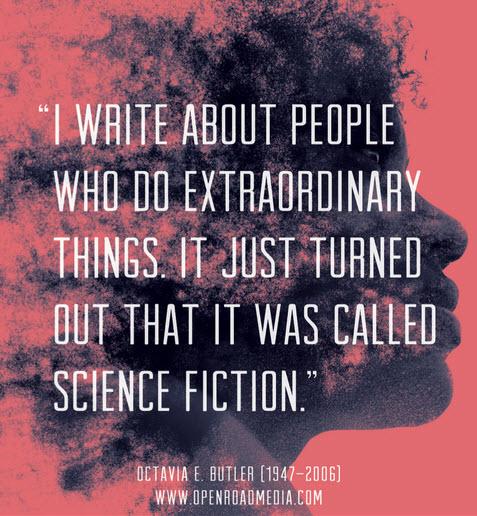
Octavia Butler Quote Continue reading “In Defense of Speculative Fiction”

Print Books vs. Digital Books & the Reading Brain

For a variety of reasons, for the past few days I’ve been thinking even more than I usually do about the differences between print books and digital books, and how our brain processes them. There are differences in how we read in different media, and it’s important for us to understand them. If our brain interacts with different formats differently, it means that different formats will best serve different purposes.

It’s our job as librarians to fulfill our patrons’ information needs as best we can. Selecting the best format for the information is increasingly important.

This is my latest attempt to summarize my understanding of how and why print and digital differ.

Continue reading “Print Books vs. Digital Books & the Reading Brain”

The Rewards of Reading in Print

David Ulin is spot-on in his analysis of the differences between reading in print and e-reading:

Reading in the material world by David Ulin (posted by the Los Angeles Times on February 24, 2015)

This quote, in particular, resonates with me:

[O]n a device such as an iPad or an iPhone, we never lose sight of ourselves—they are customized environments, extensions of our psyches—whereas the print book exists in a different realm. It requires an externalized commitment, an accommodation, in which its otherness is part of the point.

Ebooks and print books will always offer different experiences and serve different purposes. Our cultural obsession with seeing them in competition with each other is incorrect and, I believe, does all readers a disservice.

Infographic – 2014: My Year in Reading

My friend Bil liked my 2014: My Year in Reading post so much, he made an infographic of it:

Infographic - 2014: My Year in Reading
This image is entirely the property of Bil Gaines.

He asked me to name an animal and I chose the three-toed tree sloth.

Bil is an amazing writer / artist / father / husband / shark lover / bland car enthusiast / SEO guru. Please read his blog. Also, if you want any fancy-schmancy infographics, drop him a line.

[AUTHOR’S NOTE added December 27, 2019: I was going through my old tracking spreadsheets and discovered an error in my original post. I had listed my longest stretch without reading as 28 days from August 11-September 8. I miscalculated this information. My longest stretch without reading in 2014 was actually 35 days from April 4-May 8. I can’t update this infographic, though.]