Book Review: Cosmic Bullsh*t: A Guide to the Galaxy’s Worst Life Hacks by Chris Ferrie

Cover of the book Cosmic Bullsh*t: A Guide to the Galaxy’s Worst Life Hacks by Chris Ferrie
Cosmic Bullsh*t: A Guide to the Galaxy’s Worst Life Hacks
by Chris Ferrie
Sourcebooks, 2025

This review was first published by Booklist on March 11. 2025.

Ferrie’s latest “Bullsh*t” title (after Quantum Bullsh*t, 2023) takes on some of the most pernicious anti-science conspiracy theories with his trademark snark, put-downs, and pop culture references. He confronts stories about the origin of life, astrology, aliens, time travel, and the end of the world, taking readers through various non-scientific beliefs and summarizing the best current understanding science gives us. It has all the ingredients his fans have come to expect. He’s mostly preaching to the choir, as it’s hard to image this will appeal to anyone who doesn’t already agree with him, and he doesn’t really offer any new information on any of these topics. Nevertheless, it’s a solid overview of the real science behind the conspiracies. Perhaps most interesting, and what gives his work real depth, is the nuance with which he treats both science and non-scientific beliefs: despite the damage conspiracy theories can do, they tap into the essential human need for storytelling, and science can too easily become another form of dogma. Both are at their best when we embrace empathy, fascination, and inherent complexity.

Book Review: These Strange New Minds: How AI Learned to Talk and What It Means by Christopher Summerfield

Cover of the book These Strange New Minds: How AI Learned to Talk and What It Means by Christopher Summerfield
These Strange New Minds: How AI Learned to Talk and What It Means
by Christopher Summerfield
Viking, 2025

This review was first published by Booklist on March 1, 2025.

**STARRED REVIEW** Summerfield, neuroscientist and former researcher at Deepmind, offers one of the most balanced and realistic assessments of the current state of AI technology as well as a summary of how AI was first conceived and developed. In doing so, he spends as much time exploring linguistics and neuroscience as he does with technology. Noam Chomsky is as much a part of this as Alan Turing is. Summerfield examines the philosophies of the major players in the AI sphere and spends some time assessing the various hopes and fears people have for it. Amongst the slate of AI-focused, pop-sci books hitting the shelves recently, this one does the best job of explaining for a lay reader how AI is structured and trained. But Summerfield takes it further, comparing the ways AI functions to the workings of the human brain to show not just the potential of AI for true intelligence and creativity but also that AI is fundamentally different from human intelligence. Those differences pose the biggest challenges to the next steps of AI development. This technology contains both tremendous potential and very real danger. Summerfield tackles all this with humor, wit, and candor.

Book Review: Dimming the Sun: The Urgent Case for Geoengineering by Thomas Ramge

Cover of the book Dimming the Sun: The Urgent Case for Geoengineering by Thomas Ramge
Dimming the Sun: The Urgent Case for Geoengineering
by Thomas Ramge
The Experiment, 2025

This review was first published by Booklist on March 1, 2025.

Solar geoengineering—altering the albedo of Earth to reflect more of the sun’s energy and cool down global warming—is an idea that has long floated around the periphery of climate-change-action circles. Ramge argues that it’s an idea whose time has come. It has the potential to make a significant, immediate impact and is easily reversible. It could be accomplished on a large scale with technology that’s commonplace right now. But Ramge also urges caution: it’s not a long-term solution, merely a step that can buy us time to meet necessary carbon-reduction goals. He sees a realistic danger that nonstate actors may take it upon themselves to pursue this path. There’s been very little research into solar geoengineering, so we don’t have a full understanding of the risks and possible consequences. The possibility that someone, somewhere, may turn to this approach creates an urgent need for better understanding and regulatory framework. Dimming the sun is a realistic and potentially powerful option to combat climate change. Ramge believes we should at least explore the possibility.

Book Review: Chain Reactions: The Hopeful History of Uranium by Lucy Jane Santos

Cover of the book Chain Reactions: The Hopeful History of Uranium by Lucy Jane Santos
Chain Reactions: The Hopeful History of Uranium
by Lucy Jane Santos
Pegasus, 2024

This review was first published by Booklist on October 11, 2024.

Santos’ second offering on the history of radioactivity (after Half Lives, 2021) takes readers through the history of uranium and its by-products. The earliest use of uranium was as a colorant for glass and ceramics, a use which continued into the twentieth century. Supposed medicinal uses spurred a rush to locate and mine uranium deposits, with devastating consequences for Native populations across the world. Most famously, uranium fueled the development of nuclear weapons and has been controversial as a power source. But nuclear power has a safety record surpassed only by solar, and radioactivity isn’t as dangerous as we once believed. Santos argues nuclear power deserves reassessment and another chance, especially in light of the urgent need to wean society off fossil fuels. Some of this content will be familiar to readers of Santos’ previous work, and the use of uranium in nuclear weapons and power is widely understood, so this book offers fewer surprises than its predecessor. Nonetheless, it is well researched and engaging and an important corrective to the misinformation and paranoia that surround uranium.

Book Review: How to Kill an Asteroid: The Real Science of Planetary Defense by Robin George Andrews

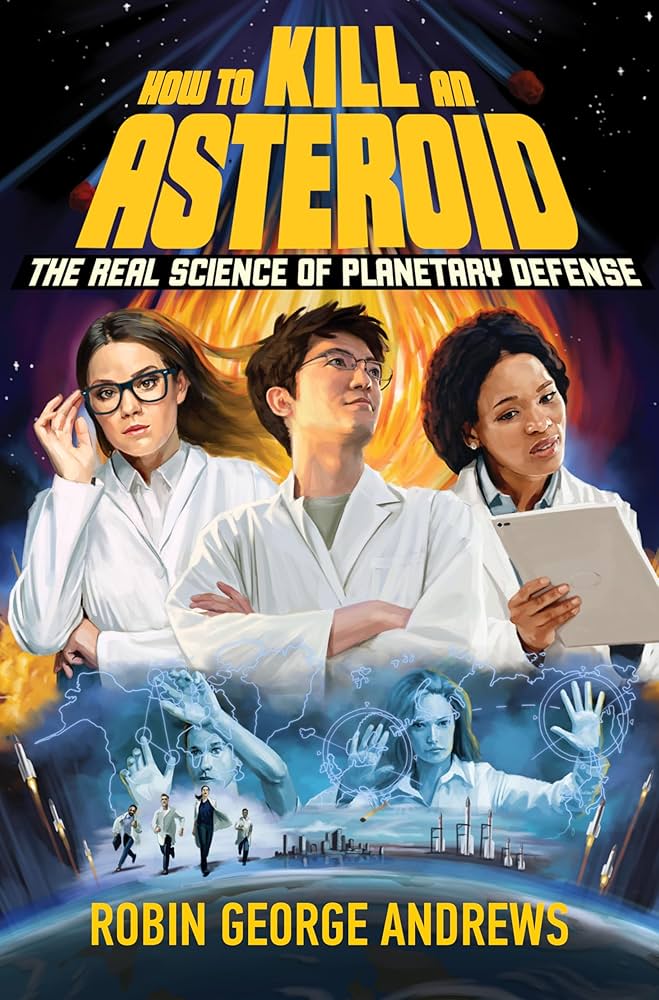
Cover of the book How to Kill an Asteroid: The Real Science of Planetary Defense by Robin George Andrews
How to Kill an Asteroid: The Real Science of Planetary Defense
by Robin George Andrews
Norton, 2024

This review was first published by Booklist on September 1, 2024.

**STARRED REVIEW** It’s impossible to prevent most natural disasters. The exceptions to this are asteroid and comet strikes—stopping cosmic impacts is possible and could save literally billions of lives. Framed around an account of NASA’s recent DART mission (Double Asteroid Redirection Test), Andrews takes readers on an exciting tour of how the science of planetary defense was born and where scientists are hoping to take it from here. He interviewed several of the most prominent people involved in planetary defense, sharing their firsthand accounts of their work and motivations, which provide compelling insight into this growing field. We know how to stop asteroids and comets from hitting Earth, using everything from deflecting them with fast rockets to disintegrating them with nuclear bombs. The challenge is mostly in how we detect these threats, especially smaller “city killers,” and Andrews offers compelling arguments for the need to build a stronger detection network. Andrews’ writing style is funny, wry, passionate, and deeply informed. How to Kill an Asteroid is one of the most entertaining pop-science reads of the year.

Book Review: Supremacy: AI, ChatGPT, and the Race That Will Change the World by Parmy Olson

Cover of the book Supremacy: AI, ChatGPT, and the Race That Will Change the World by Parmy Olson
Supremacy: AI, ChatGPT, and the Race That Will Change the World
by Parmy Olson
St. Martin’s, 2024

This review was first published by Booklist on September 1, 2024.

**STARRED REVIEW** The current ascendancy of artificial intelligence has been driven mostly by two men: Sam Altman, creator of ChatGPT, and Demis Hassabis, creator of DeepMind. Both idealists, Altman and Hassabis are driven by a conviction that AI can solve society’s deepest problems and make things better for humankind. Both men set out to ensure AI would be developed responsibly and kept out of the hands of profit-driven Big Tech corporations, and both men soon enough sold control of their creations to Microsoft and Google. This is a tale of competitive nature run amok, where the need to be first led to the abandonment of cautious plans in favor of rapid development and poorly planned deployment. It’s a frankly terrifying exposé of the dangers posed by the current, unregulated technology market. Perhaps most importantly, Olson warns against our popular obsession over the existential threat AI poses to humanity at the cost of ignoring real harms AI is already causing: it perpetuates bias and fuels polarization in society and removes human oversight from crucial decisions that affect people’s lives. Olson’s warning is clear; we’re losing control over our own creation. Add this to the growing stack of recent books sounding the alarm about unchecked tech.

Book Review: Devil in the Stack: Searching for the Soul of the New Machine by Andrew Smith

Cover of the book Devil in the Stack: Searching for the Soul of the New Machine by Andrew Smith
Devil in the Stack: Searching for the Soul of the New Machine
by Andrew Smith
Grove, 2024

This review was first published by Booklist in August 2024.

**STARRED REVIEW** Many of us have a sense that modern technology, especially social media, is damaging human society and relationships. Smith was curious to understand if that’s true and, if so, why. Here, he takes a deep dive into the culture of computer coders: he learned to code, attended coding conferences, and interviewed some of the most eminent persons of the coding world. Along the way, he offers a course in the history of the creation and development of computers and code, a necessary context to understand how we got to where we are today. He explores the nature of coding itself: is it more math or language, science or art, and how do human brains process it? He also calls our attention to the divisive, often counterintuitive history of diversity in tech. Smith believes modern technology is doing harm to society and ultimately suggests a well-reasoned argument for why, with suggestions to address the damage. But technology also offers tremendous potential to do good, and much of the culture around tech is deep with creativity, imagination, and hope. Devil in the Stack is a humane, nuanced, humorous, insightful work and a much-needed call for greater due diligence around some of the most impactful innovations in human history.

Book Review: Ka-Boom! The Science of Extremes by David Darling

Cover of the book Ka-Boom! The Science of Extremes by David Darling
Ka-Boom! The Science of Extremes
by David Darling
Oneworld, 2024

This review was first published by Booklist on June 14, 2024.

People are perennially fascinated by extremes. What’s the most massive object we know of? The fastest computer? The loudest sound? The longest-lived being? The coldest temperature? The biggest explosion? Darling serves up a fun, informative, and quirky overview of some fascinating science facts. He surveys physics, space, materials, technology, and the natural world, offering myriad examples of the extremes we’ve discovered in the course of our exploration of our universe. There’s something for everyone in this quick and engaging read. There may not be much new information here for existing science aficionados, he repeats a few examples in different subject sections, and he doesn’t go into much depth on any of them, but his delight in exploring this material is invigorating. Even inveterate science geeks should enjoy this time spent with fascinating facts. Ka-Boom! is most valuable as an ideal introduction to the science of extremes for people just starting out on their journey into the vast realms of scientific knowledge.

Book Review: The Heart and the Chip: Our Bright Future with Robots by Daniela Rus and Gregory Mone

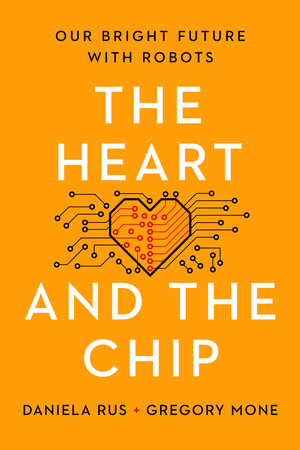
Cover of the book The Heart and the Chip: Our Bright Future with Robots by Daniela Rus and Gregory Mone
The Heart and the Chip: Our Bright Future with Robots
by Daniela Rus and Gregory Mone
Norton, 2024

This review was first published by Booklist on February 9, 2024.

Rus, Director of the MIT Computer Science and Artificial Intelligence Laboratory, knows more about robots and artificial intelligence than just about anyone. Here she takes readers on a tour of the cutting edge of this technology. She assures us there’s no danger of a robot apocalypse. She and many of her colleagues envision a world where robots and people cooperate to enhance our abilities, where the human heart and the computer chip work together to make the world better for everyone, especially people who are disabled or disadvantaged. Modern robots aren’t clunky metal contraptions as they’re so often portrayed. They can be made from fabrics, plastics, just about anything, in all kinds of shapes and sizes, and can be used in everything from non-invasive surgeries to training athletes to helping the elderly maintain mobility and independence. Robots can help us solve deep-set problems, even aid us in healing the planet. Not a world of robot overlords, but a world full of Iron Man suits made of stylish fabrics instead of steel. It’s a compelling vision.

Book Review: How to Win Friends and Influence Fungi: Collected Quirks of Science, Tech, Engineering, and Math from Nerd Nite by Chris Balakrishnan and Matt Wasowski

Cover of the book How to Win Friends and Influence Fungi: Collected Quirks of Science, Tech, Engineering, and Math from Nerd Nite by Chris Balakrishnan and Matt Wasowski
How to Win Friends and Influence Fungi: Collected Quirks of Science, Tech, Engineering, and Math from Nerd Nite
by Chris Balakrishnan and Matt Wasowski
St. Martin’s, 2024

This review was first published by Booklist on December 22, 2023.

How to Win Friends and Influence Fungi is a selection of various Nerd Nite presentations collected in written form. As one would expect from Nerd Nite, these presentations range across a remarkable array of subjects, and they vary in length (although none is more than a handful of pages). The 71 essays collected here are loosely arranged into 11 topics (animals, space, math, bodily fluids, etc.) and span the gamut from stories of animal procreation to how cups of tea led to better scientific, experimental protocols to the multiple definitions of infinity. The appeal of Nerd Nites—people presenting information on subjects they’re passionate about—translates well into book form. It’s quirky, fun, engrossing, and informative. It’s a delightful collection! Perfect for existing fans of Nerd Nite, it also serves as an ideal introduction for anyone who may not have heard of these gatherings before. It should appeal to nerds and information lovers of all ilk, despite some salty language and subject matter.