Book Review: Midnight in Chernobyl: The Untold Story of the World’s Greatest Nuclear Disaster by Adam Higginbotham

Cover of the book Midnight in Chernobyl: The Untold Story of the World's Greatest Nuclear Disaster by Adam Higginbotham
Midnight in Chernobyl: The Untold Story of the World’s Greatest Nuclear Disaster
by Adam Higginbotham
Simon & Schuster, 2019

This review was first published by Booklist on January 1, 2019.

**STARRED REVIEW** Midnight in Chernobyl is a top-notch historical narrative: a tense, fast-paced, engrossing, and revelatory product of more than a decade of research. Higginbotham interviewed most of the surviving central participants in the disaster, examined volumes of newly declassified Soviet documents, and surveyed previous research and reportage. The result is a stunningly detailed account of the explosion of Reactor Four at the Chernobyl nuclear-power plant on April 26, 1986. It offers a brief history of the development of the Soviet nuclear-power program leading up to the construction of the plant at Chernobyl, a second-by-second account of the night of the accident, the confluence of causes, the evacuation of the surrounding countryside, the containment and cleanup efforts, and a deep dive into the aftermath: the medical and environmental consequences, the political machinations and missteps, the role Chernobyl played in the downfall of the USSR, and the effect it had on the pursuit of nuclear power worldwide. For all its wealth of information, the work never becomes overwhelming or difficult to follow. Higginbotham humanizes the tale, maintaining a focus on the people involved and the choices, both heroic and not, they made in unimaginable circumstances. This is an essential human tale with global consequences.
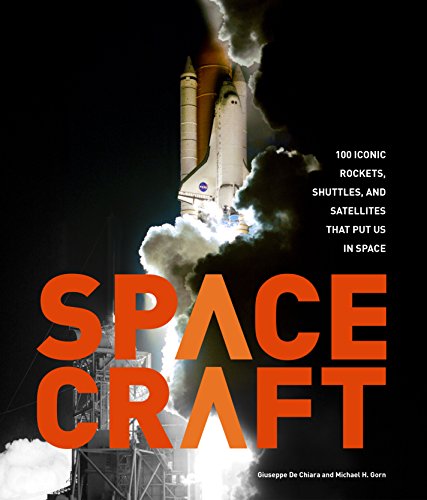
Book Review: Spacecraft: 100 Iconic Rockets, Shuttles, and Satellites That Put Us in Space by Michael H. Gorn

Cover of the book Spacecraft: 100 Iconic Rockets, Shuttles, and Satellites That Put Us in Space by Michael H. Gorn
Spacecraft: 100 Iconic Rockets, Shuttles, and Satellites That Put Us in Space
by Michael H. Gorn
Quarto/Voyageur, 2018

This review was first published by Booklist on December 1, 2018.

Spacecraft profiles 100 craft that are significant in the history of space exploration: rockets, orbiters, spaceplanes, landers, space stations, satellites, and exploratory craft from the U.S., Russia, Europe, China, and more recent private, corporate ventures into space flight. The articles offer thorough physical and technical descriptions of each craft, along with a history of its development and use. The book is organized into 3 main sections, each covering a 20-year span from 1957 through 2017. Articles are further organized by the type of craft, with each country’s being grouped together. It’s not a strictly chronological narrative, but it provides an overall understanding of the history of the development and deployment of spacecraft. Readers can also use the table of contents to flip to any specific article that interests them. The articles are accompanied by numerous full-color drawings by illustrator Giuseppe De Chiara that show the details even better than the photographs do. This work is high quality; an effective hybrid of reference volume and coffee-table book. A solid choice for any public library.

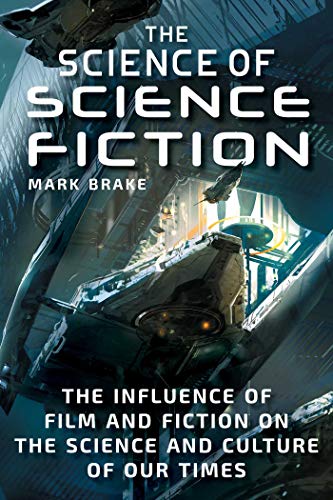
Book Review: The Science of Science Fiction: The Influence of Film and Fiction on the Science and Culture of Our Times by Mark Brake

The Science of Science Fiction: The Influence of Film and Fiction on the Science and Culture of Our Times
by Mark Brake
Skyhorse, 2018

This review was first published by Booklist on November 2, 2018.

Brake (Different Engines, 2007, with Neil Hook) is a scholar and authority on how science fiction can influence the course of science and define our popular perceptions. The short essays—none longer than half a dozen pages—collected here are grouped into four main themes: “Space,” “Time,” “Machine,” and “Monster.” Some essays fit more than one theme, but they give the work a useful structure. Each essay is a quick read, but none go into much depth. Anyone looking for a robust scholarly treatment of the subject might be disappointed. Brake takes a valuable historical view, citing several stories from the earliest days of the genre, dating back to the 1600s and earlier, as well as classic and modern movies. However, the examples he chooses seem somewhat random and lack modern literary selections. He examines the history of science from Galileo and Newton to Einstein and the atomic bomb and on to the invention of computers and the internet. The book comes across as almost a random selection of short works; nonetheless, it is insightful, fascinating, and an easy read.

Book Review: Dispatches from Planet 3: 32 (Brief) Tales on the Solar System, the Milky Way, and Beyond by Marcia Bartusiak

Cover of the book Dispatches from Planet 3: 32 (Brief) Tales on the Solar System, the Milky Way, and Beyond by Marcia Bartusiak
Dispatches from Planet 3: 32 (Brief) Tales on the Solar System, the Milky Way, and Beyond
by Marcia Bartusiak
Yale, 2018

This review was first published by Booklist on August 13, 2018.

These 32 short essays cover major events in the history of astronomy and cosmology, ranging from the demotion of Pluto to the status of dwarf planet, the evolution of galaxies, the detection of gravity waves and neutrinos, and the role of time in the Big Bang. Bartusiak’s (The Day We Found the Universe, 2009) goal is to provide historical context for many recent discoveries and a summary of how we got to where we are now in the science of space, offered in easy-to-read, bite-size morsels. Many of these essays cover events from the late 1800s through the mid-1900s, the period when modern cosmology was born, but the collection isn’t arranged chronologically. Rather, the essays are grouped, small to large, by topic, starting from the solar system and working out to the larger universe. Of particular value, several essays focus on women who did significant work, but who historically haven’t gotten credit. This is an informative and rewarding read for anyone interested in our understanding of the universe. Recommended for fans of Amanda Gefter’s Trespassing on Einstein’s Lawn (2014).

Thoughts in the Wake of a Total Solar Eclipse

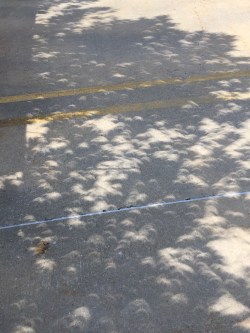
Eclipse shadow through tree leaves, over half occluded. Downtown Kansas City, August 21, 2017

Eclipse shadow through tree leaves, over half occluded. Downtown Kansas City, August 21, 2017.
Image property of John Keogh

In the early afternoon on August 21, 2017, a total solar eclipse traversed the United States from Oregon to South Carolina. In Kansas City, morning storms cleared and blue sky opened just in time to view the event, from the first sliver of moon shadow through totality. It’s the only total solar eclipse I’ve witnessed. I’m struggling to put the experience into words.

I started studying astronomy in 2nd and 3rd grade. In 3rd grade, we had to write an essay about what we wanted to be when we grew up and the title of mine was “When I Grow Up I Want to Be a Cosmologist.” Space was my first fascination and my first love.

I’ve seen partial solar eclipses in person. I’ve seen images of total eclipses and they’re beautiful. Astronomically speaking, eclipses aren’t that rare or complex. They happen pretty often, simple mass body physics.

So I expected the total eclipse to be spectacular, gorgeous. I expected it to be cool and interesting. I expected to be fascinated by it and by the effect it had on insects and animals. I expected to completely geek out over it.

I never expected it to be so powerful.

Continue reading “Thoughts in the Wake of a Total Solar Eclipse”

Book Review: Trespassing on Einstein’s Lawn by Amanda Gefter

Trespassing on Einstein's Lawn book cover
Trespassing on Einstein’s Lawn by Amanda Gefter, published by Bantam 2014

I love Trespassing on Einstein’s Lawn by Amanda Gefter more than I’ve loved any book in a long time.

I first became fascinated by cosmology in third grade (no kidding, in third grade I wrote an essay for school titled, “When I Grow Up I Want to Be a Cosmologist.” You can ask my mom—she still has it.) While I didn’t dedicate my life to pursuing the subject the way that Ms. Gefter has, her delight and fascination with the theories of cosmology perfectly captures my own. I know the thrill of them the same way she does.

More than any other, this book reminds me why I love this field of study.

Continue reading “Book Review: Trespassing on Einstein’s Lawn by Amanda Gefter”