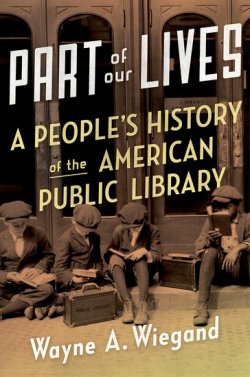
Book Review: Part of Our Lives by Wayne A. Wiegand

Part of Our Lives by Wayne A. Wiegand
Part of Our Lives: A People’s History of the American Public Library by Wayne A. Wiegand
Oxford University Press, 2015

I recently read the book, Part of Our Lives: A People’s History of the American Public Library by Wayne A. Wiegand. Rather than write a typical review of it, I want to share a letter that I sent the author.

(TL;DR version: This book is wonderful and every public librarian and public library user should read it. I think it’s important.)


Dear Dr. Wiegand,

I’d like to thank you for writing Part of Our Lives: A People’s History of the American Public Library. Before I proceed to explain why I want to thank you, I need to spend some time voicing a complaint about something you wrote in your introduction. Bear with me—the extent of my gratitude for your work won’t be clear without this context.

Continue reading “Book Review: Part of Our Lives by Wayne A. Wiegand”

Another Benefit of Ebooks for Libraries

A friend of mine was recently introduced to a certain genre fiction author who has been writing an ongoing series for the past couple of decades. My friend naturally wanted to start this series at the beginning and read it all the way through, in order. So, my friend turned to their local public library.

Ongoing series pose a difficulty for library collections. The earliest titles stop circulating after so many years, or our copies become worn out and damaged beyond repair. As a result, these items get weeded. Sometimes there’s not enough demand to justify restocking an older title. Sometimes we can’t restock them because we can’t afford the physical shelf space to hold them.

Frequently, publishers stop printing older titles from their catalogs, or distributors stop carrying them, which means libraries often can’t replace these titles in our collections even if we see a need for them. Therefore, it’s not uncommon for libraries to have more recent titles in ongoing fiction series on their shelves but not the earliest ones.

Continue reading “Another Benefit of Ebooks for Libraries”

Proud to Be a Librarian: Thoughts on the KLA/MLA Joint Conference

Last week, I attended the three-day joint conference of the Kansas and Missouri Library Associations, “Libraries Without Borders.” I attended half a dozen sessions, learned about some useful projects and products, met lots of people – all the things you go to a conference to do. It was an enjoyable and productive few days. Every night, I went home excited to talk about all the new ideas in my head.

But the part of it that I keep going back to, the bit that sticks with me most powerfully, is the awards reception that was held at the end of the second day. Representatives of both the KLA and MLA handed out awards to various individuals for meritorious service, distinguished professionals, best library, etc. Pretty standard, as awards ceremonies go. What struck me about it is this:

Every single person who received recognition that evening made it a point to pass on credit for their work in their acceptance speech. Every one of them made it clear that they didn’t do their work alone, and that their awards belonged as much to their staff, or their director, or their board who supported them. Every one of them acknowledged that their success was the result of the efforts of many other people, working on many fronts.

Continue reading “Proud to Be a Librarian: Thoughts on the KLA/MLA Joint Conference”

Digital Technology: It’s Just a Tool

Let’s not make more of it than it is.


This is the second of my point / counterpoint posts. Read the first post here.


When we think about digital illiteracy, we picture people who lack familiarity or skill with technology, people who lack knowledge or comfort with digital information resources. We think about luddites—some willing, some unwilling.

But there’s a kind of digital illiteracy that exists at the other end of the spectrum: technolust. People who adopt new technologies and digital resources too enthusiastically.

An uncritical acceptance of digital technology fails to understand it in a way as profound as any luddite.

Digital technology provides us with tools. A proper understanding of our tools doesn’t just mean knowing what they can do—it also means knowing what they can’t do, and what we shouldn’t try to make them do.

Understanding our tools means knowing their limitations as well as their strengths.

Continue reading “Digital Technology: It’s Just a Tool”

Luddite Librarians

Digital technology is part of our job now, whether we like it or not.


This post is the first of two that I plan to present as a point / counterpoint kind of thing. Read the second post here.


Every library, it seems, has a handful of staff members who just won’t get onboard with new technology and new digital services. Some of them even make it a point of pride—they see themselves as stalwarts, holdouts against unnecessary change.

Some say they’re too set in their ways and technology changes too fast to keep up with it. Some flat out don’t trust new technology or digital information resources.

As a profession, we grimace and shrug and resign ourselves to the fact that some of our coworkers are going to be like that.

But consider it from a different angle:

Continue reading “Luddite Librarians”

The Transformative Power of Reading

I have a social media friend—you know the type: you’re barely even acquaintances in real life but you have enough mutual friends to be friends online. We’ve been social media friends for some years now.

For the past couple of weeks, I’ve been watching her life transformed by the power of reading. That sounds cheesy and dramatic, I know, but it’s literally true.

My social media friend is currently in her early 30s. She’s Hispanic Latina, born into a fairly poor family, raised in a fairly poor neighborhood, with all the disadvantages inherent to such a background in this country. She had her first child when she was still in high school and married the father when she turned 18. They had a couple more kids over the next few years. She didn’t go to college. She went straight from high school to being a working mother, raising her children and holding down a series of part-time, low skilled, hourly wage jobs. A few years ago, she and her husband got divorced, so she took her kids and moved back in with her parents.

She decided to change the course of her life and she enrolled in a community college to get a degree in nursing. This is where her current transformation begins…

Continue reading “The Transformative Power of Reading”

Libraries Should Be About Books

It’s de rigueur nowadays for people to criticize libraries for being “too much about books.” The idea being that too many libraries are still stuck in the past, in outmoded service models, and failing to adapt to new technologies, trends, etc.

There is some truth in the criticism—although I also find that too many of these critics fail to be critical enough of new trends and tend too often to promote faddishness.

It makes me want to ask the obvious question:

What’s wrong with libraries being about books?

Books mean reading. Books are still the best, most valuable tool of a reading life. This makes books timelessly important—beyond fads, more enduring than ever-changing technology.

Books matter. Still and always. Because reading matters.

Continue reading “Libraries Should Be About Books”

Digital Comics for Libraries: Good News!

In my recent interview for Corner Shelf, Rebecca Vnuk asked me what kinds of things my library’s collections are most in need of.

My answer: digital comics. Specifically—Marvel and DC.

As of June 25, 2015, hoopla digital offers DC titles in digital format. This includes titles from their Vertigo imprint. Their collection includes several of the most important issues and graphic novels in DC / Vertigo’s catalog: Watchmen, V for Vendetta, Frank Miller’s Dark Knight, The Killing Joke, Gaiman’s Sandman

It’s not everything from DC but it’s a lot of the really good stuff.

This is huge. This makes me really happy. This could be a game-changer.

Kudos to hoopla!

hoopla digital logo

Public Library Reference: An Unscientific Test

I debated for several weeks about writing this post. Some of what I want to talk about I already discussed in my post, The Pain of Bad Reference Interactions. I think there’s more to say, though.

My concern is that I have some strong criticisms of the reference interactions I’ve had with some public libraries in the United States. I use no names and I leave out all identifying details—but it’s still possible that some of these libraries, or even some of their librarians, will be able to recognize themselves if they read this.

I have no desire to shame anyone with this post. I find online public shaming culture abhorrent and I refuse to participate in it.

I believe that criticism is necessary for improvement. I offer all criticisms in the sincere hope that it will help us all to serve our communities even better than we already do, and in my desire to help define the best path forward for public libraries in the Digital Information Age.

Continue reading “Public Library Reference: An Unscientific Test”