Book Review: City of All Seasons by Oliver K. Langmead and Aliya Whiteley

Cover of the book City of All Seasons by Oliver K. Langmead and Aliya Whiteley
City of All Seasons
by Oliver K. Langmead and Aliya Whiteley
Titan, 2025

This review was first published by Booklist on April 1, 2025.

**STARRED REVIEW** This dark fantasia of magical realism is set in a city split in two, one version stuck in perpetual winter, one in unremitting summer, both cut off from the rest of the world. The mystery of how it happened is inextricably knotted up with the conflicts in the town’s most powerful family. Two cousins separated by the split must unravel the mystery, defy authority, and find their way back to each other. This is one of those novels that’s impossible to describe without reducing its magic. It’s strange and eerie, familiar and alien, compelling and off-putting, deeply rendered and mysterious, meditative and unexpectedly comforting. It feels more like a modern fable than contemporary fantasy. It’s an examination of family, conflict, and love, and how people and places imprint on each other, a kaleidoscope of time and atmosphere. The world and characters are equally complex and believable, and both are essential to the story. Readers must be willing to suspend disbelief for the premise and accept that there really isn’t a full explanation for what happens. But if they allow themselves to immerse in it, the experience is quite wonderful. Recommended for fans of Seanan McGuire and Stephen King’s fantasy work.

Book Review: The Fourth Consort by Edward Ashton

Cover of the book The Fourth Consort by Edward Ashton
The Fourth Consort
by Edward Ashton
St. Martin’s, 2025

This review was first published by Booklist on February 1, 2025.

Life isn’t going so well when Dalton Greaves gets recruited by the alien Unity coalition to be a “ground pounder”—someone who makes first contact with newly discovered, sentient species. Competition for first contact comes from the Assembly, a different coalition of aliens. When Dalton makes contact with the minarchs—a tentacled, insectoid, predatory species—things don’t go at all to plan. He and his partner end up stranded on the minarch planet along with an Assembly “stickman” and get caught up in local political conflicts. Dalton becomes the fourth consort of the minarch queen, forms an unexpected truce with his Assembly enemy, and lands in a fight for his life. Ashton (Mal Goes to War, 2024) excels at creating compelling characters. Especially impressive is how believable his different alien races are: each has its own culture and motivations, and they all make sense. The conflicts that drive the action arise from the miscommunications between them. Speculative fiction is a lens for us to reflect upon ourselves in interesting ways, and this is ultimately a delightful examination of what it means to be human.

Book Review: Dengue Boy by Michel Nieva

Cover of the book Dengue Boy by Michel Nieva, tr. by Rahul Bery
Dengue Boy
by Michel Nieva, tr. by Rahul Bery
Astra, 2025

This review was first published by Booklist on November 1, 2024.

**STARRED REVIEW** Nieva’s debut expands his O’Henry award-winning short story into a full novel. The result is a dystopian fever dream that’s equal parts poetic and profane, beautiful and splattered with gore. In the year 2272, the polar ice caps have melted, Patagonia is a tropical archipelago, Antarctica is the new Caribbean, terraforming technology is used to create paradises only for the rich, and global corporations make fortunes off of pandemics. Dengue Boy is a mutant mosquito, born to a human mother, who is ostracized as child and grows up to wreak destruction. His foil is El Dulce, an entirely self-centered tween who helps smuggle contraband through Patagonia, whose only real interest is getting his hands on a prime video game console, and who comes face-to-face with a primordial force beyond reckoning. Furthermore, there’s a hallucinogenic video game that breaks the concept of time and causation. Dengue Boy is a trip. It’s a cry of rage against the inhumanity of corporate greed, a mourning for the destruction of our climate, a warning of the dangers we’re unlocking from the thawing ground, and a heartbreaking loss of hope for the future of mankind. It’s a pessimistic and transformative experience that is powerful, challenging, rewarding, and difficult to sit with.

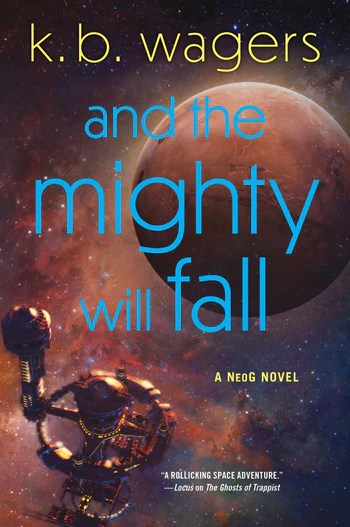
Book Review: And the Mighty Will Fall by K. B. Wagers

Cover of the book And the Mighty Will Fall by K. B. Wagers
And the Mighty Will Fall
by K. B. Wagers
Harper Voyager, 2024

This review was first published by Booklist on November 1, 2024.

The NeoG is set to hand control of the Mars Orbital Station to local Martians—a major step in granting Mars independence. Maxine Carmichael is on site to supervise when the station is hijacked by a group with unclear motives, sowing discord between the NeoG and the Free Mars activists. With Max, Sahib, and several civilians taken hostage, Nika leads a team on the ground to figure out what’s going on, avert disaster, and bring their people back alive. What ensues is a violent fight for survival amidst political intrigue. Wagers refers to this newest NeoG novel (after The Ghosts of Trappist, 2023) as “Die Hard in space.” This is accurate, though it sells the story short. There are deep themes explored here: the brutality of long-standing conflict where everyone is harmed and the psychological cost of violence. The novel is weightier and darker than its predecessors, notably more grim while retaining innate hopefulness. As always, the heart of the story is the emotional support and vulnerability the characters grant one another. It’s the only thing that can heal wounds this deep.

Book Review: The Last Dangerous Visions by Harlan Ellison and others. Ed. by Harlan Ellison

Cover of the book The Last Dangerous Visions by Harlan Ellison and others. Ed. by Harlan Ellison
The Last Dangerous Visions
by Harlan Ellison and others. Ed. by Harlan Ellison
Blackstone, 2024

This review was first published by Booklist on October 1, 2024.

**STARRED REVIEW** After more than 50 years, it’s finally here: the concluding volume of Ellison’s groundbreaking speculative-fiction anthology (which began with 1967’s Dangerous Visions). While credited to Ellison, it was completed by J. Michael Straczynski, close friend and executor of the Ellison estate, based on Ellison’s wishes. Most of the stories were solicited and purchased by Ellison over the years, including works from such luminaries as Edward Bryant, A. E. Van Vogt, and Robert Sheckley, and a terrifyingly prescient story by Dan Simmons. Straczynski solicited the rest in order to bring contemporary voices into the mix, including Max Brooks, Cory Doctorow, Adrian Tchaikovsky, a remarkable entry from first-time author Kayo Hartenbaum, and a story from James S. A. Corey potentially so controversial Straczynski questioned whether to even include it. What’s most remarkable is how seamlessly the old and new fit together. It’s a testament to the universality of the themes, ideas, concerns, and experiences they explore. This is deep, daring, and inventive storytelling. Of particular value are Straczynski’s “Ellison Exegesis,” in which he shares his perspective on why Ellison never could finish this work, and “Tetelestai!” where he explains his process for selecting the stories he included. A worthy capstone to Ellison’s monumental legacy.

Book Review: Nether Station by Kevin J. Anderson

Cover of the book Nether Station by Kevin J. Anderson
Nether Station
by Kevin J. Anderson
Blackstone, 2024

This review was first published by Booklist on September 15, 2024.

Nether Station is an experiment in genre mash-ups: space adventure meets cosmic horror. A wormhole is discovered in the Kuiper Belt, and an ultrarich tech mogul funds an expedition to explore it. After a series of eerie and unsettling experiences, the crew find themselves fighting for survival against an ancient and eldritch threat. In Anderson’s (Persephone, 2024, with Jeffrey Morris) experienced hands, this combination of genres is certainly fun. The book features a neurodivergent lead who brings a different perspective to a type of story so often dominated by neurotypical adventure heroes, adding a welcome new dynamic to the proceedings. The tech mogul is an obvious reference to Elon Musk, but Anderson doesn’t allow him to become an easy caricature; he’s fully fleshed out and multifaceted. The remaining cast is no less unique, and it’s satisfying to see how they all rise to the occasion. Anderson’s world building remains top-notch, and the pacing is propulsive. All in all, a successful experiment.

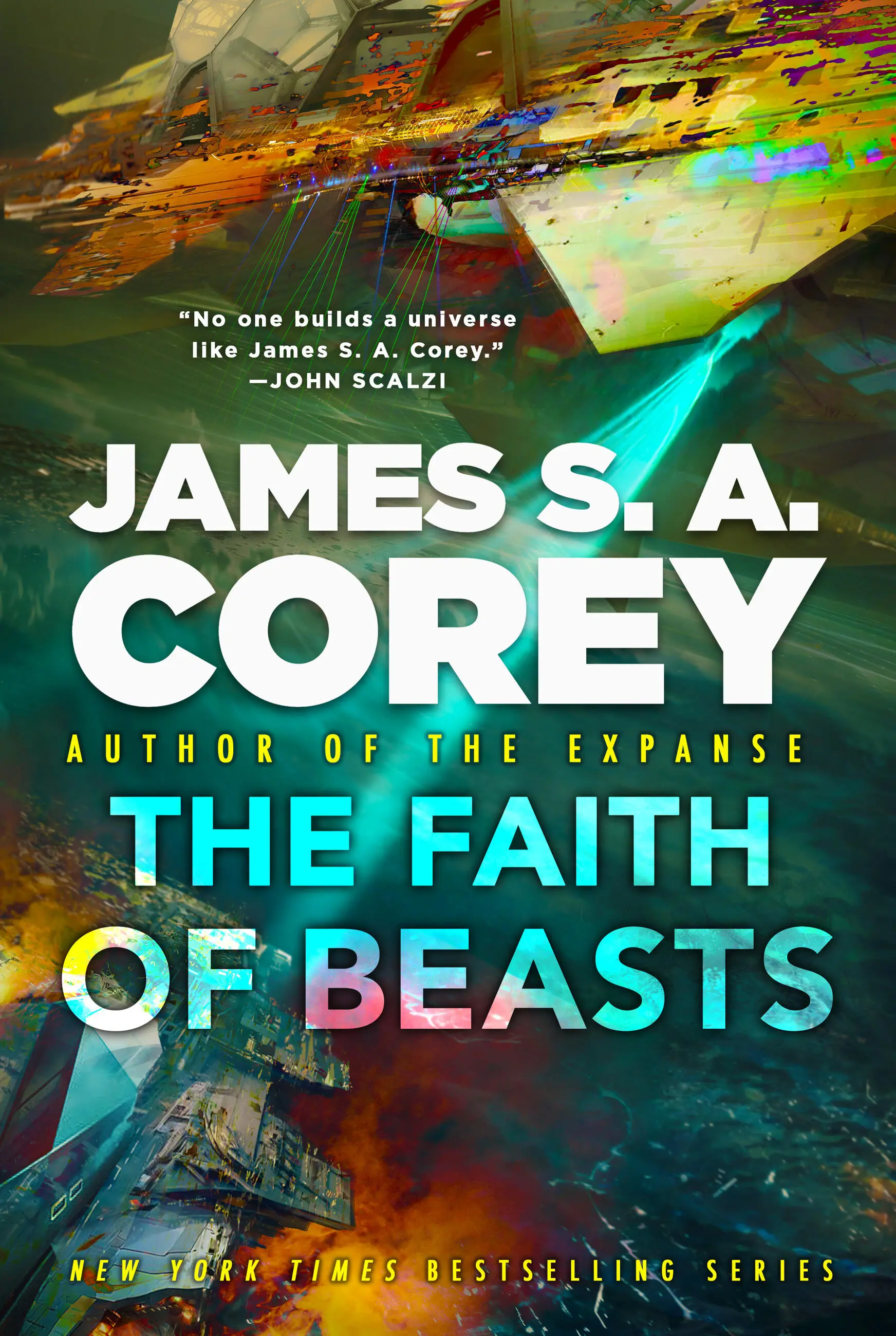
Book Review: The Mercy of Gods by James S. A. Corey

Cover of the book The Mercy of the Gods by James S. A. Corey
The Mercy of the Gods
by James S. A. Corey
Orbit, 2024

This review was first published by Booklist on July 15, 2024.

**STARRED REVIEW** No one remembers how humanity came to live on the planet Anjiin. Then the alien Carryx arrive to enslave mankind. Caught up in an age-old conflict they had no idea was even happening, and thrust into a far wider galactic community of aliens, the survivors from Anjiin must figure out how to navigate their subjugation and maybe even find a path back to freedom. Writing duo Corey (Memory’s Legion, 2022) once again does a masterful job of populating their settings with deeply drawn, unique characters. The settings are immersive and interesting, and the history of the Carryx provides compelling depth to the grand conflict of the story. The Carryx are an insectoid villain race, but Corey explores their worldview, mindset, and culture more deeply than is typical, making them more believable and interesting than the usual genre stereotype. They’re the most well-developed insectoid baddies since Orson Scott Card’s original Ender Trilogy. The Mercy of Gods starts in an unspecified part of the galaxy, assumed to be far from Earth, at an unspecified, far-future time, giving it a more speculative, fantastical feel compared to Corey’s Expanse series. This is old-fashioned space opera on a grand scale and a promising start for an epic new series.

Book Review: The Book of Elsewhere by Keanu Reeves and China Miéville

Cover of the book The Book of Elsewhere by Keanu Reeves and China Miéville
The Book of Elsewhere
by Keanu Reeves and China Mi&eacuteville
Del Rey, 2024

This review was first published by Booklist on June 1, 2024.

A warrior who can’t be killed and who doesn’t understand why. A government agency studying him. Ancient powers who worship him and seek to destroy him. And an immortal deer-pig. A novel cowritten by beloved sf movie star Reeves and beloved sf author Miéville (The Last Days of New Paris, 2016) doesn’t disappoint, but it may not be quite what anyone expects. Set in the same universe as Reeves’ BRZRKR graphic novel series, the nature of the narrative is revealed somewhat slowly, and the writing style is oddly anachronistic and very erudite. It’s stylistically daring, combining sf, fantasy, parascience, history, and action. It’s violent, propulsive, and introspective, ultimately offering a philosophical exploration of identity and the meaning of mortality, chaos, and entropy. The Book of Elsewhere gets under your skin and into your mind and revels in a pervasive sense of mystery. Or it could just be a weird riff on some of the most popular Reeves internet memes. Whatever it is, it works.

HIGH-DEMAND BACKSTORY: Reeves and Miéville each have their own legions of fans, and their collaboration is bound to draw both groups in.

The Core Conflict in Science Fiction

Most of my favorite science fiction authors were members of the literary science fiction movement. These are authors who grew up reading pulp, Golden, and Silver Age scifi. They loved the scope and potential of these types of speculative stories, but they were frustrated by the lack of artistry in the writing. A lot of classic scifi was, let’s be honest, pretty poorly written. Hugely imaginative but there wasn’t much style. When their turn came to become authors and storytellers, they wanted to play in this genre but they also wanted to innovate stylistically, to explore the potentials of language and storytelling structure in a way that matched the technological and scientific innovation that drove scifi from the beginning. They wanted to transform scifi into a literature with deeper artistic merit.

And that’s how most of us tend to understand literary scifi: it made scifi more artsy.

Continue reading “The Core Conflict in Science Fiction”

Book Review: Rogue Sequence by Zac Topping

Cover of the book Rogue Sequence by Zac Topping
Rogue Sequence
by Zac Topping
Tor, 2024

This review was first published by Booklist on May 1, 2024.

Ander Rade is a genetically modified and psychologically conditioned corporate soldier-for-hire. Imprisoned after a failed mission, he’s released by a new U.S. government agency to help stop a terrorist attacking corporate sites—a terrorist who used to be a member of Rade’s squad. Set in a near-future, reshaped United States, this taut, violent, race-against-time thriller is a tale of one man coming to terms with the evils of his past and exploring the possibility of redemption. It’s also a stark warning about the dangers of unchecked corporate power and government corruption. Topping (Wake of War, 2022) refuses to make simplistic judgements about his characters. While it’s clear who the good and bad guys are, they all have understandable reasons for what they do, and they’re all caught up in the larger machinations of powerful corporate and government interests. Topping’s military experience shines in the vivid fight scenes and his descriptions of the characters’ surroundings. It makes the action more believable and compelling. Recommended for fans of espionage thrillers, as well as military sf readers.