Book Review: The Long Sunset by Jack McDevitt

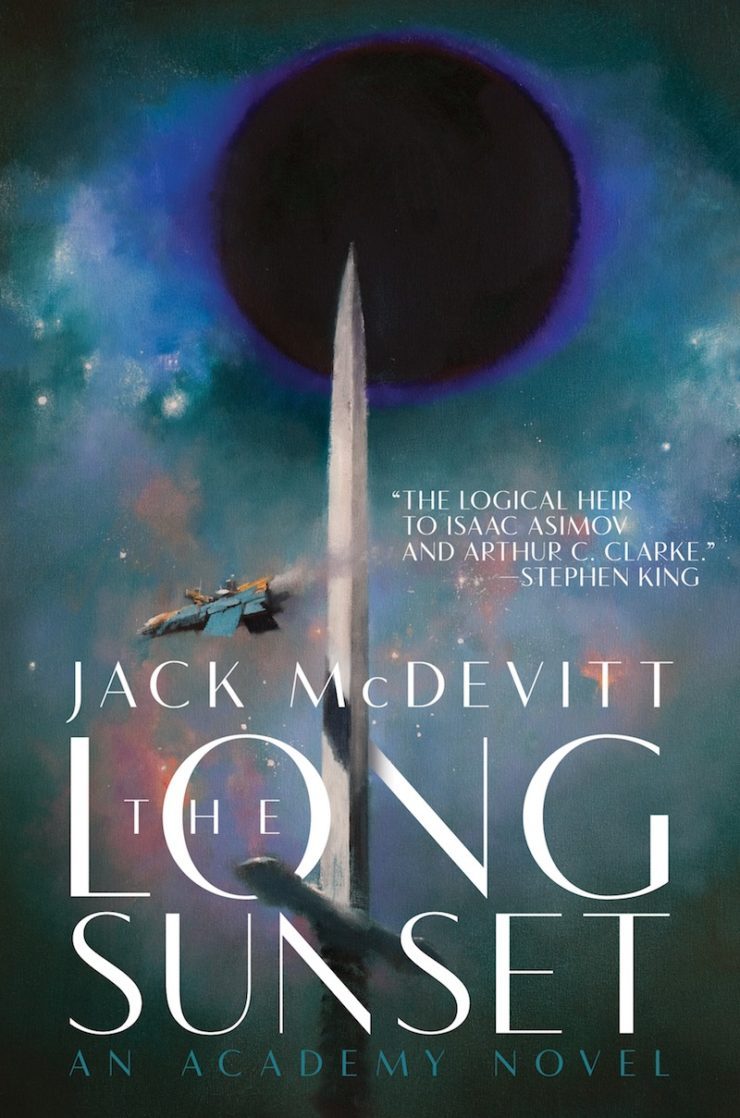
Cover of the book The Long Sunset by Jack McDevitt
The Long Sunset
by Jack McDevitt
Saga, 2018

This review was first published by Booklist on March 15, 2018.

Priscilla Hutchins is the captain of an interstellar crew sent to explore the origin of a mysterious signal from another planet. But there’s resistance to the mission, as many believe continued interstellar exploration has become too dangerous. Hutch takes off despite opposition and embarks upon a journey that will lead her to discover new artifacts, alien life, and a looming celestial apocalypse. But this isn’t an adventure story; it’s a story focused mostly on people and how we relate to one another. McDevitt (Time Travelers Never Die, 2009) offers a unique take on aliens and how civilizations might arise on other planets, an unexpected and interesting choice in the realm of space-based science fiction. The active conflict of the story is political; unfortunately, McDevitt doesn’t delve as deeply into this aspect of the story as he could. But his unique vision, the way his imagination plays across a galactic stage, and the inherent tension of an unavoidable disaster make up for it. He also introduces important new elements into his ongoing Academy series, making this a worthy read.

Book Review: Phoresis by Greg Egan

Cover of the book Phoresis by Greg Egan
Phoresis
by Greg Egan
Subterranean, 2018

This review was first published by Booklist on March 1, 2018.

**STARRED REVIEW** Tvíbura and Tvíburi: twin planets locked in close orbit. Tvíbura is inhabited, Tvíburi isn’t. When an environmental crisis threatens to render life unsustainable on Tvíbura, the people there undertake a generations-long project to build a bridge to reach their twin planet and save themselves. Phoresis is an elegant, spare, evocative jewel of a novella told in three parts. We see the genesis of the project, its fruition, and the eventual outcome. The title (which means transmission) is both a literal description of the main action of the story and almost poetic in its sound. It’s an appropriate encapsulation of this book. Egan (Incandescence, 2008) offers a master class in world building—he starts with a strong, science-based idea and envisions a unique people with a vibrant culture that inhabit a complex world. It all works together to create an immensely satisfying experience. He recognizes this is a story worth telling but doesn’t try to force it to be a full novel. He tells us everything necessary with nothing extraneous; there’s tremendous depth in his brevity. In a genre dominated by series and lengthy tomes, Phoresis is a refreshing reminder that compelling stories come in all lengths.

Book Review: The Long Sunset by Jack McDevitt

The Long Sunset by Jack McDevitt
The Long Sunset
by Jack McDevitt
Saga Press, 2018

The Academy has been shuttered and Priscilla Hutchins (Hutch) is adjusting to life on Earth. Humanity has become fearful of continued space exploration—there’s a growing paranoia that someday such expeditions will bring back something too dangerous. The President herself is campaigning for reelection on a platform of ending the space program.

When an astronomer discovers a signal from deep space which clearly indicates the presence of an intelligent, technologically sophisticated alien civilization, he recruits a team to seek out these aliens and Hutch is put in command. But people don’t want them to go and the team must race to take off before the government can shut them down.

Continue reading “Book Review: The Long Sunset by Jack McDevitt”

Classic SF & Welcoming New Readers

On November 28, 2017, the author Seanan McGuire posted an excellent tweet thread about classic SF and entry points for readers new to the genre. She addresses crucial issues of diversity and inclusion. This perspective is important. Please take the time to click through and read it.

Conclusion: classic SF will always be important but it’s not a good way to bring in new readers.

Introducing new readers to science fiction can be tricky. It’s a challenging genre to learn and get used to. I decided years ago (long before I became a librarian or knew anything about readers advisory) that it doesn’t work to get people started in the genre with classic Asimov, Clarke, et al.

I’m ashamed to admit my reasoning at the time had nothing to do with the narrow Western cultural male whiteness of the work. It was because of the writing and the science.

Consider Isaac Asimov.

Continue reading “Classic SF & Welcoming New Readers”

Book Review: Black Star Renegades by Michael Moreci

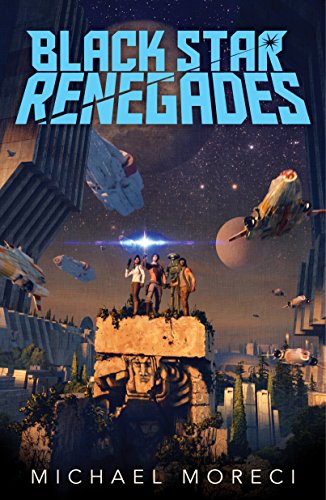
Cover of the book Black Star Renegades by Michael Moreci
Black Star Renegades
by Michael Moreci
St. Martin’s, 2018

This review was first published by Booklist on December 1, 2017.

Rai brothers Cade and Tristan Sura are elite warriors dedicated to keeping peace. Tristan is destined to become the Paragon, wielder of a legendary weapon that can protect civilization from an evil empire threatening to take over the galaxy. But when Tristan dies, Cade is stuck with the weapon—and saving civilization. Problem is, he doesn’t want the job. Moreci’s debut novel is a delightful mash-up of genre tropes: a reluctant hero, swashbuckling space adventure, martial arts, an evil empire, a scrappy band of outcasts, and a sentient killer robot. It’s a loving ode to the science fiction Moreci grew up with. The pacing is fast and exciting, strong on action and generous with humor. Moreci’s writing style could stand to be a bit more sophisticated; he doesn’t fully adapt to prose from his beloved work in comics (Roche Limit, 2015). But he clearly has fun telling this story, and his joy is infectious; fans of his work in comics and the online Star Wars community will be looking for this one.

Book Review: Terminal Alliance by Jim C. Hines

Cover of the book Terminal Alliance by Jim C. Hines
Terminal Alliance
by Jim C. Hines
DAW, 2017

This review was first published by Booklist on November 3, 2017.

A biological attack turns most of the crew of the spaceship Pufferfish into ravening zombies. Only the janitorial crew members survive unscathed. It’s up to them to figure out how to avoid the attackers still hunting them—but first they have to figure out how to fly the ship. Thus begins Terminal Alliance, the first novel in a new series from the author of the Magic Ex Libris series (Revisionary, 2017) that raises the bar for humorous postapocalyptic science fiction with charming underdogs, fascinating alien races, complex intergalactic politics, and a far-reaching conspiracy. With so much serious dystopia on the shelves, a story like this is a genuine pleasure to read: proudly funny and ridiculous. But don’t dismiss this novel as only silly fun. It is also good science fiction: a solid premise, an expansive universe, a compelling history, a strong and varied cast of characters, pulse-pounding action, and a galactic crisis with high stakes. The fact that it’s funny is icing on a rich and delicious cake. Clever, and should appeal to fans of Douglas Adams and John Scalzi.

Book Review: Too Like the Lightning by Ada Palmer

Too Like the Lightning by Ada Palmer
Too Like the Lightning
by Ada Palmer
Tor, 2016

In the future, mankind has avoided self-destruction by a hair’s breadth. Organized religions have been outlawed. Ultrafast transportation has rendered geographical nations irrelevant. Society has been rebuilt according to the ideals of 18th century Enlightenment philosophy. The world’s most notorious criminal—serving a sentence in service to any who command—and a sensayer (a spiritual therapist and guide) discover a child who can perform miracles, with the power to irrevocably change the nature of reality itself. And a brazen theft threatens to expose secrets that could topple the world’s greatest powers.

Too Like the Lightning by Ada Palmer is a near perfect blend of science fiction and philosophy.

Continue reading “Book Review: Too Like the Lightning by Ada Palmer”

Book Review: Tropic of Kansas by Christopher Brown

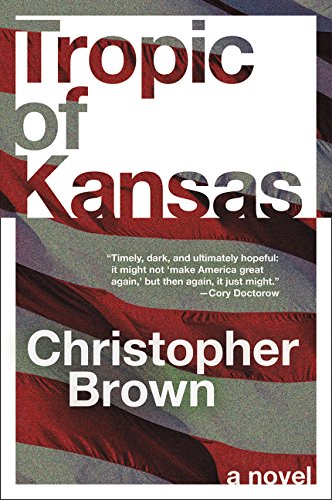
Cover of the book Tropic of Kansas by Christopher Brown
Tropic of Kansas
by Christopher Brown
Harper/Voyager, 2017

This review was first published by Booklist on September 27, 2017.

In the near future, the U.S. is broken apart into warring territories, the president is a tyrant, and rebellion rends the land. Immigration across all borders is restricted. Sig, a feral and fugitive young man, and Tania, a lawyer working for the government and daughter of a revolutionary, are connected by their past, and both get caught up in the burgeoning rebellion. They journey into the Tropic of Kansas, through the broken heartland of America to a flooded New Orleans, a world populated by smugglers, militia bands, monolithic corporations, and revolutionaries. Confronted by unreliable alliances and uncertain trust, they both must decide where their loyalties lie. This vision of the future is violent, unforgiving, and bleak: Cormac McCarthy meets Philip K. Dick. It’s disturbing because of how believable it is. The novel’s structure is fractured: chapters are short, with frequent jumps between characters. This gives the work an uncertain and unsettled feel and captures the fractured nature of the world these people inhabit. It’s remarkably effective. Recommended for fans of Paolo Bacigalupi and China Miéville.

Book Review: What the Hell Did I Just Read by David Wong

Cover of the book What the Hell Did I Just Read by David Wong
What the Hell Did I Just Read
by David Wong
St. Martin’s, 2017

This review was first published by Booklist on September 21, 2017.

David, John, and Amy are back in their third adventure (after This Book Is Full of Spiders: Seriously, Dude, Don’t Touch It, 2012), and it’s as snarky, bleak, and funny as one could hope for. The narrative starts with a high-speed car chase and never slows down, racing headlong at a breathtaking pace. Children are being kidnapped; the Big Bad is a shape-shifter; and there’s an abandoned mine, a motorcycle gang, and yet another mysterious black-cloak organization. Our heroes remain hilariously incompetent and incredibly lucky. Then things get really weird. This book is a mind-trip, messing with the characters’ heads and making the reader question reality right alongside them. These are established characters, so readers shouldn’t look for much development. It’s also a bit too fast-paced: it’s easy to miss details that need to be remembered later. Although it’s not the strongest entry in the series, it’s exciting and a great deal of fun, which is really what Wong’s fans want.

Book Review: Artemis by Andy Weir

Cover of the book Artemis by Andy Weir
Artemis
by Andy Weir
Crown, 2017

This review was first published by Booklist on September 1, 2017.

**STARRED REVIEW** Jazz Bashara grew up in Artemis, the only city on the moon. She’s a young, misanthropic, underachieving genius who side-hustles as a smuggler. One day, she takes on a job that proves too dangerous and finds herself wrapped up in murder and an interplanetary struggle for control over a new technology worth billions. This exciting, whip-smart, funny thrill-ride boasts a wonderful cast of characters, a wide cultural milieu, and the appeal of a striking young woman as the main character. It’s one of the best science fiction novels of the year—but to make it clear, Artemis is not The Martian (2011) redux. Tone, characters, structure are all very different. It’s more traditional sf and lacks the cheery novelty that characterized Weir’s famous first novel. The setting is just as detailed and scientifically realistic, but science isn’t the focus this time. Weir’s sarcastic humor is on full display, but Jazz delivers it with an anger that Watney (The Martian‘s protagonist) never had. The Martian appealed to a broad audience beyond regular sf fans, and Weir’s second novel will be in high demand, thanks to that, though it may not be to everyone’s taste.