In Praise of Formulaic Genre Fiction

A friend of mine posted this article on Twitter a couple days ago (via the New York Public Library):

What Makes Great Detective Fiction, According to T. S. Eliot
by Paul Grimstad (posted by The New Yorker, February 2, 2016)

I love knowing that no less a luminary than T. S. Eliot was a passionate advocate of early detective fiction. But more illuminating is this glimpse into historic perceptions of genre fiction:

Namely, critics have always dismissed genre fiction as low-brow and formulaic, as intrinsically non-literary, and therefore less worthy.

Continue reading “In Praise of Formulaic Genre Fiction”

On the Need for Diverse Books

Last week, I wrote about how important Octavia Butler’s work is to me. Every time I tell people how much I like Octavia Butler, someone inevitably says, “You should read Nnedi Okorafor!” or, “Have you read any of Tananarive Due’s works?”

And I always want to ask them:

“Are you recommending them because you think their writing style / subject matter / perspective is similar enough to Butler’s to merit the comparison? Or are you just naming them because they’re another black woman who writes SF?”

Continue reading “On the Need for Diverse Books”

In Defense of Speculative Fiction

Octavia Butler is one of my most treasured authors. Her work is astounding. More than anyone in the past few decades, she took up the mantle of the literary scifi authors of the 1960s and ’70s—Ursula K. Le Guin, Samuel R. Delany, Harlan Ellison, et al.

Like them, Butler’s work transcends boundaries and achieves a level of artistry and power that’s rare. She’s an irreducibly important author. Her legacy is one to be treasured and honored.

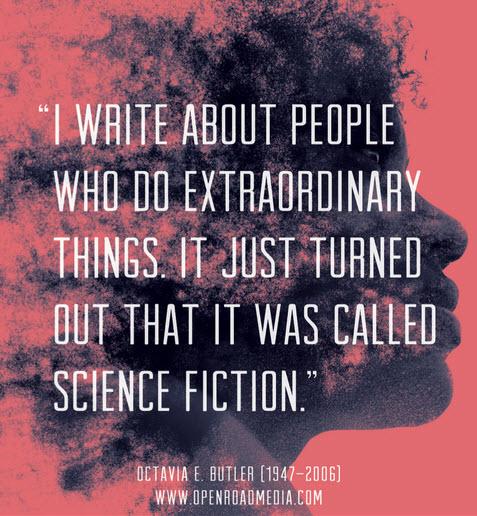
Octavia Butler Quote Continue reading “In Defense of Speculative Fiction”

Why I’m Fascinated by Ancient History

How History and Speculative Fiction Intersect

I’m fascinated by ancient history—the archaic and classical Mediterranean, ancient Egypt, Sumeria and Mesopotamia. Mostly, though, I love studying paleoanthropology and archaeology—the Paleo- and Neolithic periods, the evolution of human kind and our spread across the face of the planet.

Recent history doesn’t particularly interest me. I understand the proximal importance of the Modern Era, the World Wars, the Cold War, etc., to the present day but it doesn’t capture my imagination. I look at the world during that time and I see something very much like the world I was born into. It’s too familiar to be fascinating.

I’m fascinated by ancient and prehistory because these eras are so vastly different from the world I live in. In a review I wrote of Madeline Miller’s novel, The Song of Achilles, I refer to the “alien-ness of Bronze Age Greece”. I read articles like this one about Kennewick Man and it’s shocking to realize just how little prehistoric life resembles my own. How vastly different it was than anything I’ve ever known.

Continue reading “Why I’m Fascinated by Ancient History”

The Potential of Ebooks, Part 2: Another Modest Proposal

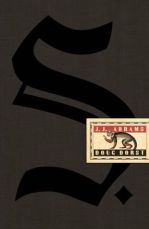
S.
S. by Doug Dorst & J.J. Abrams
I keep thinking about the novel S. and how Doug Dorst and J.J. Abrams intended it to be a celebration of the printed book—they created an experience calibrated to take advantage of aspects that are unique to printed material.

It has me wondering—how do you create a story that equally celebrates ebooks and takes full advantage of the aspects that are unique to electronic formats?

Part of the challenge with such a goal is that we haven’t even come close to developing the full potential of ebooks yet: multimedia integration, burying easter eggs in the pixels, ereader versions of the Konami Code… There’s tremendous opportunity for a level of interactivity that print simply can’t match and we’ve barely scratched the surface.
Continue reading “The Potential of Ebooks, Part 2: Another Modest Proposal”

Website Development as Storytelling

In my last few jobs—non-profit health support organizations in Chicago, the Kansas City Public Library—I developed a reputation as the person who can break your brand new website in ways that you never anticipated.

As we built our award-winning Civil War on the Western Border website here at KCPL; as the non-profit I worked at for my last few years in Chicago went through two different content management systems and completely redid their website—we obviously spent a lot of time testing the new sites and services, making certain of the functionality, running the systems through their paces before launching them to the public.

In the process, I learned that I’m the guy who identifies the most bizarre ways that things break down and fall apart. I search for the most counter-intuitive paths I can take through a site and I see where they lead me.

For example:
Continue reading “Website Development as Storytelling”

The Importance of Deep Reading

I’ve long wondered about the differences between reading in print, reading online, and reading in mobile formats. Science is bearing out my belief that our brains apprehend and process language differently in different mediums.

Technology is changing the way we read, with a much greater emphasis on skimming and speed reading. Apps like Spritz—well-intentioned though they may be—intrinsically promote an idea that reading isn’t worth investing time, a belief that deep reading is flawed because it’s inefficient.

I can’t believe that this is a good thing. So I was very happy to read this article:

Reading Literature Makes Us Smarter and Nicer by Annie Murphy Paul (posted by Time on June 3, 2013)

It’s an excellent summary of the importance of deep reading. Intentional, invested, slow reading.
Continue reading “The Importance of Deep Reading”

SF as Psychological Exploration

I love this article exploring the connections between storytelling and memory:

What Novels Can Tell Us About Memory by Charles Fernyhough (posted on The Huffington Post on January 28, 2014)

We’re storytelling creatures, it’s built into the most essential processes of our consciousness. Storytelling and memory are how we define our identities—biological, individual, social, cultural.

As always, whenever I think about identity and storytelling, I think about why I love SF stories and novels.

I’ve long believed that SF (speculative fiction—scifi, fantasy, horror) offers the best venue for us to explore what it means to be human: biologically, personally, socially, culturally.

SF allows us to create situations as extreme as we can conceive, and then imagine how people might behave, react, adapt to them.

In trying to imagine beings that aren’t human at all—aliens, fantastical creatures, paranormal entities—the contrast throws into stark relief what it means to be human.

Consider how our sense of self must change when we imagine how we might be changed through science or magic: technological enhancements to our bodies; computer enhanced consciousness; bodiless consciousness; transfiguration. How must humanity be defined when we adapt ourselves to multiple worlds? When we transcend corporeality and become patterns of information in a matrix? When we exist across and outside of perceived linear time? When we can transform ourselves into other sorts of creatures?

When we radically alter the most basic elements of our existence, what’s left? What are the irreducible, essential things that make us human? How much can be changed—in ourselves, in our environment—before we stop being human?

How varied can human beings become and still be contained in humankind?

SF is one big thought experiment exploring the breadth and depth, the capacity and essence, the potential of human nature.

It’s said that art holds up a mirror to the world. SF allows us to create mirrors that are unlike anything else.

Theatre, the Arts & Libraries: The Power of Storytelling

One of the things that strikes me most about working in a library is how much overlap there is between libraries and theatre.

In my MLIS program, there were several of us who came from a career in theatrical tech / stage management and were transitioning into librarianship. As I’ve noted before, theatrical technician-to-librarian is a fairly common path.

The professor who taught my Intro to Library Science class (the ever-delightful Dr. Janice Del Negro) once commented that “librarians tend be a little bit off of center”. Theatre people tend to be a lot off of center, so we feel right at home in libraries.

Theatre is about telling stories—librarianship, at heart, is about sharing stories. Both passions are founded on a love of storytelling, a recognition of the irreducible importance of storytelling in society. Even history, science, math… All forms of human communication and the sharing of knowledge are forms of storytelling.

So when I read this article about the nature of arts and theatre, I couldn’t help but think of how it applies libraries, too.

The Truth About the Arts: Art is Activism by Lisa A. Kramer (posted on her blog on August 25, 2013)
Continue reading “Theatre, the Arts & Libraries: The Power of Storytelling”

The True Scope of History, Part II

Homo sapiens is unique on this planet in that we’re the only genus with only one species. It’s not normal to be the only species within a genus! All other animals exist in a world in which there are others very like themselves, but not them.

Humans, by contrast, take it for granted that there are no other species in the world like us.

It didn’t used to be that way, though. We used to share this planet with other people who weren’t us.
Continue reading “The True Scope of History, Part II”