I’ve spent a lot of time and devoted a lot of attention to the development of AI over the past few years, and my thoughts about it can be summed up very simply:
Why are we trying so hard to remove people from the world we’re building for ourselves?
I don’t understand why this is the thing we’ve decided we should want.
Years ago, I read some commentary that said this about social media: “More and more of our social lives are being designed and maintained by deeply antisocial people.”
This is especially true of AI. The people building it all seem to be deeply antisocial, even misanthropic. I could also update this criticism for AI a couple other ways:
In a recent discussion, a group of us were talking through options for using LLMs to make some our work tasks more efficient. I made the comment that I don’t believe efficiency is the correct goal for us to focus on. This statement set some of my colleagues aback. Modern American work culture is so steeped in the ideal of efficiency, it seems tantamount to sacrilege to suggest we shouldn’t value it the way we do.
I want to take some time here to unpack this belief. There are good reasons why I feel this way, but I also need to caution myself against dismissing the very real values that efficiency can bring.
Let’s start with a trite phrase: “Time is money.”
This phrase never sat quite right with me. It feels more correct to say, “Time is value.” On the face of it, these seem like they should be the same statement: money is intended as a measure of value, after all. But something interesting happens when you delve deeper into them.
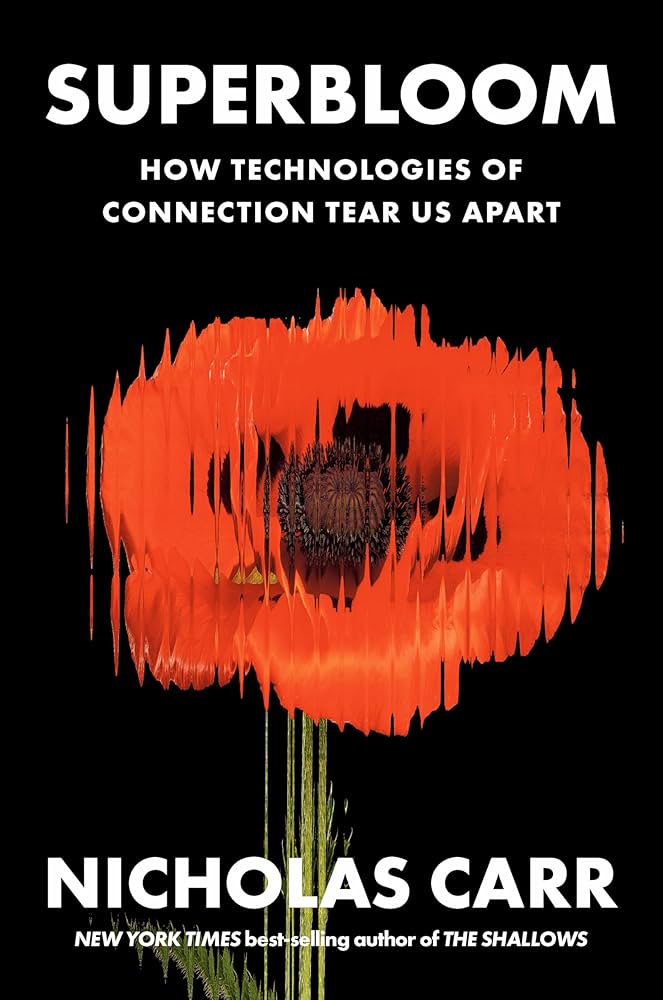
Superbloom: How Technologies of Connection Tear Us Apart by Nicholas Carr Norton, 2025
This review was first published by Booklist on January 1, 2025.
**STARRED REVIEW** Carr (The Shallows, 2010) does a deep dive into the history of social media and examines the damage it’s doing to modern society. Our craze for communications technology began with the invention of the telegraph, when people predicted that our expanded ability to communicate would put an end to wars. This echoes language we hear today from tech moguls who believe social-media platforms will bring about unprecedented freedom and democratic ideals. But it never turns out that way. Carr considers what we know about human communication and psychology and argues that modern social media is ideally suited to increase intolerance, anxiety, and factionalism. Turns out, more communication isn’t automatically better. Quality matters more than quantity; efficiency is anathema to deep understanding. He examines the history of how governments have regulated communication media over the years and the ramifications of deregulating both news media and the internet. We sacrificed accountability to the public good for the sake of innovation and convenience. Far from empowering all people, social media has accelerated the concentration of wealth and power into the hands of only a few. As always, Carr’s perspective is urgent and bracing, a necessary challenge to idealistic visions of a democratic internet.
Supremacy: AI, ChatGPT, and the Race That Will Change the World by Parmy Olson St. Martin’s, 2024
This review was first published by Booklist on September 1, 2024.
**STARRED REVIEW** The current ascendancy of artificial intelligence has been driven mostly by two men: Sam Altman, creator of ChatGPT, and Demis Hassabis, creator of DeepMind. Both idealists, Altman and Hassabis are driven by a conviction that AI can solve society’s deepest problems and make things better for humankind. Both men set out to ensure AI would be developed responsibly and kept out of the hands of profit-driven Big Tech corporations, and both men soon enough sold control of their creations to Microsoft and Google. This is a tale of competitive nature run amok, where the need to be first led to the abandonment of cautious plans in favor of rapid development and poorly planned deployment. It’s a frankly terrifying exposé of the dangers posed by the current, unregulated technology market. Perhaps most importantly, Olson warns against our popular obsession over the existential threat AI poses to humanity at the cost of ignoring real harms AI is already causing: it perpetuates bias and fuels polarization in society and removes human oversight from crucial decisions that affect people’s lives. Olson’s warning is clear; we’re losing control over our own creation. Add this to the growing stack of recent books sounding the alarm about unchecked tech.
The Heart and the Chip: Our Bright Future with Robots by Daniela Rus and Gregory Mone Norton, 2024
This review was first published by Booklist on February 9, 2024.
Rus, Director of the MIT Computer Science and Artificial Intelligence Laboratory, knows more about robots and artificial intelligence than just about anyone. Here she takes readers on a tour of the cutting edge of this technology. She assures us there’s no danger of a robot apocalypse. She and many of her colleagues envision a world where robots and people cooperate to enhance our abilities, where the human heart and the computer chip work together to make the world better for everyone, especially people who are disabled or disadvantaged. Modern robots aren’t clunky metal contraptions as they’re so often portrayed. They can be made from fabrics, plastics, just about anything, in all kinds of shapes and sizes, and can be used in everything from non-invasive surgeries to training athletes to helping the elderly maintain mobility and independence. Robots can help us solve deep-set problems, even aid us in healing the planet. Not a world of robot overlords, but a world full of Iron Man suits made of stylish fabrics instead of steel. It’s a compelling vision.
Unmasking AI: My Mission to Protect What Is Human in a World of Machines by Joy Buolamwini Random, 2023
This review was first published by Booklist on November 1, 2023.
**STARRED REVIEW** Buolamwini fell in love with robotics as a teenager and found a passion for using technology to solve real-world problems when she studied in Africa. At MIT she discovered the burgeoning world of artificial intelligence and, hidden within it, programmatic biases she calls “the coded gaze.” AI encodes the personal assumptions of the individuals who develop it as well as the structural biases of the communities who use it. Trained on datasets that reflect the social inequities of our society, AI too often ends up perpetuating prejudice. As we increasingly rely on AI to handle decision-making responsibilities in everything from hiring and housing to criminal identification and immigration, these baked-in biases have immense power to destroy lives and worsen social inequalities. Buolamwini takes readers step-by-step through an examination of how such biases enter AI in the first place, how they affect people in the real world, and how we can correct them. Woven through her critique of this increasingly important technology is her personal story of discovery and awakening. This is as much a memoir as it is a clarion call for change. Unmasking AI belongs alongside Cathy O’Neil’s Weapons of Math Destruction (2016) and Safiya Umoja Noble’s Algorithms of Oppression (2017) as essential warnings for our time. It’s an important corrective to our unquestioning embrace of technology.
There’s been an inordinate amount of ink spilled online about all the things that are wrong with online culture. Indeed, it’s one of the most popular subjects of online discourse. There are many ways the online culture we’ve created is toxic and amplifies the worst aspects of our nature. There are many factors which cause online toxicity, but the one I tend notice most is how so many people are obsessed with being right. And with making sure everyone knows it.
I keep seeing posts from the subreddit AITA. They show up on Twitter, Buzzfeed, lots of different places. They bother me. They’re emblematic of our need to prove ourselves right. Every AITA post is essentially someone asking for people to tell them they’re right. That doesn’t sound like such a bad thing, really, so why does it bother me?
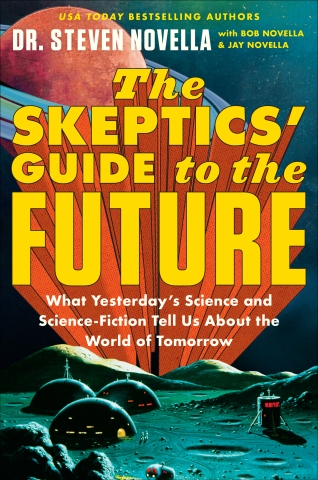
The Skeptics’ Guide to the Future: What Yesterday’s Science and Science Fiction Tell Us About the World of Tomorrow by Steven Novella and others Grand Central, 2022
This review was first published by Booklist on August 5, 2022.
People have a long history of trying to predict the future, especially with the rise of modern science and science fiction. Several futuristic tropes have become common, such as cyborgs, brain-machine interfaces, robots, artificial intelligence, virtual reality, immortality, space exploration and settlement, energy weapons, faster-than-light travel, flying cars, and more. Novella turns his skeptical eye on futurism, assessing whether any of these predictions are possible, from the likely to the probably impossible. He identifies several common fallacies which plague our attempts at futurism, most notably the tendency to overestimate short term advancement while underestimating long term change, and our insistence on picturing people in the future as just like us. Old technology persists for surprisingly long times, and new disruptive technology can radically alter who we are and our relationship to the world. Predicting the future isn’t an exact science, but skeptical scientific inquiry can help assess the likelihood of our various visions for it. A fun overview of both the current state of modern science and a general survey of the history of futurism.
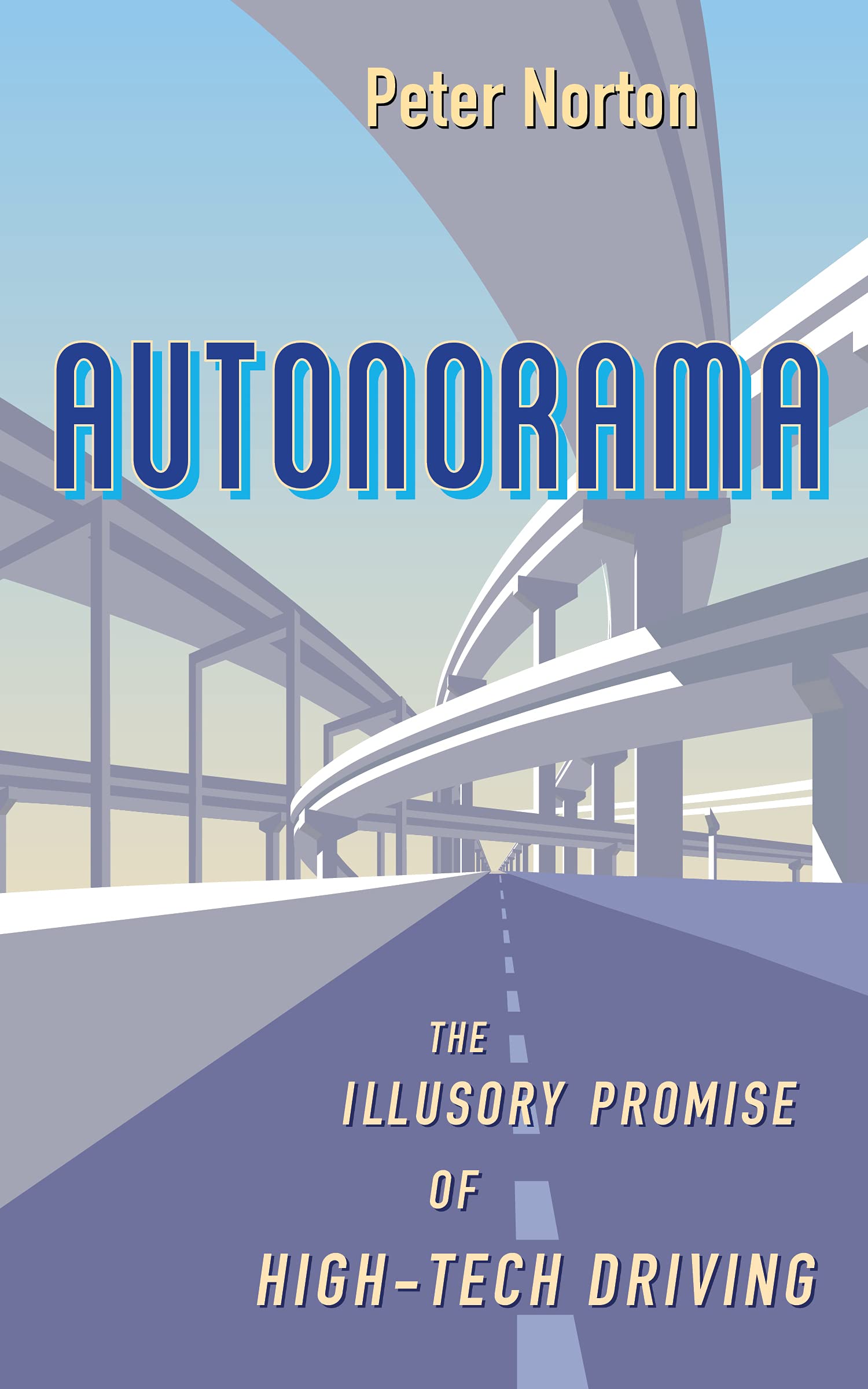
Autonorama: The Illusory Promise of High-Tech Driving by Peter Norton Island, 2021
This review was first published by Booklist on September 1, 2021.
Autonomous vehicles promise to eliminate congestion on our roadways, reduce traffic accidents to near zero, and end greenhouse gas pollution. But as Norton points out, we’ve heard these promises before, many times. Car manufacturers have been proclaiming solutions to traffic problems since the 1930s, always by adding more roads and putting more cars on them. Autonorama is a deep dive into the history of our car dependency and the ways automotive manufacturers have strung along American consumers with promises of “just over the horizon” solutions to the problems cars themselves have caused. Norton argues the goal of car manufacturers has never been to satisfy mobility needs but to promote ever-increasing car dependency: Charles Ketterings’ famous maxim to keep the customer dissatisfied. Autonomous vehicles offer more of the same: empty promises of imminent solutions which can only increase our dependence on cars. Car dependency itself is the problem and cars can’t solve that. This is a bracing challenge to the dogma of autonomous vehicle enthusiasts and a clarion call for more varied and humane mobility solutions.
A Brief History of Motion: From the Wheel, to the Car, to What Comes Next by Tom Standage Bloomsbury, 2021
This review was first published by Booklist on July 30, 2021.
Traffic jams. Accidents. Pollution. Safety concerns. This was the situation faced by cities at the end of the nineteenth century, with a glut of horse-drawn vehicles clogging streets and dirtying roads. The car was supposed to solve all that. Instead, automobiles came with their own problems: congestion, deadlier accidents, climate impacts, and the worsening of economic and cultural divides. Standage believes a look back at the history of wheeled vehicles and their impacts is useful to guide us toward the future. Cars fundamentally altered the landscape of the modern world, driving the redesign of urban areas and fueling the rise of suburbia. The popularity of cars had ramifications even beyond urban planning and traffic: factory mechanization, planned obsolescence, and the creation of teenage culture were all affected. He offers a balanced overview of new options being explored: autonomous vehicles, ride-share apps, vehicle sharing, and integrated transit systems. All offer potential benefits, and all come with risks. Any new technology will have consequences we don’t foresee. This is a well-researched exploration of an urgent subject.




 John the Librarian