Book Review: Modern Monopolies: How Online Platforms Rule the World by Controlling the Means of Connection by Alex Moazed and Nicholas L. Johnson

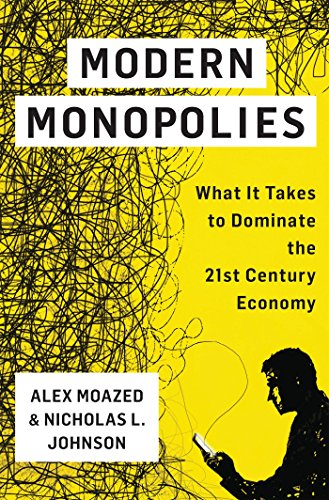
Cover of the book Modern Monopolies: How Online Platforms Rule the World by Controlling the Means of Connection by Alex Moazed and Nicholas L. Johnson
Modern Monopolies: How Online Platforms Rule the World by Controlling the Means of Connection
by Alex Moazed and Nicholas L. Johnson
St. Martin’s, 2016

This review was first published by Booklist on May 18, 2016.

When we think about companies like Facebook, Google, Apple, Amazon, YouTube, and Uber, we tend to focus on the technology they innovate and how they’re changing our daily lives. But these platform businesses are some of the largest in the world today, commanding huge swaths of the modern economy. They’ve attained a scale long considered impossible by more traditional business models. Modern Monopolies analyzes platform businesses from the perspective of economics. Platform companies haven’t just beaten more traditional businesses; they’ve changed the nature of business itself, created whole new markets, and redefined what constitutes value. The authors analyze the path to success for platform companies and explore several ways that these businesses can fail. They display a strong grasp of the theoretical principles at play here but also evince a down-to-earth, nuanced, and critical view of how these companies function. Of particular importance, they suggest a fundamental reanalysis of the assumed value of “network effects.” This book is satisfying and timely, a valuable contribution to our understanding of modern business.

Book Review: The Science of Growth: How Facebook Beat Friendster—and How Nine Other Startups Left the Rest in the Dust by Sean Ammirati

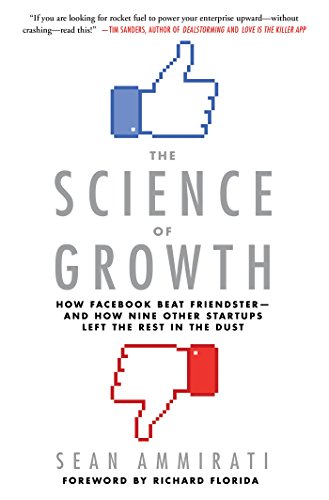
Cover of the book The Science of Growth: How Facebook Beat Friendster--and How Nine Other Startups Left the Rest in the Dust by Sean Ammirati
The Science of Growth: How Facebook Beat Friendster—and How Nine Other Startups Left the Rest in the Dust
by Sean Ammirati
St. Martin’s, 2016

This review was first published by Booklist on April 1, 2016.

So you’ve started a business, now what? Ammirati seeks to answer this question in this sequel of sorts to the standard texts on the science of startups. In response, Ammirati offers a science of growth—a guide on how to scale your business once it’s successfully established. Why did Facebook beat Friendster? How did Tesla outdo Fisker? Why does McDonald’s boast over 35,000 locations worldwide, when White Castle has fewer than 500? Ammirati examines 26 well-known companies to discover what separates the success stories from the failures. He draws examples from diverse industries and isolates several variables: prerequisites for growth, catalysts for growth, and foundational elements to sustain it. An authority in the field of the startup economy, Ammirati teaches the subject at Carnegie Mellon and heads of the country’s most successful startup incubators, and it shows in the way his book is thoroughly researched. It’s also accessible, easy to read, and eye-opening. This is a necessary and welcome addition to the business canon.

Internet Access as Public, Social & Cultural Space

In his book, Part of Our Lives: A People’s History of the American Public Library, Dr. Wayne Wiegand groups library services into three major categories:

  • Information access
  • Reading materials
  • Public space

These categories clarify a nagging issue I have with the language we use to talk about the importance of internet access in libraries. The following quote from a recent article by Larra Clark is a good example:

Continue reading “Internet Access as Public, Social & Cultural Space”

Bridging the Digital Divide: A Matter of Equality

I spoke to a gentleman recently about the efforts of public libraries to bridge the Digital Divide, both in terms of offering broadband internet access to those who otherwise don’t have it, and teaching digital and information literacy to those who need it.

This gentleman told me that he thinks the internet is useless. He’s been online, tried the social media thing, wandered around the web, and he sees no value in any of it. He concluded that it’s all just a flood of unreliable, unverified information, and people being mean and wasting time. He believes that we’d all be better off without it.

He told me that he can’t understand why we work so hard to provide access to something that people don’t need and shouldn’t be using in the first place. I don’t believe this man was intentionally exclusionary or prejudiced—he sincerely couldn’t understand why anyone would value something which, to him, is so obviously value-less.

Rather than argue with this gentleman’s opinions regarding the supposed value of the internet, I responded:

Continue reading “Bridging the Digital Divide: A Matter of Equality”

Are We Really Living in a Golden Age of Information?

Information professionals like to crow that we’re living in a Golden Age of Information. More information is available to more people than ever before in history, and it’s easier to access than ever.

The standard response is to point out that there’s more bad information than ever before. A whole lot of the information currently circulating around out there isn’t reliable.

This is true. But it’s also true that there’s more good information available to us than ever before, too. Just as bad information has increased, good information has increased alongside. I believe this firmly and I’ll stand by this statement.

But I’m not sure if the increase in good information is keeping pace with the increase in bad. It may be the proportion of good-to-bad has become more unbalanced. It may be that good information is being increasingly overwhelmed by the bad.

Continue reading “Are We Really Living in a Golden Age of Information?”

Once Again, Print Proves Its Worth

Perhaps it’s ironic, but the more time I spend as a digital librarian, learning and exploring new technology, finding new and better ways to provide technology to our patrons, the more I find myself passionately advocating for the importance of print and the necessity of its continued presence in our reading culture.

Once again, print proves its worth:

Reading Books Instead of Kindles Can Improve Your Memory, Concentration and Good Looks by Jon Levine (posted on Arts.Mic on August 20, 2015)

Nothing in this article surprises me (although I get frustrated every time someone implies that ebooks aren’t books). It all pretty well stands to reason:

Continue reading “Once Again, Print Proves Its Worth”

Print Books vs. Digital Books & the Reading Brain

For a variety of reasons, for the past few days I’ve been thinking even more than I usually do about the differences between print books and digital books, and how our brain processes them. There are differences in how we read in different media, and it’s important for us to understand them. If our brain interacts with different formats differently, it means that different formats will best serve different purposes.

It’s our job as librarians to fulfill our patrons’ information needs as best we can. Selecting the best format for the information is increasingly important.

This is my latest attempt to summarize my understanding of how and why print and digital differ.

Continue reading “Print Books vs. Digital Books & the Reading Brain”

Book Review: Information Doesn’t Want to Be Free: Laws for the Internet Age by Cory Doctorow

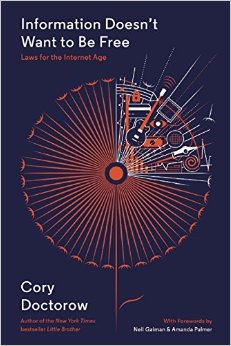
Information Doesn't Want to Be Free - book cover
Information Doesn’t Want to Be Free: Laws for the Internet Age by Cory Doctorow
McSweeney’s Books, 2014
Information Doesn’t Want to Be Free by Cory Doctorow is, as one would expect, an incisive and lively exploration of the issues surrounding copyright and enforcement in the Internet Age.

Dr. Doctorow is established as an outspoken critic of the various methods that media corporations use to try and enforce their interpretation of copyright laws on the Internet: digital locks, DRM efforts, automated “Notice and Takedown” practices, etc. He takes on each of these methods and explains clearly what they’re intended to accomplish, why they fail, and the damage they do to creative workers and Internet users in general.

Some of these methods involve pretty esoteric computer science and Dr. Doctorow is the best in the business at translating the argot of technology into terms anyone can understand. Continue reading “Book Review: Information Doesn’t Want to Be Free: Laws for the Internet Age by Cory Doctorow”

The Rewards of Reading in Print

David Ulin is spot-on in his analysis of the differences between reading in print and e-reading:

Reading in the material world by David Ulin (posted by the Los Angeles Times on February 24, 2015)

This quote, in particular, resonates with me:

[O]n a device such as an iPad or an iPhone, we never lose sight of ourselves—they are customized environments, extensions of our psyches—whereas the print book exists in a different realm. It requires an externalized commitment, an accommodation, in which its otherness is part of the point.

Ebooks and print books will always offer different experiences and serve different purposes. Our cultural obsession with seeing them in competition with each other is incorrect and, I believe, does all readers a disservice.

Serendipitous Discovery: A Critical Perspective

Given my passion for serendipitous discovery in libraries, I was delighted to read this paper by Patrick L. Carr:

Serendipity in the Stacks: Libraries, Information Architecture, and the Problems of Accidental Discovery (PDF)

It had never occurred to me to consider serendipitous discovery from this angle before. Serendipity can be construed as a failure of a user-centered information environment to properly meet the needs of a user. Perhaps serendipitous discovery isn’t a benefit so much as it’s a compensation mechanism for the failures of our search systems.

This suggests interesting avenues for inquiry and development. I think it’s a beneficial perspective. Serendipity isn’t all good and librarians should approach it strategically.

I’m particularly struck by this passage on page 18:

Continue reading “Serendipitous Discovery: A Critical Perspective”