Library Services – or, What Makes A Library Valuable?

An Attempt to Bring Together a Variety of Recent Issues

I know the hoopla about Terry Deary is old news already, but I keep thinking about it, circling back around to it.

Despite my powerful and vociferous reaction to his statements about the value of public libraries, there’s something about this situation that still isn’t resolved in my mind. And I think I know what it is.

Terry Deary is absolutely, 100% wrong about the “concept behind libraries”. Which begs an essential question:

How did a well-educated, literate man come to view public libraries so wrongly in the first place?
Continue reading “Library Services – or, What Makes A Library Valuable?”

Ebook Lending for Kindles & Patron Privacy

Back in November, I wrote about some serious concerns I have regarding library-based social sharing platforms and patron privacy. More recently, I find myself harboring similar concerns about ebook lending for Kindles.

I’ve never actually checked out an ebook from my library. So the other week, when I was asked to help a patron check out an ebook for her Kindle, I was taken aback when we reached the step where she was required to sign in to Amazon using her personal Amazon ID. This step raises an important question:

What happens to the record of this transaction in Amazon’s database?
Continue reading “Ebook Lending for Kindles & Patron Privacy”

Data Handling in Electronic Systems – Inspiration for a Paradigm Reassessment

At my library, we’re currently working on a project in conjunction with several other regional knowledge institutions to put online our full collection of historical documents regarding the Civil War in Missouri and Kansas. One piece of functionality we’re creating is a way to visually represent the relationships between people, places, and things within this pool of data. These visualizations are based on a relationship database that we constructed, using a basic semantic structure: “Object A [relationship] Object B” and we can verify this relationship with “Document X”. Thus, for example:

Iskabibble Jones is married to Bridgette Jones and we know this because of information contained in Bridgette’s letter dated …

Only, instead of statements, we represent this all graphically with links to images and documents. It’s a pretty nifty function!

The way we’re building the database for this relationship visualization tool is representative of how online data gets handled in general. It illustrates the fundamental paradigm that has governed computer development from the beginning – and, indeed, the development of mechanized data handling even before the advent of computers.
Continue reading “Data Handling in Electronic Systems – Inspiration for a Paradigm Reassessment”

On Robotic Libraries and Serendipity

The James B. Hunt Jr. Library
The James B. Hunt Jr. Library at NC State University

I just saw this article online today:

Let’s Hope Snøhetta’s New Robotic Library At NC State Isn’t Run By An Evil Super Computer

I think this library is absolutely gorgeous! I really like how peaceful and bright and comfortable it looks inside.

I find this type of robotic technology fascinating. We know that it works – the Joe and Rika Mansueto Library at the University of Chicago is testament enough to that. Space and storage have been perpetual challenges for libraries for a long, long time. This represents an elegant and cost-effective solution. As one who has long been interested in archival work, I’m excited by the potential this technology has for that field, as well.
Continue reading “On Robotic Libraries and Serendipity”

The Joy of Saying Yes

Last week, I switched into a new job here at the Kansas City Public LibraryDigital User Specialist. As we expand our library services through new technological portals, it’s my responsibility to ensure that these new services and interfaces answer to the needs of our patrons, and that they’re actually usable. I’ll be doing usability testing, creating personas, collecting user feedback, lots of wire-framing. But mostly, I’ll be the one constantly asking the questions:

  • “Does this actually work for our patrons?”
  • “Will this allow us to provide more and better services?”
  • “Is this something our patrons need?”

Moreover, I’ll be the one encouraging all my library co-workers to ask these questions, as well.
Continue reading “The Joy of Saying Yes”

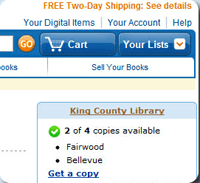
Search Amazon – Go to Your Library

Amazon's Library ExtensionI think this is wonderful! I can’t wait until this extension is available for all browsers…

Browser Extension Encourages Amazon Searchers to Head to Their Library by Matt Ennis (published online by Library Journal on Jan. 2, 2013)

It reminds me of an idea I had when I was in grad school for a location-based mobile app that would integrate nearby library holdings and databases with online search results – so that whatever you’re searching for, you’d see what’s online side-by-side with the resources are close by in the nearest library.

‘Tis the Season for Mobile Technology!

According to many sources, this Christmas was a big one for mobile technology! Ebook and app downloads hit record highs! Ebook readership continues to grow while print readership declines!

It’s an exciting time to be a digital librarian!

Wandering through the library these past couple of weeks, with new technology the talk of the season, I overheard several comments that went something like this:
Continue reading “‘Tis the Season for Mobile Technology!”

The Right War Over Ebooks

Last week, this article was tearing through the rounds of the library community:

The Wrong War Over eBooks: Publishers Vs. Libraries by David Vinjamuri

This is an important read. It raises some really good points, challenges some often unquestioned perspectives, and his proposed “pay-per-circ” model appears to have some real potential.

Still, though, I can’t get behind him on this issue. I feel that he misses the whole point. Continue reading “The Right War Over Ebooks”