Book Review: Apocalypse Nyx by Kameron Hurley

Cover of the book Apocalypse Nyx by Kameron Hurley
Apocalypse Nyx
by Kameron Hurley
Tachyon, 2018

This review was first published by Booklist on July 5, 2018.

Hurley’s collection revisits the world of the Bel Dame Apocrypha (beginning with God’s War, 2011) with five stories featuring intergalactic bounty hunter Nyxnissa so Dasheem (aka Nyx) and her crew on some of their dangerous jobs. The plots are taut, thrilling, gritty, violent, profane, magical—everything Hurley’s readers expect. New readers will not feel lost in this world—Hurley has created one of the most engrossing environments in modern sf—but fans will delight in learning how Nix meets Khos and the first time she hires Anneke. Though there is not much personal growth, all of the characters are well realized, even in the short story format, and each story covers familiar interpersonal conflicts and emotional highs and lows. These stories were previously published online, but fans of sf adventure stories with lots of political intrigue will welcome them in print.
The Problem of Neutrality

I’ve written before about my misgivings regarding the ideal of neutrality in public libraries. I recently read an excellent post by Dr. Donna Lanclos titled, “Maybe We Shouldn’t Talk About Diversity Anymore.” There’s a quote in this piece which echoes the argument I’ve made about why neutrality is a problematic concept:

What about notions of ‘neutrality’ and ‘nice’ that talk about the importance of ‘all voices’ when we really should be protecting voices that historically have no platform. Let’s end false equivalencies, and recognize that people who have traditionally had power and influence (especially white men) don’t ever really lose their opportunity to participate just because we make sure that people and especially women of color get to take up space and have their say.”

(http://www.donnalanclos.com/maybe-we-shouldnt-talk-about-diversity-anymore/, posted June 30, 2018)

I want to explain a bit more about why neutrality makes me uncomfortable.

Continue reading “The Problem of Neutrality”

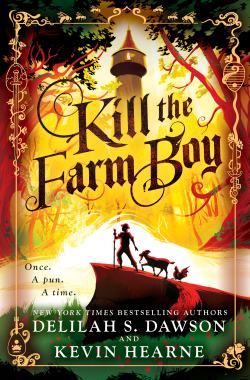
Book Review: Kill the Farm Boy by Delilah S. Dawson and Kevin Hearne

Kill the Farm Boy by Delilah S. Dawson and Kevin Hearne
Kill the Farm Boy
by Delilah S. Dawson and Kevin Hearne
Del Ray, 2018

Kill the Farm Boy is a delight. It’s funny, unexpected, clever. It’s a quick read without sacrificing any substance. The characters are wonderful—interesting, infuriating, and sympathetic by turns—the world is well-rendered and the plot well-paced.

Did I mention it’s funny? Like, really funny. I have high hopes for the series this book sets up.

Fair warning: you better love puns.

I read an advance reader copy of the novel and it came with a summary of the planned marketing and promotional strategy. The marketing for this book emphasizes a comparison with the work of Terry Pratchett. This offers a good way to explore what Kill the Farm Boy is really about.

Continue reading “Book Review: Kill the Farm Boy by Delilah S. Dawson and Kevin Hearne”

How Do You Know When It’s Time?

I’ve long been fascinated by the question: How do you know when it’s time to move on?

For example, my dad spent over 20 years—my entire childhood and into my college years—working at a state university. When he decided to leave, I asked him how he knew it was the right time. There were several factors at play but mostly, he said, it was because he didn’t feel like there was anything new to learn there. Every year, there had been something new to do, something new to learn: a new position, a new committee or task force of some kind, a new challenge. But after 20+ years, he’d gone as far in the organization as he could go. There was nothing new.

I thought about this when I made the decision to leave theater. I’d gone to college with the goal of working professionally in theater in a big city. I did that for over a decade. But I knew when it was time to stop. There were several factors at play—the manual labor of tech work was taking a toll on my body, nonunion freelance work meant I had no health insurance or retirement plan—but mostly it was because I’d reached a point where I needed to take the next step on the career ladder, and move up into technical director and production management roles. But I didn’t want to. In truth, I was a few years past the point when I should have made this transition but those jobs had no appeal for me. In part, it was because TDs and PMs don’t typically run shows, and running shows was what I loved. But if I’m honest… The thought of taking on that much responsibility, the idea of being in charge, filled me with dread.

Continue reading “How Do You Know When It’s Time?”

Onward & Upward

I’ve written three posts over the past few weeks exploring lessons I’ve learned about customer service through a variety of past jobs and experiences, as well as from my more recent years as a public librarian. I’ve spent a lot of time lately looking back over my working life and mining it for all the wisdom I can.

There’s a reason for this retrospection:

On June 11th, I begin a new job. I’m leaving the Kansas City Public Library—today is my last day, actually.

I’ve accepted a position with the Johnson County Library system in Johnson County, Kansas (the Kansas side of the KC metro area). I’ll be the Branch Manager for three of their locations: Gardner, Edgerton, and Spring Hill.

Continue reading “Onward & Upward”

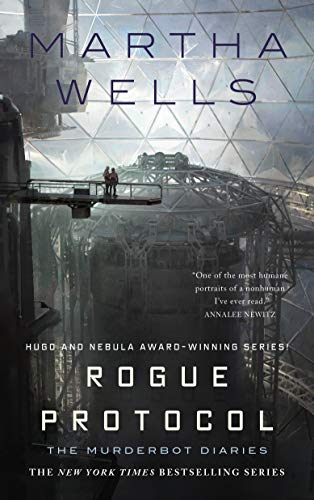
Book Review: Rogue Protocol by Martha Wells

Cover of the book Rogue Protocol by Martha Wells
Rogue Protocol
by Martha Wells
Tor, 2018

This review was first published by Booklist on May 29, 2018.

In Rogue Protocol, the third (after Artificial Condition, 2018) of Wells’ Murderbot Diaries, Murderbot is on a mission to find evidence to bring down the GrayCris Corporation for good. Their journey takes them beyond the Corporate Rim to a derelict terraforming station that hides a secret. Once again, they must protect a human crew, and when their secret identity as a rogue SecUnit is threatened, they have to decide whom they can trust. As always, the story is fast-paced and action-packed, colored by Murderbot’s acerbic commentary throughout. Though the main character remains as appealing as ever, this entry in the series feels less substantial, less happens, the plot and secondary characters are less complex, and there’s more exposition filling the pages. It’s clear the primary purpose of this book is to set the stage for the next one. On its own merits, Rogue Protocol doesn’t quite live up to the first two books in the series, but readers will be thrumming with excitement for what comes next.

I Hate Saying “I’m Sorry”

I’ve done customer service in a lot of different jobs and in every one, a typical exchange goes like this:

Angry Customer: I need you to do [something completely unreasonable]!

Customer Service Rep: I’m sorry but I can’t do that.
*or*
I’m sorry but that’s against policy.

For a long time, every time I heard a customer service rep say, “I’m sorry but…,” I cringed. I hated hearing it. I tried never to say those words. Why?

Because I’m not sorry. Because I haven’t done anything wrong. Because my employer hasn’t done anything wrong. We’re not at fault.

Continue reading “I Hate Saying “I’m Sorry””

Book Review: Arthur C. Clarke by Gary Westfahl

Cover of the book Arthur C. Clarke by Gary Westfahl
Arthur C. Clarke
by Gary Westfahl
Univ. of Illinois, 2018

This review was first published by Booklist on May 22, 2018.

Westfahl (Science Fiction Quotations, 2005) offers a well-considered reevaluation of Arthur C. Clarke’s legacy, tracing broad topics and contradicting some commonly held beliefs. For example, although many separate Clarke’s technical sf from his quasi-mystical imaginings, Westfahl shows it to all be of a piece: near-future technology is relatively comprehensible to modern readers, whereas far-future technology would be so far beyond our comprehension as to appear magical—a logical conclusion. His analysis is most valuable in its scope, ranging beyond Clarke’s major works and considering his myriad stories, his less successful novels, his nonfiction, and even his juvenilia. Where this book fails is in its attempts to grapple with Clarke as a person. Clarke was a deeply private man, and there’s little evidence to consider about his life beyond his published works. Westfahl tries too hard to read too much significance into what little evidence there is. It’s a bit abstruse for anyone unfamiliar with Clarke’s work, and it verges on hagiography at times. Still, a worthy analysis of an important sf writer.

My Customer Service Philosophy: Lessons from a Ten Year Old

I was asked recently what my customer service philosophy is. I responded with this:

The customer isn’t always right but they’re usually not wrong.

What do I mean by that?

I mean that some behavior is simply unacceptable. Customers don’t have the right to abuse staff, to expect preferential treatment, to demand we make exceptions just for them. Basic human decency and respect are still required. I won’t tolerate threats to the safety of staff members.

However, in my experience, when someone is acting out there’s usually a reason for it. There’s usually a need or a want that isn’t being met—and that need or want is usually legitimate. Problematic behavior arises when someone can’t figure out how to get what they need or want. And while the behavior may be a problem, this underlying reason can be productively addressed.

A ten year old boy taught me this lesson.

Continue reading “My Customer Service Philosophy: Lessons from a Ten Year Old”

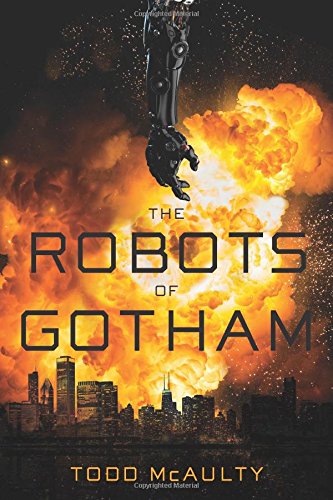
Book Review: The Robots of Gotham by Todd McAulty

Cover of the book The Robots of Gotham by Todd McAulty
The Robots of Gotham
by Todd McAulty
HMH/John Joseph Adams, 2018

This review was first published by Booklist on May 15, 2018.

**STARRED REVIEW** Machine intelligences rule most of the world, human governments are rapidly losing their power, a war-ravaged U.S. is on the brink of descending into chaos, and a mysterious new plague is on the loose. In Chicago, one man finds himself at the nexus of a complex web of secrets that threatens to upend the world as we know it. This debut novel beautifully combines a postapocalyptic man-versus-machine conflict and a medical thriller. The world is immersive and detailed, the characters have depth, the writing is assured, the plotting intelligent, and the pacing about perfect. McAulty’s take on how AI might evolve gives the premise a unique twist. The story is action-packed, starting with a boom (literally) and driving you along from one crisis to the next. The action rarely lets up, yet it never becomes tiresome. The exposition gets a bit heavy-handed at times, but not enough to slow things down. There are intriguing details of this world that McAulty teases but never fully reveals, and that builds anticipation for his next books. This is thrilling, epic sf.