I Hate Poet Voice

We all know what “Poet Voice” is, right? A poet reads their work aloud and they take on a vocal style that’s flat, slow, monotonous, weighted down with cringing self-conscious significance.

I harbor an intense dislike of Poet Voice. I’m happy to see rigorous analysis backs me up on this.

An Algorithmic Investigation of the Highfalutin ‘Poet Voice’ by Cara Giaimo, posted on Atlas Obscura, May 1, 2018

Still, it bothers me when people critique Poet Voice primarily by comparing it to regular conversational voice. Poetry shouldn’t be treated like normal speech—it’s an elevated use of language and recitation should reflect that. Poetic recitation should be more performative, more crafted, distinct from casual conversation. Each word of a poem is significant and must be heard and understood.

The problem isn’t that Poet Voice is unnatural or different from conversational voice. The problem is that Poet Voice is boring.

Continue reading “I Hate Poet Voice”

Experience & Context

Some years ago, when I was still doing theater work in Chicago, I had gotten off a job late one night and found myself craving a pint of ice cream. So I stopped by a corner market on my way home. Another gentleman—a complete stranger to me—arrived at the same time I did. We approached the door just in time to see the proprietor throw the lock and change the sign to “Closed”. He shrugged at us, pointed to the sign listing the store’s hours, and walked off.

I was disappointed and somewhat miffed. The other guy proceeded to throw a spectacular tantrum.

I stood there nonplussed, unsure what to do. Once this strange man had stopped yelling and stomping around, I asked him, “Are you OK?” (Inane question, I know—clearly he wasn’t—but it was late and I was tired and hungry.)

He proceeded to tell me a Tale of Woe for the Ages. All about his terrible, horrible, no good, very bad day, very bad week, very bad month. Everything that could go wrong in this guy’s life had gone wrong. All he wanted now was some potato chips—crunchy bites of salty comfort. Is that too much to ask?

So I took him to a local bar and bought him a beer.

He apologized for making such a scene. He knew it was a ridiculous overreaction. I assured him I totally understood. And I did understand: for me, having the door locked in my face was annoying. For him, it was ONE MORE THING in a long line of crappy things that had happened to him lately.

For him, it was the one thing too many.

This experience taught me something important:

Context matters.

Continue reading “Experience & Context”

Book Review: Artificial Condition by Martha Wells

Cover of the book Artificial Condition by Martha Wells
Artificial Condition
by Martha Wells
Tor, 2018

This review was first published by Booklist on April 15, 2018.

Everyone’s favorite Murderbot is back. The second installment in Wells’ Murderbot Diaries picks up where All Systems Red (2017) left off, with the series’ titular character seeking answers to its origin by traveling back to where it first went rogue to learn what really happened. Along the way, it makes friends with an intelligent research transport ship and agrees to protect a group of naive researchers whose discoveries make them a target for murder. Murderbot is one of the most delightful characters in current science fiction: a killing machine who chooses to be a good person, a robot who suffers from crippling social anxiety, a sarcastic misanthrope who really just wants to be left alone to watch TV. The relationship between Murderbot and ART (the intelligent ship) adds an entertaining The Odd Couple element to the story. Like the first book, this one is a fast, fun, exciting read, and the series keeps getting funnier. Perfect entertainment for a quiet evening. Although Artificial Condition can be read as a stand-alone, readers will prefer reading the series in order.

Book Review: The Song of Achilles by Madeline Miller

The Song of Achilles by Madeline Miller
The Song of Achilles
by Madeline Miller
Ecco, 2012

This review was originally posted on my Goodreads account in early February 2013. I’m reposting it here, given that I refer to it not infrequently.

I was astounded by this book. Madeline Miller’s achievement cannot be overstated. Here’s a novel that’s absorbingly readable for a modern audience, but that still has the poetry of Homeric sagas. What’s most impressive to me is the balance she finds between exploring the universality of human nature throughout the ages and maintaining the innate alien-ness that I experience every time I read The Iliad—the culture of archaic Greece was so very different from this world we live in today. She lets the truth of that age live and breathe without trying to tame or update it.

And yet, I recognize myself in this story.

Continue reading “Book Review: The Song of Achilles by Madeline Miller”

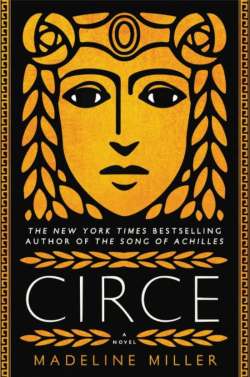
Book Review Circe by Madeline Miller

Circe by Madeline Miller
Circe
by Madeline Miller
Little, Brown and Company, 2018

I have a difficult time imagining how any book will be able to unseat Madeline Miller’s Circe as my favorite book of the year. It’s lyrical and poetic, intimate and grand in scope, human and godly, challenging and comforting. It’s wise. It’s profound.

It fulfills all the hopes I had for Ms. Miller’s work after her astounding first novel.

Where The Song of Achilles is her reinterpretation of The Iliad, Circe is a looser, more oblique riff on The Odyssey. Told from the first person perspective of the titular character, the work spans centuries and is filled with famous characters from throughout ancient Greek lore: Titans and Olympian gods, Scylla, King Minos and the Minotaur, Daedalus, Jason and Medea, and, of course, Odysseus, Penelope, and Telemachus all make appearances. It begins with Prometheus stealing fire and ends with the aftermath of Odysseus’ death. The largest part is taken up with Circe’s relationship with Odysseus and what happens after.

Continue reading “Book Review Circe by Madeline Miller”

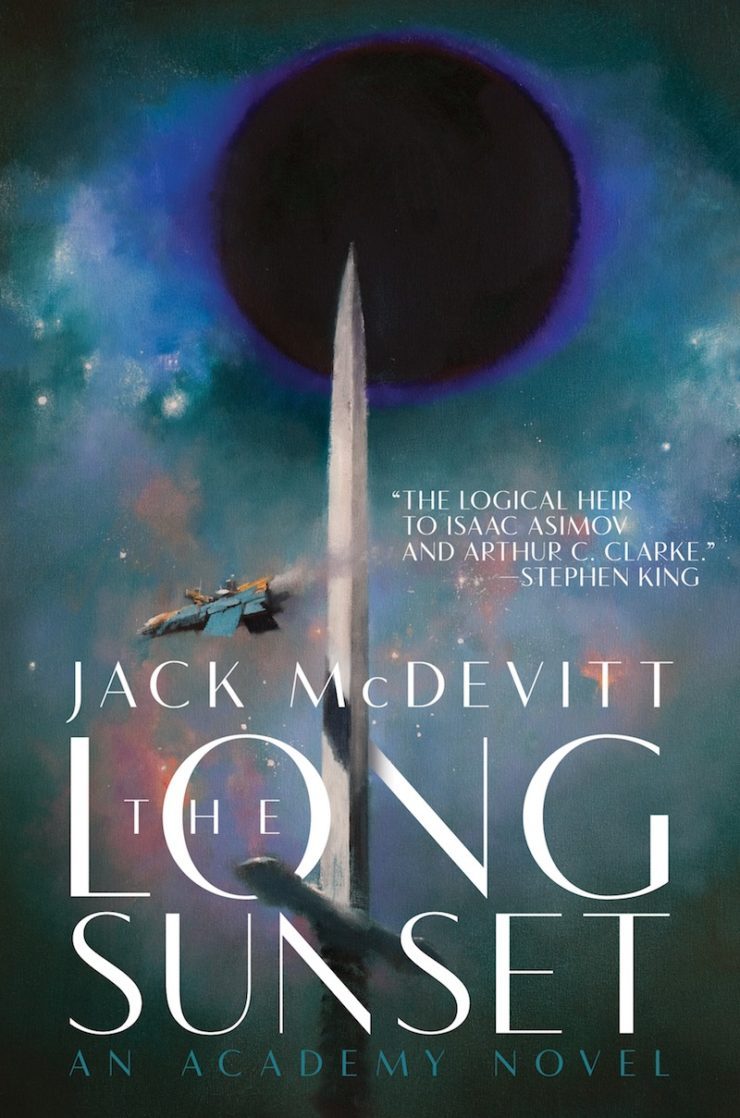
Book Review: The Long Sunset by Jack McDevitt

Cover of the book The Long Sunset by Jack McDevitt
The Long Sunset
by Jack McDevitt
Saga, 2018

This review was first published by Booklist on March 15, 2018.

Priscilla Hutchins is the captain of an interstellar crew sent to explore the origin of a mysterious signal from another planet. But there’s resistance to the mission, as many believe continued interstellar exploration has become too dangerous. Hutch takes off despite opposition and embarks upon a journey that will lead her to discover new artifacts, alien life, and a looming celestial apocalypse. But this isn’t an adventure story; it’s a story focused mostly on people and how we relate to one another. McDevitt (Time Travelers Never Die, 2009) offers a unique take on aliens and how civilizations might arise on other planets, an unexpected and interesting choice in the realm of space-based science fiction. The active conflict of the story is political; unfortunately, McDevitt doesn’t delve as deeply into this aspect of the story as he could. But his unique vision, the way his imagination plays across a galactic stage, and the inherent tension of an unavoidable disaster make up for it. He also introduces important new elements into his ongoing Academy series, making this a worthy read.

Some Thoughts on Libraries & Neutrality

At the 2018 Midwinter Conference of the American Library Association, the President’s Program was a panel discussion titled, “Are Libraries Neutral? Have They Ever Been? Should They Be?” There were debaters and commentators assigned to represent both sides of the argument. This debate inspired a vigorous parallel discussion among librarians and library professionals on Twitter.

I approach the issue of library neutrality from two different directions: ideology and pragmatism. Let’s start with ideology.

When we talk about neutral library spaces and services, we talk about being a place where everyone is welcome, where all views are represented, where everyone has the freedom to make their voices heard and have their needs met. As James LaRue stated for the pro side of the debate: “Everyone gets a seat at the table.”

I passionately agree with Mr. LaRue on this point: libraries should be spaces where everyone gets a seat at the table.

But these words don’t describe neutrality—they describe equality. They envision a space where everyone is equal in access, representation, voice.

The world we all live and serve in is not equal.

Continue reading “Some Thoughts on Libraries & Neutrality”

Book Review: Phoresis by Greg Egan

Cover of the book Phoresis by Greg Egan
Phoresis
by Greg Egan
Subterranean, 2018

This review was first published by Booklist on March 1, 2018.

**STARRED REVIEW** Tvíbura and Tvíburi: twin planets locked in close orbit. Tvíbura is inhabited, Tvíburi isn’t. When an environmental crisis threatens to render life unsustainable on Tvíbura, the people there undertake a generations-long project to build a bridge to reach their twin planet and save themselves. Phoresis is an elegant, spare, evocative jewel of a novella told in three parts. We see the genesis of the project, its fruition, and the eventual outcome. The title (which means transmission) is both a literal description of the main action of the story and almost poetic in its sound. It’s an appropriate encapsulation of this book. Egan (Incandescence, 2008) offers a master class in world building—he starts with a strong, science-based idea and envisions a unique people with a vibrant culture that inhabit a complex world. It all works together to create an immensely satisfying experience. He recognizes this is a story worth telling but doesn’t try to force it to be a full novel. He tells us everything necessary with nothing extraneous; there’s tremendous depth in his brevity. In a genre dominated by series and lengthy tomes, Phoresis is a refreshing reminder that compelling stories come in all lengths.

2017: My Year in Reading

All of the data that follows was collected by me throughout the year using a combination of Google Sheets and Google Calendar. All seasonal and monthly calculations are based on the date each title was begun. Average days to read titles are based on the number of days actually spent reading each title, and not necessarily the full span from begun date to completed date.

A complete list of all the books I read in 2017 is at the bottom of this post


First things first: I’m a hypocrite.

In 2016, I wrote a post about the importance of reading more widely in genres I don’t normally read. I even posted lists of titles and swore to spend some amount of time in 2017 reading them.

I didn’t. I didn’t read any of them.

Continue reading “2017: My Year in Reading”

Book Review: The Long Sunset by Jack McDevitt

The Long Sunset by Jack McDevitt
The Long Sunset
by Jack McDevitt
Saga Press, 2018

The Academy has been shuttered and Priscilla Hutchins (Hutch) is adjusting to life on Earth. Humanity has become fearful of continued space exploration—there’s a growing paranoia that someday such expeditions will bring back something too dangerous. The President herself is campaigning for reelection on a platform of ending the space program.

When an astronomer discovers a signal from deep space which clearly indicates the presence of an intelligent, technologically sophisticated alien civilization, he recruits a team to seek out these aliens and Hutch is put in command. But people don’t want them to go and the team must race to take off before the government can shut them down.

Continue reading “Book Review: The Long Sunset by Jack McDevitt”