I won’t be participating in NaPoWriMo this year. I waffled for the past couple of months as to whether or not I should. To explain why I’m not, I need to tell you about a recent revelation I had about myself:
I finally realized that I’m not actually a creative person. More importantly—I’m happy with that. I’m tired of feeling like I’m supposed to be creative when I’m clearly not.
To explain this revelation, I need to tell you a story about LEGO…
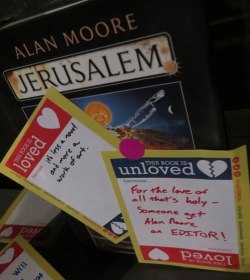
I’ve had conversations now with a few other people about this book and discovered that I’m in a minority in my opinion. Most people I know couldn’t stand it. Most didn’t finish it. Mostly, they found it too long, too wordy, too self-indulgent. The general reaction is that Moore desperately needed an editor to reel him in.
I get that. On some level, I feel this way, too. I spent quite a lot of the book convinced that he was over-indulgent and lacking writerly discipline.
However, as others have stated (and I quote Library Journal here), Jerusalem is “[m]ore a work of art than a novel.”
I recently heard a story about a guy sitting in a public place, clearly wearing a wedding ring and clearly scrolling through a dating app. What’s disturbing wasn’t just the fact that he was cheating on his partner, but that he was doing it so obviously, right out in the open where anyone could see.
What a bastard.
It’s times like this when I’m reminded most powerfully of David Foster Wallace’s “This Is Water” speech (*). He challenges us to try and do better when we make assumptions, to think better. We have a choice whether to assume or not, and if we choose to make assumptions, we get to choose what we assume.
This is a story that hits much closer to home for me, as it happened to a friend of mine. But her story has done as much as anything to affect how I understand poverty, how I understand the role of government assistance, of social safety nets.
And it has done as much as anything to teach me the dangers of making assumptions.
I have a friend who experienced difficult times during the recession of the Bush Years. She and her husband are both capable and hard workers, college educated. He worked in a skilled labor field and she did general office work. They did fine for themselves.
Then he was involved in an accident and was severely injured. He’s disabled for the rest of his life. As a result, he could no longer work in his chosen field. He lost his job, lost his health insurance. And we all know COBRA is prohibitively expensive.
Poverty is something I think about frequently. Working in an urban public library system, many of our patrons are poor. The community we serve has significant neighborhoods of poverty. It’s our responsibility to understand what our patrons need, what life is really like for them.
This is an issue that’s always on my mind but it seems particularly important to speak out about it now.
There’s a group of kids—teens and tweens—who hang out at a local library. Sometimes they hang out at the McDonald’s down the street. These kids clearly live in poverty.
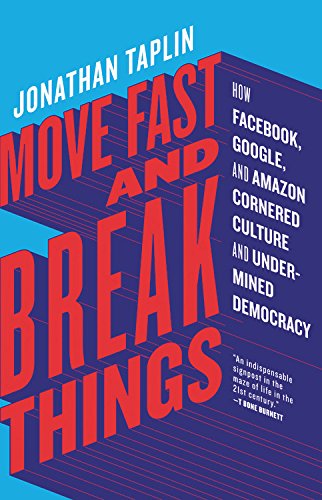
Move Fast and Break Things: How Facebook, Google, and Amazon Cornered Culture and Undermined Democracy by Jonathan Taplin Little, Brown, 2017
This review was first published by Booklist on March 3, 2017.
Taplin urges caution in the face of our increasingly connected technology. Facebook, Google, and Amazon seem to be taking over the world. These companies are monopolies, wielding more wealth and power than any companies in history, and are even shaping laws in their own favor. He examines what motivates the men who lead these companies and discovers a frightening landscape of unchecked Randian libertarianism. His conclusion that they represent a threat to democracy itself may be hyperbolic, but it’s valuable to consider—current events may soon show whether he’s correct. Taplin also takes on the state of copyright laws and media distribution in the digital age. Here, his arguments become less nuanced. He shows little awareness of the substance of the myriad counter-arguments in the copyright debate, some of his positions are misinformed, even factually incorrect (such as his condemnation of streaming media services)—and he offers overly simplistic understandings of complex issues. But he does present a necessary challenge to conventional wisdom about modern technology and how it affects all our lives.
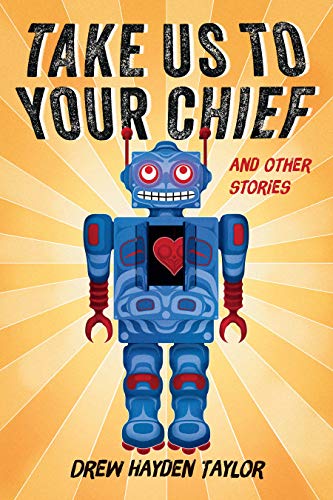
Take Us to Your Chief and Other Stories by Drew Hayden Taylor Douglas & McIntyre, 2017
This review was first published by Booklist on March 3, 2017.
Taylor is on a mission to create science fiction written by indigenous First Nations authors. That alone makes his collection of short stories important. These nine stories are highly entertaining, the quality is high, and his range of tone is impressive. The First Nations perspective gives an interesting take on the “first contact” theme, paralleling the arrival of Europeans to the Americas. Most of these stories are humorous, but there are a couple serious ones thrown in. Many have a 1950s, Silver Era, silly pop-movie feel, which lends them a nostalgic patina. Unfortunately, the retro feel of these stories is at odds with the progressive goal of the author, coming across a tad dated and frivolous. The collection is a fun and quick read, but as entertaining as these stories are, such a slim volume isn’t quite enough to satisfy. Still, readers will be looking for more to come from Taylor.
This review was first published by Booklist on March 3, 2017.
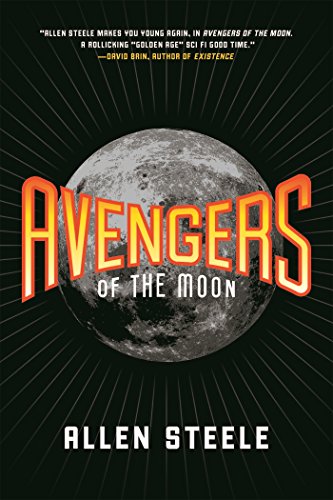
In Avengers of the Moon, Steele resurrects Captain Future, a hero of classic pulp serials created by Edmond Hamilton, and retcons him for the twenty-first century. This all-new origin story introduces Captain Future and his crew to a new audience, pits him against his archnemesis, and sets up a continuing series. It’s a classic rollicking adventure story—exciting and entertaining, with enough callbacks to the original to appeal to existing fans. Steele states in his afterword that his intent is to recapture the magic of old pulp SF, but he doesn’t completely succeed. This isn’t the fault of the book—it’s well written, appropriately pulpy, and fun to read. It’s just that pulp doesn’t necessarily work with a modern audience. The pulp era grew out of a sense of wonder; audiences then possessed a wide-eyed credulity. Modern readers aren’t that credulous anymore. Without that innocence and idealism, pulp SF is an awkward fit. Still, this book is worth reading for the fun of it.
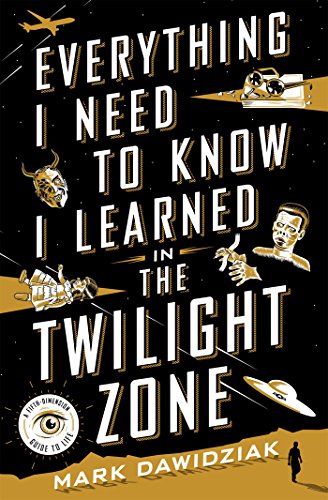
Everything I Need to Know I Learned in The Twilight Zone by Mark Dawidziak St. Martin’s/Thomas Dunne, 2017
This review was first published by Booklist on March 3, 2017.
This book is a delightful love letter to the original The Twilight Zone television series, the primary writers of the show, and its creator, Rod Serling. The narrative is presented as a lighthearted guide to life, as Dawidziak sets forth 50 “life lessons” that can be found in various episodes. Some of the lessons are a bit on the nose, but make no mistake—as humorous as this book is, these lessons are substantial. The Twilight Zone episodes functioned as mini-morality plays, after all, steeped in Serling’s belief in the fundamental dignity of individuals. One could do worse than try to live by the book’s precepts. The book reminds us, too, of how revolutionary and brilliant the show was. Dawidziak includes statements from a variety of showbiz movers and shakers about why The Twilight Zone was important and the influence it had on them. This book won’t stand as a scholarly work, but that’s not the point: it’s a joyful celebration of being a fan. If nothing else, it will make readers want to rewatch the show—and that’s surely a welcome thing.
The greatest challenge about reviewing Jerusalem by Alan Moore is summarizing what it’s about. This isn’t a traditional novel and it doesn’t deliver a normal story. The plot is meandering, almost vestigial in some sections. Setting is paramount—language, tone, atmosphere, characters: all of these matter far more than mere plot.
I’ve come to think of this book as being akin to the Bayeux Tapestry—a sprawling and artistically audacious account of a place and its people. It’s a love letter to a neighborhood as only Moore can write it.
In general terms, it’s a quasi-fictional history of the Boroughs—the poverty-stricken Northampton neighborhood in England where Alan Moore was born, raised, and still lives—from ancient times through the near future, not told in chronological order, and actively eschewing the concept of linear narrative. It’s the story of a unique family who lives there through several generations, and various persons associated with them. It’s a story of the afterlife and eternity and the Universe. It’s a story about life and death, art and work, obligation and free will, ghosts and angles and builders and demons. Visions and dreams are as real in this world as reality.
If I had to categorize this book, I’d probably call it fantastical realism. Everyone is going to shelve it in their SF sections. But it’s more than just these—it’s philosophical, historical, political, religious.
It’s holy and profane, poetic and pedestrian, beautiful and gritty. It’s deeply human. It’s hard to explain. You really need to read it.


 John the Librarian