On Food and Headaches

I started getting headaches in my mid-20s. I threw out my back at work one day and never did anything to fix it—I relied on my standard “ignore it and it’ll go away” strategy. This caused entrenched muscle imbalances, which led to steadily mounting tension along the length of my spine, which eventually came to rest in my neck and shoulders.

I started getting tension headaches at the back of my head, where my spine connects to my skull. These headaches are a dull throb on one side or the other, sometimes nothing much, sometimes bad enough to make me sweaty and nauseous and shaky. I always knew when one was coming on because it would be preceded by a few hours of mounting tension in my back and shoulders. I always knew when one would be really bad because my neck would start cracking every time I moved my head.
Continue reading “On Food and Headaches” →

Book Review: Dead on Arrival by Matt Richtel

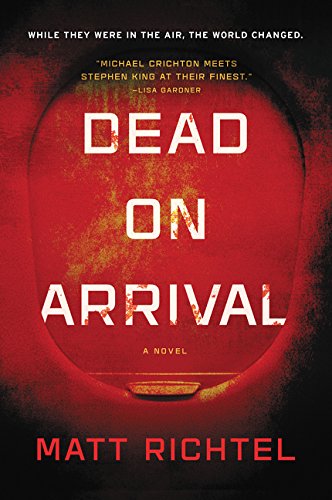
Cover of the book Dead on Arrival by Matt Richtel
Dead on Arrival
by Matt Richtel
Morrow, 2017

This review was first published by Booklist on May 31, 2017.

The promotional blurbs for Richtel’s latest compare it to Michael Crichton’s thrillers and Stephen King’s The Stand, and these comparisons aren’t without some merit. The story is similar in atmosphere and style to both suggestions, and it’s a cautionary tale about technology and science left unchecked. An airplane lands in a remote town and everyone on the ground appears to be dead. A disgraced doctor on board is the best hope to discover what’s going on. The first half of the novel is split between this mystery and flashbacks to the doctor’s past and his relationship to a particular individual who works for an online technology giant. A twist at the midpoint of the book radically changes the direction of the story, and the second half proceeds as a conventional race-against-the-clock thriller. The pacing is excellent, the science is detailed and believable, and the flashback structure is handled well. Richtel’s writing style is urgent, making this an enjoyable and gripping read.

Remembrance of Earth’s Past by Liu Cixin: A Critical Follow-Up

Shortly after I published my review of the “Remembrance of Earth’s Past” trilogy by Liu Cixin, I tweeted a link to it and @ referenced both the author and the two English language translators of the series, Ken Liu and Joel Martinsen. Shortly after that tweet, Ken posted a series of tweets in response.

I’m incredibly grateful that Ken took the time to respond. His tweets are insightful and his critique of my review is helpful. I’ve included them here with his permission. Please read through them.

https://twitter.com/kyliu99/status/858025429793468417 Continue reading “Remembrance of Earth’s Past by Liu Cixin: A Critical Follow-Up” →

Book Review: Remembrance of Earth’s Past by Cixin Liu

Remembrance of Earths Past by Cixin Liu

The Three-Body Problem by Cixin Liu
(translated by Ken Liu)
Tor, 2014

The Dark Forest by Cixin Liu
(translated by Joel Martinsen)
Tor, 2015

Death’s End by Cixin Liu
(translated by Ken Liu)
Tor, 2016

In my review of Leviathan Wakes by James S. A. Corey, I compare reading it to reading Asimov’s Foundation when I was a kid.

I’m going to make the same comparison with the “Remembrance of Earth’s Past” series by Cixin Liu. Reading this awakens the same sense of discovery and amazement as reading Asimov when I was a child. Liu gifts us a story that’s astounding in scope and vision, with some of a biggest Big Ideas in science fiction.

The English translations of Liu’s work boast an admirable level of stylistic polish. There’s a spare and refreshing lyricism at work here. I’m as impressed with the quality of the translations as I am with Liu’s story.

This is what science fiction should be. I’m in awe of Liu’s imagination and accomplishment.

Continue reading “Book Review: Remembrance of Earth’s Past by Cixin Liu” →

Book Review: Bit by Bit: How Video Games Transformed Our World by Andrew Ervin

Cover of the book Bit by Bit: How Video Games Transformed Our World by Andrew Ervin
Bit by Bit: How Video Games Transformed Our World
by Andrew Ervin
Basic, 2017

This review was first published by Booklist on April 15, 2017.

It’s unusual for a history of video games to feature multiple quotes from Rilke, references to philosophy and Zen Buddhism, and comparisons to great works of art. But that’s exactly what Ervin serves up to support his compelling argument: video games can be art. They can achieve the same heights of storytelling and social commentary, inspire genuine self-reflection, and promote personal and social progress, like any other creative medium. He examines what he considers the most seminal games, designers, and developments in the short history of video games. This isn’t a comprehensive history and doesn’t pretend to be. It’s a personal list—Ervin focuses on what he considers most important and his own experiences as a lifelong gamer. He’s clear about his personal preferences but does his best to understand the appeal of important games he doesn’t like. Ultimately, this is less about how video games have transformed our world and more about how they can. Ervin’s hopefulness sometimes feels naive, but that doesn’t render his faith in games any less compelling.

Unreliable Narrators

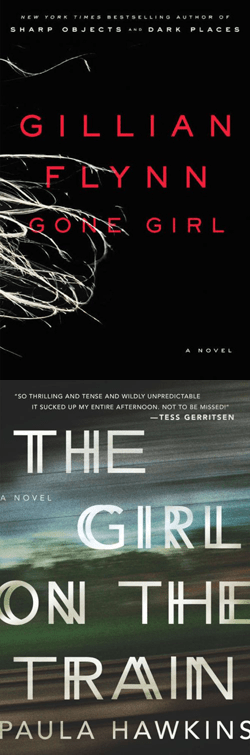
Gone Girl by Gillian Flynn & The Girl on the Train by Paula Hawkins

Gone Girl by Gillian Flynn
Crown, 2012

The Girl on the Train by Paula Hawkins
Riverhead Books, 2015

In 2012, Gillian Flynn published Gone Girl and kick-started our current craze for unreliable narrator stories. 2015 saw the release of The Girl on the Train by Paula Hawkins and the unreliable narrator novel was firmly ensconced.

Rarely have I witnessed two books compared to each other more than these.

Not only was The Girl on the Train trumpeted as “this year’s Gone Girl,” not only did every critic and reviewer on the planet compare the two, but just about everyone I knew picked a favorite and took a side in the which-is-better debate.

Most people I know like both but have a clear preference for one or the other, and there are more than a few who love one and hate the other.

For most, their preference seems to boil down to which narrator appealed to them best. It’s not a matter of which you like best, as neither narrator is intended to be likeable. But both are meant to be intriguing.

I’m convinced that character appeal isn’t all that’s going on here. I think focusing on which narrator appeals the most is circling around a deeper issue.

Continue reading “Unreliable Narrators” →

Artists vs. Craftsmen, or: Why I’m Not Participating in NaPoWriMo This Year

I won’t be participating in NaPoWriMo this year. I waffled for the past couple of months as to whether or not I should. To explain why I’m not, I need to tell you about a recent revelation I had about myself:

I finally realized that I’m not actually a creative person. More importantly—I’m happy with that. I’m tired of feeling like I’m supposed to be creative when I’m clearly not.

To explain this revelation, I need to tell you a story about LEGO…

Continue reading “Artists vs. Craftsmen, or: Why I’m Not Participating in NaPoWriMo This Year” →

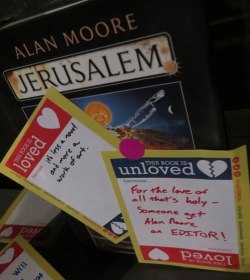
Further Ruminations on Jerusalem by Alan Moore

Reader comments left on a copy of Jerusalem by Alan Moore

Reader comments left on a copy of Jerusalem by Alan Moore

Photo from the ReBound event on March 21, 2017, hosted by the Young Friends of the Kansas City Public Library and KCUR’s Generation Listen KC at the recordBar in Kansas City, Mo.

Image © Kansas City Public Library. Used with permission.

After writing the single longest and most exhaustive review I’ve ever written for Jerusalem by Alan Moore, I find I still have more to say.

I’ve had conversations now with a few other people about this book and discovered that I’m in a minority in my opinion. Most people I know couldn’t stand it. Most didn’t finish it. Mostly, they found it too long, too wordy, too self-indulgent. The general reaction is that Moore desperately needed an editor to reel him in.

I get that. On some level, I feel this way, too. I spent quite a lot of the book convinced that he was over-indulgent and lacking writerly discipline.

However, as others have stated (and I quote Library Journal here), Jerusalem is “[m]ore a work of art than a novel.”

Continue reading “Further Ruminations on Jerusalem by Alan Moore” →

Practicing Empathy

I recently heard a story about a guy sitting in a public place, clearly wearing a wedding ring and clearly scrolling through a dating app. What’s disturbing wasn’t just the fact that he was cheating on his partner, but that he was doing it so obviously, right out in the open where anyone could see.

What a bastard.

It’s times like this when I’m reminded most powerfully of David Foster Wallace’s “This Is Water” speech (*). He challenges us to try and do better when we make assumptions, to think better. We have a choice whether to assume or not, and if we choose to make assumptions, we get to choose what we assume.

Continue reading “Practicing Empathy” →

Another Perspective on Poverty

This is a story that hits much closer to home for me, as it happened to a friend of mine. But her story has done as much as anything to affect how I understand poverty, how I understand the role of government assistance, of social safety nets.

And it has done as much as anything to teach me the dangers of making assumptions.

I have a friend who experienced difficult times during the recession of the Bush Years. She and her husband are both capable and hard workers, college educated. He worked in a skilled labor field and she did general office work. They did fine for themselves.

Then he was involved in an accident and was severely injured. He’s disabled for the rest of his life. As a result, he could no longer work in his chosen field. He lost his job, lost his health insurance. And we all know COBRA is prohibitively expensive.

Continue reading “Another Perspective on Poverty” →