Book Review: Dark Matter by Blake Crouch

Dark Matter by Blake Crouch
Crown, 2016

I’ve read some truly amazing books this year. Dark Matter by Blake Crouch is probably my favorite of all of them. It’s a trip—a thriller, solid SF, mind-bending.

I had many people encourage me to read it in the months after it hit shelves. Everyone told me this book is original and mindblowing.

I admit: at first, I wasn’t sure what they were talking about. It’s a multiverse / alternate reality story. An exceptionally well-done multiverse story—much better than most—with interesting characters, high stakes, a driven plot. But the multiverse concept is pretty standard in scifi, not really original.

Then I got to the twist…

The twist is a genuine surprise, completely unexpected, yet it’s inevitable given the premise. That’s quite an achievement.

This novel is brilliant and mindblowing! I unreservedly love it! I encourage everyone to read it.

Book Review: Remnants of Trust by Elizabeth Bonesteel

Cover of the book Remnants of Trust by Elizabeth Bonesteel
Remnants of Trust
by Elizabeth Bonesteel
Harper/Voyager, 2016

This review was first published by Booklist on September 15, 2016.

This second entry in the Central Corps series is wall-to-wall action. It starts with a bang, opens new vistas of political and corporate intrigue, and pulls readers along to an ending that will leave them wanting more. After the events of The Cold Between (2016), Elena Shaw and Greg Foster were court-martialed for their actions. But instead of punishment, they’re put back on board their ship and assigned to patrol the Third Sector. When Syndicate raiders attack and destroy a fellow Corps ship, they must partner with a PSI captain and her crew to pursue the attackers. Elena’s former crewmates and commander open old wounds, as the pursuit leads to the site of one of her worst memories. Worse yet, there’s a saboteur on board. Bonesteel’s characters are what really stand out amid all the action—the relationships between them ground everything in the story, though this novel ditches the romance that characterized its predecessor in favor of more straightforward military science fiction. Fans of David Drake’s Honor Harrington series will find much to enjoy here.

Book Review: City of Weird: 30 Otherworldly Portland Tales by Gigi Little

Cover of the book City of Weird: 30 Otherworldly Portland Tales by Gigi Little
City of Weird: 30 Otherworldly Portland Tales
by Gigi Little
Forest Avenue, 2016

This review was first published by Booklist on September 1, 2016.

The 30 stories collected here come from an impressive cast of authors. All stories are set in Portland, Oregon (you don’t need to know anything about Portland to enjoy them), and partake, to varying degrees, of the unique brand of weird that defines that city. Some center around specific landmarks (Powell’s bookstore makes several appearances), some reference the history of the town, and some treat the city only as a general setting. These stories range from highly speculative to more mainstream, from upbeat to cynical, silly to serious; stories of love and loss, humor and pathos, from the bizarre to the poetic. There’s even an illustrated comic. Some are wonderfully pulpy, and some are more modern. “Transformation,” by Dan DeWeese, uses an alien invasion as critique of mindless conformity; “Yay,” by Bradley K. Rosen, is a Christmas Krampus story of madness and indigence; “Waiting for the Question,” by Art Edwards, is a gritty urban fantasia featuring Alex Trebek. All of the stories are very good, making this a fun and recommended collection.

Book Review: The Forgetting Moon by Brian Lee Durfee

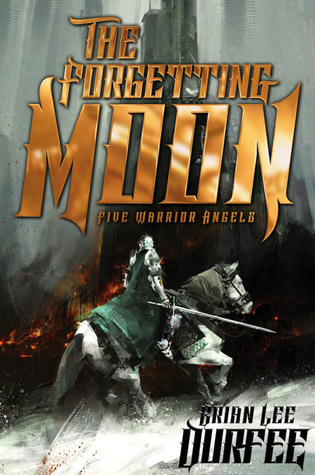
Cover of the book The Forgetting Moon by Brian Lee Durfee
The Forgetting Moon
by Brian Lee Durfee
Saga, 2016

This review was first published by Booklist on September 1, 2016.

A thousand years ago, the Five Warrior Angels rid the Five Isles of demons. Since then, their legends have given rise to religions, which now war for conquest. Many believe a prophesied apocalypse is near: some seek to hasten it, while a secret cult fights to prevent it. Magical weapons thought long lost are being found. But the legends may be lies, and the fate of the world depends on the daughters of a king, an assassin, a mysterious Vallè, and an orphan boy from a small fishing village. This is high fantasy in the vein of Stephen R. Donaldson or David Eddings, with generous helpings from George R. R. Martin. Durfee’s world building is exceptional: detailed and immersive, with a deep history and believable cultures. The plot is paced and driven, compellingly structured, with a conflict large enough to fuel forthcoming titles in the series. Some of the concepts and characters feel derivative, though archetype, and, unfortunately, the writing is inconsistent. For fans of high fantasy, the less-than-stellar writing shouldn’t detract from enjoyment of the world and the many entertainments of the story.

The Genres that Scare Me

I spend a fair amount of time talking about the importance of diversity in our stories and reading culture. I fully support the #WeNeedDiverseBooks movement. I’ve made a commitment to increase the diversity of my own reading, both in terms of authors and characters.

I read two posts over the past couple of weeks which spin the idea of diverse reading in a slightly different direction:

I Can’t Even with Librarians Who Don’t Read Diversely by Molly Wetta (posted on Bookriot, August 12, 2016)

Call to Action: Get Out There and Read Something You Are “Afraid” Of by Becky Spratford (posted on RA for All, August 22, 2016)

Normally, we talk about diverse books in terms of the ethnicity and cultures of characters, authors, and story traditions. What speaks to me about the two articles linked above is the call to increase the diversity of the genres I read. The call to “read outside [my] own taste and interest” (from Bookriot), to read things I dislike or that scare me to try (as per the RA for All post).

Continue reading “The Genres that Scare Me”

Diverse Books for My Kids

The Snowy Day by Ezra Jack Keats
Viking Press, 1962

Please read this article from Rumaan Alam. What he has to say is essential.

We Don’t Only Need More Diverse Books. We Need More Diverse Books Like The Snowy Day.
by Rumaan Alam (published by Slate, August 2, 2016)

We need diverse books to be sure, but those must be part of a literature that reflects our reality, books in which little black boys push one another on the swings, in which little black girls daydream about working in the zoo, in which kids of every color do what kids of every color do every day: tromp through the woods, obsess about trucks, love their parents, refuse to eat dinner. We need more books in which our kids are simply themselves, and in which that is enough.

Continue reading “Diverse Books for My Kids”

Childhood Memory: Found

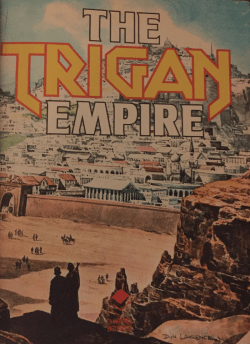
The Trigan Empire by Mike Butterworth & Don Lawrence
The Trigan Empire written by Mike Butterworth & artwork by Don Lawrence
Chartwell Publishers, 1978
(inside title page)

Without further ado, I present my long lost childhood memory:

The Trigan Empire, written by Mike Butterworth with artwork by Don Lawrence.

This is definitely the book my siblings and I read as kids. As fragmentary as my memories of it are, I was shocked at how familiar it felt to read through it again as an adult. I found that I remembered almost every page as it was revealed to me. And I was delighted to discover that the copy I received via ILL came from a public library in my home state. Seems appropriate.

The Trigan Empire was a comic that ran from 1965 to 1982, published in Britain by Fleetway, with Butterworth and Lawrence as the primary writer and artist. It ran as a serial installment in an educational magazine focused on science. The hardbound novel-length book my siblings and I read was an omnibus collection of the earliest stories from the comic, published in the United States in 1978 by Chartwell.

What’s it about?

Continue reading “Childhood Memory: Found”

Book Review: Everfair by Nisi Shawl

Cover of the book Everfair by Nisi Shawl
Everfair
by Nisi Shawl
Tor, 2016

This review was first published by Booklist in August, 2016.

Shawl’s first novel offers a steampunk-influenced alternate history of the Belgian Congo from 1889 to 1919. It envisions what would have happened if Fabian Socialists from Europe and African American missionaries had purchased land in the Congo from King Leopold and established a free state made up of native Africans, freed slaves, European settlers, and even Chinese laborers. Told from the perspectives of several different characters, it touches on themes of colonialism, sovereignty, religion, prejudice, sexuality, and identity. It is structured episodically, with each chapter offering a snapshot from the lives of the characters and the history of Everfair; some chapters could almost stand on their own as short stories. Taken together, these snapshots weave an engrossing tapestry of the history and humanity of what might have been for the Congo. The work is elegant, rendered with masterful craft in simple, compelling language—a tour de force of Shawl’s tremendous ability to create deeply nuanced characters. This is a beautifully told, important entry in the movement for greater diversity in sf.

[Author’s Note: I regret not giving this book a starred review. It deserved one—it was one of the most interesting and compelling SF novels of the year and I think it will take its place as in important work in the history of the genre. Sometimes the true value of a book takes time to realize.]

Searching for a Childhood Memory

When my siblings and I were in early grade school at the beginning of the 1980s, we discovered a strange book in the children’s section of our local public library. It was a heftier tome than we’d ever seen on the shelves, oversized and thick—close to 200 pages. Barring encyclopedias, we’d only seen books this big in the adult section or on our parents’ bookshelves at home.

But the best part was that this strange book was a comic book!

Today we’d call it a graphic novel but we hadn’t heard that term back then. We checked it out, brought it home, and each read through it a couple of times.

My memories of reading this book are difficult to properly describe: fragmentary, dissociative, surreal, and dreamlike all come close. I recall that my in-the-moment experience of reading it as a little kid was similar: surreal, dreamlike, dissociative, fragmentary. I had a difficult time keeping the narrative strung together as a cohesive whole in my head.

It was the most challenging thing I’d read up to that point in my life.

Continue reading “Searching for a Childhood Memory”

Book Review: Overcomplicated: Technology at the Limits of Comprehension by Samuel Arbesman

Cover of the book Overcomplicated: Technology at the Limits of Comprehension by Samuel Arbesman
Overcomplicated: Technology at the Limits of Comprehension
by Samuel Arbesman
Current, 2016

This review was first published by Booklist on July 7, 2016.

Modern technology has become so complex that even experts can no longer understand technological systems in all their parts and workings. It frequently feels like we’re losing control of our own technological creations. Technology often behaves in ways that appear mysterious to us, the causes of effects too difficult to tease from the tangle. Arbesman explores this complexity and the limits of our ability to comprehend truly intricate systems and offers a strategy for better understanding. He argues that such complications are inevitable and that the evolution of our technology is best understood as a quasi-biological process. Biological thinking allows us to approach technological complexity in a more useful and holistic way and to accept the limits of our ability to understand it. What stands out most is Arbesman’s compelling hopefulness for the future. Caution in the face of our technology is understandable, but there’s no reason to be afraid of it. Technology can sometimes seem miraculous—yet that’s no reason to worship it. This book aims to offer us a better way forward.