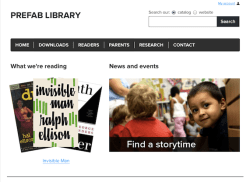
Library Website Design, Part I: The Trader Joe’s Principle

Prefab
Prefab from Influx (image used with permission)
Designing a library website is challenging. Most commercial websites – e-commerce sites, for example, or promotional sites for businesses – have clear purposes and limited use-cases.

Libraries, by contrast, offer a staggering array of services to a wide variety of users.

How do you design for that? How do you focus your layout and navigation without sacrificing the visibility of all your myriad resources and services? How do you promote certain services without ostracizing patrons who are seeking services that aren’t being promoted?
Continue reading “Library Website Design, Part I: The Trader Joe’s Principle”

Thoughts on the True Nature of Ebooks

Stuart Kelly at The Guardian has an interesting take on the potential new reality of ebooks:

Why ebooks are a different genre from print (posted March 26, 2013)

I’ve long been advocating for the multimedia potential of ebooks but I hadn’t really thought about the data-gathering and non-private nature of the medium before.

On a deeper level, I’d like to see more longitudinal studies done on information comprehension and retention when reading ebooks, as well as direct neurological mapping of ebook reading vs. print. I’m curious to know how our pre- and sub-conscious minds deal with the physical differences in the delivery mechanisms.
Continue reading “Thoughts on the True Nature of Ebooks”

Again with the Ebooks & Online Library Services & Patron Privacy

Defining a Less Polarizing Position

I was talking to my wife about my concerns over patron privacy and library ebook lending for Kindles, and she presented me with an argument that pretty well demolished my entire principled stance on this issue:

Ebook services for libraries don’t carry any really controversial or potentially dangerous stuff anyway. Ereaders are for fluff – all the data shows that pretty much no one uses them for serious reading or scholarship. There’s no real danger in exposing ebook lending records because there’s nothing there to get patrons in trouble in the first place.
Continue reading “Again with the Ebooks & Online Library Services & Patron Privacy”

Library Services – or, What Makes A Library Valuable?

An Attempt to Bring Together a Variety of Recent Issues

I know the hoopla about Terry Deary is old news already, but I keep thinking about it, circling back around to it.

Despite my powerful and vociferous reaction to his statements about the value of public libraries, there’s something about this situation that still isn’t resolved in my mind. And I think I know what it is.

Terry Deary is absolutely, 100% wrong about the “concept behind libraries”. Which begs an essential question:

How did a well-educated, literate man come to view public libraries so wrongly in the first place?
Continue reading “Library Services – or, What Makes A Library Valuable?”

Ebook Lending for Kindles & Patron Privacy

Back in November, I wrote about some serious concerns I have regarding library-based social sharing platforms and patron privacy. More recently, I find myself harboring similar concerns about ebook lending for Kindles.

I’ve never actually checked out an ebook from my library. So the other week, when I was asked to help a patron check out an ebook for her Kindle, I was taken aback when we reached the step where she was required to sign in to Amazon using her personal Amazon ID. This step raises an important question:

What happens to the record of this transaction in Amazon’s database?
Continue reading “Ebook Lending for Kindles & Patron Privacy”

Advertising In Libraries? Maybe…

I’ve been hearing about public libraries selling advertising space as a source of funding for a couple of years now. I keep thinking that I should be opposed to this idea on principle – and I’m fascinated to discover that I’m not.

I think this article does a fine and concise job of summarizing the issue:

Advertising in Libraries? Considering the Consequences (posted on Non-Profit Quarterly, February 27, 2013)

Selling advertising space in libraries has the potential to be a substantial source of funding. Librarians are well aware of the dangers this type of arrangement poses; any library wishing to go this route will make sure to include language in any such contacts that explicitly deny advertisers the right to have any say in operational or policy decisions.
Continue reading “Advertising In Libraries? Maybe…”

My Beautiful Library!

Kirk Hall at KCPL Central
Kirk Hall at the Kansas City Public Library’s Central Library

I have to take a moment to brag – Rebecca Joines Schinsky, associate editor and community manager at one of my all-time favorite bibliophile blogs Book Riot, has named the Kansas City Public Library’s Central Library the most beautiful public library in America! w00t!

America’s Most Beautiful Public Library (posted February 25, 2013)

How much do I love that I get to come to work here everyday?

Author Terry Deary On Libraries

I imagine that by now everyone in Library Land – and in Book-Lover Land more generally – has seen this news story:

Horrible Histories Author Terry Deary On Libraries: ‘No Longer Relevant’ (posted on the Huffington Post on February 14, 2013)

Such attitudes toward libraries make me sad and angry. Of course, I’m highly biased on this subject, but it’s more than that. It’s the way his whole argument perpetuates misinformation, encourages overwhelmingly selfish principles, and his understanding of how communities and social systems actually work is frighteningly simplistic.

Not only does he completely ignore the massive pile of evidence that libraries are an incredibly effective venue for reader discovery and a leading driver of book sales, I’m personally disgusted by his unmitigated self-interest.

And he’s absolutely, 100% wrong about the “concept behind libraries”.

Never forget – the intent of public libraries is to provide all citizens with access to information in service of maintaining an informed democracy. The purpose of libraries is to enable self-improvement and drive social progress. This is true throughout modern Western culture.

He considers his paycheck more important than civic duty and the communal good, and I think that’s pathetic.

Actually, now that I think of it – people holding their paychecks as more important than civic duty and the communal good is the source of most of our current social ills…