Dante’s Divine Comedy, Terza Rima & Why the Limerick Is the Greatest English Poetic Form

I took a class on Dante’s Divine Comedy in college. The class was taught by a visiting professor from the University of Padua. He talked about Dante the same way English speakers talk about Shakespeare, only even more so. The Divine Comedy is widely considered by native Italians as having invented the modern Italian language. This professor spoke of it as the purest and most perfect expression of his “mother tongue” (see footnote).

He spent significant time analyzing the terza rima structure of the work. In particular, he stated that many native Italians consider it to be, once again, the greatest expression of their language. It’s perfectly suited to Italian: the cadence captures the robust, rounded, plosive earthy lilt and rolling quality of it; Italian is one of the most rhyme rich languages in the world, and the complex rhyme scheme of terza rima is calibrated to make the most of that fact. Moreover, terza rima doesn’t work well in any other language. It’s purely Italian.

This got me wondering if there’s a poetic structure equally well suited to English, a structure as deeply native to English as terza rima is to Italian.

I’ve concluded that the limerick comes closest.

Continue reading “Dante’s Divine Comedy, Terza Rima & Why the Limerick Is the Greatest English Poetic Form”

Are We Really Living in a Golden Age of Information?

Information professionals like to crow that we’re living in a Golden Age of Information. More information is available to more people than ever before in history, and it’s easier to access than ever.

The standard response is to point out that there’s more bad information than ever before. A whole lot of the information currently circulating around out there isn’t reliable.

This is true. But it’s also true that there’s more good information available to us than ever before, too. Just as bad information has increased, good information has increased alongside. I believe this firmly and I’ll stand by this statement.

But I’m not sure if the increase in good information is keeping pace with the increase in bad. It may be the proportion of good-to-bad has become more unbalanced. It may be that good information is being increasingly overwhelmed by the bad.

Continue reading “Are We Really Living in a Golden Age of Information?”

Conflicted Thoughts about Kim Stanley Robinson

Kim Stanley Robinson has come up a couple of times on this blog lately. I recently reviewed his latest novel, Aurora, and of course his Mars Trilogy came up in my thoughts about The Martian by Andy Weir. The Mars Trilogy was at the back of my mind the whole time I was reading the short story anthology Old Mars—I wasn’t sure how I’d react to retro Planetary Romance-style stories about the Red Planet in a post-Robinson world.

I have Robinson on my mind.

Continue reading “Conflicted Thoughts about Kim Stanley Robinson”

On the Need for Diverse Books

Last week, I wrote about how important Octavia Butler’s work is to me. Every time I tell people how much I like Octavia Butler, someone inevitably says, “You should read Nnedi Okorafor!” or, “Have you read any of Tananarive Due’s works?”

And I always want to ask them:

“Are you recommending them because you think their writing style / subject matter / perspective is similar enough to Butler’s to merit the comparison? Or are you just naming them because they’re another black woman who writes SF?”

Continue reading “On the Need for Diverse Books”

In Defense of Speculative Fiction

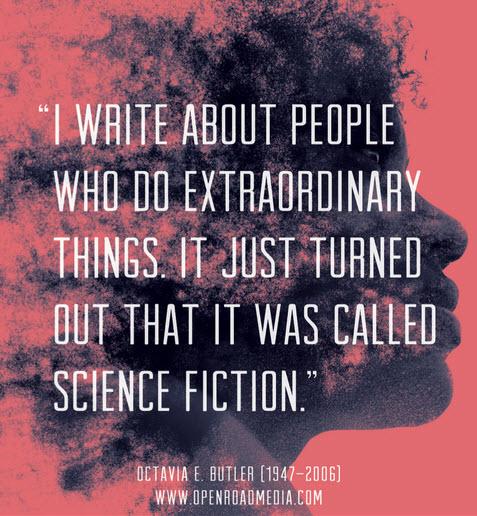
Octavia Butler is one of my most treasured authors. Her work is astounding. More than anyone in the past few decades, she took up the mantle of the literary scifi authors of the 1960s and ’70s—Ursula K. Le Guin, Samuel R. Delany, Harlan Ellison, et al.

Like them, Butler’s work transcends boundaries and achieves a level of artistry and power that’s rare. She’s an irreducibly important author. Her legacy is one to be treasured and honored.

Octavia Butler Quote Continue reading “In Defense of Speculative Fiction”

Education in America: An Expanded Argument

I keep thinking about my latest posts on education and the need I see for a three-legged balance between STEM, liberal arts, and vocational training. It occurs to me that this is incomplete. There needs to be a fourth leg:

Arts education.

Music, visual arts, performing arts—these are different from liberal arts (philosophy, history, literature study, rhetoric, etc.), just as liberal arts are different from STEM. But just like liberal arts and STEM, arts education also seeks to develop critical thinking skills, along its own lines and according to its own standards.

When I critiqued the STEAM concept, I did so in terms of liberal arts but that’s incorrect. The “A” in STEAM stands for “Arts”—as in arts education, not liberal.

I think my critique still stands: integrating arts education with STEM is a mistake. I believe that conflating them makes it virtually impossible to avoid subordinating the arts aspect to the STEM aspect. They’re both best served when they’re allowed to stand on their own.

A four-legged educational system: STEM—Liberal arts—Arts—Vocational training.

That should be our goal.

STEAM

A couple of people responded to my previous post about education and the need for three pillars: liberal arts + STEM + vocational training. They point out that a movement exists to expand STEM to STEAM—to integrate arts education into STEM education.

I disagree with this idea. I’m convinced that liberal arts and STEM education need to be allowed to flourish each on their own and to interact with each other as equals. I feel that STEAM initiatives intrinsically subordinate the arts aspect to the larger STEM aspect.

But my concern about STEAM speaks to something deeper. At their cores, both liberal arts and STEM educations seek to teach strong critical thinking skills. They use very different methodologies to do so, and are based on different structures of reasoning, logic, discourse, etc.

I know many people for whom STEM education doesn’t work. Their minds simply don’t respond to that teaching methodology, to those structures of knowledge. Likewise, I know many people for whom liberal arts education doesn’t work and for the same reasons.

If the goal is to promote critical thinking skills, it’s obvious to me that we need to maintain multiple avenues for people to get there.

Intentionally conflating different educational methodologies and pathways is a mistake. Cramming them together narrows the options available for people to learn the critical thinking skills they need in ways that are best suited to them.

I believe that this can only reduce the efficacy of education overall.

Public Libraries: STEM, Maker Spaces & the State of Modern Education

Please read this article. He makes an important point. The headline, as always, is composed to be divisive—his argument is more nuanced than the headline lets on.

Why America’s obsession with STEM education is dangerous by Fareed Zakaria (posted by The Washington Post on March 26, 2015)

Let me start with this: STEM education is important. Despite the headline, this article doesn’t try to argue that it isn’t important.

Looking back at the history of education in this country, it seems to me that we were at our best, our strongest and most successful, when we had a balance across three arenas of study: liberal arts + STEM + vocational training. We need all three, equally. Liberal arts, in particular, is what stood us apart from much of the rest of the world during the 20th century. We also had far-and-away the most robust and most affordable vocational training in the world during the middle section of the century.

Liberal arts tracks have been under attack for pretty much my entire life, and prior. Vocational training in this country has been utterly gutted over the past decades. STEM education is important but I also worry that we emphasize it at the expense of reestablishing this three-pillared balance.

Continue reading “Public Libraries: STEM, Maker Spaces & the State of Modern Education”

Farewell, Sir Terry

The passing of Sir Terry Pratchett hurts.

It’s not normal for me to get caught up in the passing of a celebrity. I might take part in conversations about issues surrounding them (as I did with Robin Williams and depression) but Sir Terry is different. His death hits me personally.

Reading his work left you with the sense that you now had a personal connection with him. His words were so open and forthright, you felt that he was sharing his soul with you in a way that is rare. His characters found homes inside each of us, they became a part of us, on a level more intimate than any other author I know of.

To everyone who read and treasured his work, he wasn’t just a favorite author—he felt like a friend.

None of what I’ve written here is sufficient to express how important his novels are to me. As author Ellie Di Julio puts it:

Sir Terry taught me about being human.

I’m glad that he has been freed from his suffering. But I’ll truly miss his words. The world has lost a great man and wondrous soul.

The best way to honor this great man is to donate to The Research Institute for the Care of Older People.