On Work and Taking Time Off

I recently added the following statement to the “Experience” section on my About Me page:

In 2006-7, I took seven months off and didn’t work. It’s the second best thing I ever did for myself.

And this to the “Work History” section on my Experience page, sandwiched between two other jobs:

I took time off from October 2006 through April 2007.

It might seem weird to brag about not working for seven months when talking about my work history and experience, but I put a great deal of thought and planning into it. It was very good for me personally and for my career. It’s an important part of my history.

Continue reading “On Work and Taking Time Off”

Critical Questions of Social Justice Movements

I’m an ally. I’m an ally for LGBTQIA+ folk. An ally for #TransRights. For #MeToo. I support #OwnVoices and #WeNeedDiverseBooks. In general, I ally with anyone fighting for equity and justice, and against intolerance and discrimination.

There are some critical questions I want to ask about many of these movements and organizations. Sometimes I see things that give me pause, that concern me. Actions taken or statements made which seem problematic or counterproductive. There are questions I want to ask.

But I shouldn’t ask them. I’ve spent a lot of time thinking about why I believe I shouldn’t ask them.

I’ve always believed it’s good and healthy to ask critical questions of the world. I believe there’s great benefit in it.

I was raised in a very intellectual home. Both of my parents have Masters degrees in history; my father has an EdD and spent his career in higher education administration. My mother has the equivalent of a Masters in architecture. I spent my childhood surrounded by books on history, art history, philosophy. I immersed myself from a young age in my father’s science fiction collection and grew up wanting to be scientist and a philosopher. I grew up wanting to be a learned man. I was formed in an environment of inquiry and exploration and sincere critique.

I genuinely want what’s best for those fighting for equity and justice. I believe it’s crucial and beneficial to ask critical questions.

So why have I decided I shouldn’t ask them?

Continue reading “Critical Questions of Social Justice Movements”

Book Review: Conversations from the Edge: The Galaxy’s Edge Interviews by Joy Ward

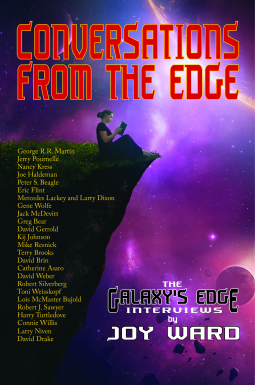
Cover of the book Conversations from the Edge: The Galaxy's Edge Interviews by Joy Ward
Conversations from the Edge: The Galaxy’s Edge Interviews
by Joy Ward
Phoenix Pick, 2019

This review was first published by Booklist on June 14, 2019.

Galaxy’s Edge, a monthly sf and fantasy magazine edited by Mike Resnick, has been publishing interviews with prominent figures from the sf and fantasy fields since 2014, all conducted by Joy Ward. Conversations from the Edge collects 25 of these interviews into a single volume, in what will hopefully be the first of many such collections. The interviews are an impressive who’s who: George R. R. Martin, David Brin, Connie Willis, Larry Niven, Lois McMaster Bujold, David Drake, Greg Bear, and many more. Some interviews are presented as they originally appeared in the magazine, and some are expanded. They’re remarkable for their candidness: Ward has a talent for encouraging her subjects to speak deeply and at length, with honesty and candor. The interviewees speak about such topics as their personal history, their writing process, where they find inspiration, where they see the genres headed, even how they define sf and fantasy (there’s not as much agreement about this as one might think). This book is a treasure for fans and historians of sf.

Drag Queen Story Times in Public Libraries

NOTE: Everything on this blog is an expression of my personal opinions and not those of my employer. It’s especially important to keep this in mind for this post.

Drag Queen Story Times in public libraries are causing quite a lot of controversy lately. The most important thing for me is to state as clearly as I can:

I am an ally.

I do not believe it’s legitimate to cancel these programs because of the prejudices of some members of a community. It’s discriminatory. Public libraries have an obligation to represent all members of our community, which includes LGBTQIA+ folk.

It also includes representing those people who are offended by the drag queen story times. But when you cancel one at the behest of the other, you’re de facto showing preference for the people who are offended.

Some people argue this the other way around: if you go through with a drag queen story time, are you not de facto showing preference for the queens over those who are offended by them?

For me, the answer lies in who’s doing harm.

Continue reading “Drag Queen Story Times in Public Libraries”

Perspectives on SF

Conversations from the Edge: The Galaxy's Edge Interviews by Joy Ward
Conversations from the Edge: The Galaxy’s Edge Interviews
by Joy Ward
Phoenix Pick, 2019

I recently got to read an advance reading copy of Conversations from the Edge by Joy Ward, a collection of interviews she conducted for Galaxy’s Edge magazine since 2014. I spend a lot of time thinking about SF—what it is, how it works, why I love it (see here, here, here, here, here, and here). It’s wonderful to hear SF writers talk about the genre and how they see it.

There were two quotes about science fiction in this collection that particularly struck me: one from Nancy Kress and one from Connie Willis. (This is an ARC so apply the standard disclaimer that the accuracy and page numbers of quotes might change.)

From the interview with Nancy Kress in which she talks about how science fiction gives her a big canvas to work with:

Continue reading “Perspectives on SF”

Book Review: Meet Me in the Future by Kameron Hurley

Cover of the book Meet Me in the Future by Kameron Hurley
Meet Me in the Future
by Kameron Hurley
Tachyon, 2019

This review was first published by Booklist on June 1, 2019.

**STARRED REVIEW** In her introduction, Hurley (The Light Brigade, 2019) admits that short stories aren’t her typical fare: her heart belongs to novels. And yet, she has produced one of the best story collections of the past few years. Hurley imagines brutal worlds, and her work is typically violent and vulgar. But as these stories make clear, her visions offer much more than shock value: these tales are emotionally powerful, lyrical, occasionally hopeful, and flirt with the profound. She creates worlds and characters as full and fascinating in a dozen pages as any she offers in her longer works. They throw into stark relief the core themes of her larger body of work: physical and linguistic expressions of gender or bodies fraught with illness (“Elephants and Corpses,” “Tumbledown,” “The Plague Givers”); war and the cycle of violence (“The Red Secretary,” “Garda,” “The War of Heroes”); storytelling as a medium for both social control and individual freedom (“Sinners on Solid Ground,” “The Corpse Archives”). What makes Hurley’s stories unique is her focus on what comes after: after war, after plague, after the collapse of civilization. These are stories that pack a punch. Highly recommended for existing fans and as an introduction for new readers.

Are Human Beings Unique or Not? Part 2

Human beings are storytelling creatures.

How many times have I said this over the course of my life? Far too many to count. It’s my very most favorite fact about us. It’s a source of absolute delight to me. We’re the only animal that has been observed to tell stories. It begs a question in response to my last post re: what, if anything, makes humans unique from other animals:

Why didn’t I list storytelling as the characteristic that makes us unique?

Why did I end up with something as depressing as “we’re the only animals who sometimes hate ourselves?”

Storytelling is built into the most basic functioning of our brains. It’s how memory works. It’s how we make sense of the world. For something so deeply embedded in us, it can’t be something entirely unique to us—it must be based on antecedent mental abilities in the animal world. So, as with so many things, storytelling is a unique expression but not unique in its essential nature.

Continue reading “Are Human Beings Unique or Not? Part 2”

Are Human Beings Unique or Not?

I recently took a leadership class that talked about ethics. The instructor said something interesting:

Humans are the only animals that rationalize behavior we know is wrong.

I think that’s correct—but I would add the caveat: “The only animals that we know of…”

When I was a kid, people still preached the idea of Man the Rational Animal. The persistent Enlightenment belief that what distinguishes us from other animals is our ability to reason.

Even as a kid, I knew this was a load of crap.

Continue reading “Are Human Beings Unique or Not?”

Book Review: Reentry by Peter Cawdron

Cover of the book Reentry by Peter Cawdron
Reentry
by Peter Cawdron
HMH/John Joseph Adams, 2019

This review was first published by Booklist on May 17, 2019.

After defeating the artificial intelligence on Mars, Liz Anderson and two other survivors arrive back on Earth, but not to the welcome they expect. Earth is in turmoil after the devastation of nuclear war, and paranoia and hatred of AIs run rampant. The astronauts return with the remnants of the Martian AI, which contains the uploaded consciousness of Liz’s dead lover. Or does it? It turns out the AIs aren’t done with her yet, and all is not as it seems. Targeted by the U.S. government and aided by AI sympathizers, Liz must figure out whom to trust. In Cawdron’s follow-up to Retrograde (2016), he develops his ideas about artificial intelligence and the nature of life in complex and interesting ways. The political ramifications that drive the action are entirely believable. Reentry is a worthy sequel. Though it lacks the novelty of its predecessor, this series entry develops this world more broadly and leaves open the possibility of future stories. Fans will be satisfied.

Book Review: Octavia Gone by Jack McDevitt

Cover of the book Octavia Gone by Jack McDevitt
Octavia Gone
by Jack McDevitt
Saga, 2019

This review was first published by Booklist on May 17, 2019.

Octavia Gone, the eighth entry in McDevitt’s Alex Benedict series (after Coming Home, 2014), brings back long-missing character Gabe, while Alex and crew tackle the tandem mysteries of a disappeared research station and a possibly alien artifact. What the crew discovers entails a moral conundrum that forces them to make difficult choices to find a resolution. As always, McDevitt’s story is well-structured and paced. His characters are relatable and it’s interesting to see how they react to Gabe’s reappearance. One of McDevitt’s hallmarks is his focus on external conflicts—solving the mystery and navigating its implications—but there’s little conflict between the characters; people in McDevitt’s worlds are reasonable and resolve their interpersonal issues without much ado. While the two mysteries tie together in the end, for much of the book they seem oddly unrelated. This book offers what McDevitt’s fans are looking for, but new readers will want to start with earlier books in the series.