I Hate Saying “I’m Sorry”

I’ve done customer service in a lot of different jobs and in every one, a typical exchange goes like this:

Angry Customer: I need you to do [something completely unreasonable]!

Customer Service Rep: I’m sorry but I can’t do that.
*or*
I’m sorry but that’s against policy.

For a long time, every time I heard a customer service rep say, “I’m sorry but…,” I cringed. I hated hearing it. I tried never to say those words. Why?

Because I’m not sorry. Because I haven’t done anything wrong. Because my employer hasn’t done anything wrong. We’re not at fault.

Continue reading “I Hate Saying “I’m Sorry””

Book Review: Arthur C. Clarke by Gary Westfahl

Cover of the book Arthur C. Clarke by Gary Westfahl
Arthur C. Clarke
by Gary Westfahl
Univ. of Illinois, 2018

This review was first published by Booklist on May 22, 2018.

Westfahl (Science Fiction Quotations, 2005) offers a well-considered reevaluation of Arthur C. Clarke’s legacy, tracing broad topics and contradicting some commonly held beliefs. For example, although many separate Clarke’s technical sf from his quasi-mystical imaginings, Westfahl shows it to all be of a piece: near-future technology is relatively comprehensible to modern readers, whereas far-future technology would be so far beyond our comprehension as to appear magical—a logical conclusion. His analysis is most valuable in its scope, ranging beyond Clarke’s major works and considering his myriad stories, his less successful novels, his nonfiction, and even his juvenilia. Where this book fails is in its attempts to grapple with Clarke as a person. Clarke was a deeply private man, and there’s little evidence to consider about his life beyond his published works. Westfahl tries too hard to read too much significance into what little evidence there is. It’s a bit abstruse for anyone unfamiliar with Clarke’s work, and it verges on hagiography at times. Still, a worthy analysis of an important sf writer.

My Customer Service Philosophy: Lessons from a Ten Year Old

I was asked recently what my customer service philosophy is. I responded with this:

The customer isn’t always right but they’re usually not wrong.

What do I mean by that?

I mean that some behavior is simply unacceptable. Customers don’t have the right to abuse staff, to expect preferential treatment, to demand we make exceptions just for them. Basic human decency and respect are still required. I won’t tolerate threats to the safety of staff members.

However, in my experience, when someone is acting out there’s usually a reason for it. There’s usually a need or a want that isn’t being met—and that need or want is usually legitimate. Problematic behavior arises when someone can’t figure out how to get what they need or want. And while the behavior may be a problem, this underlying reason can be productively addressed.

A ten year old boy taught me this lesson.

Continue reading “My Customer Service Philosophy: Lessons from a Ten Year Old”

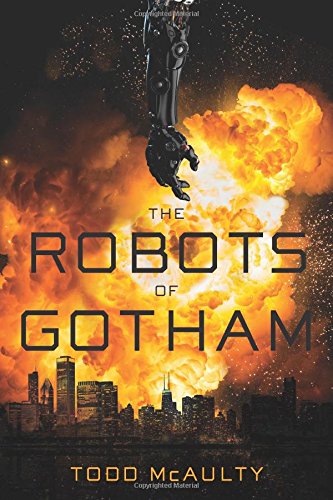
Book Review: The Robots of Gotham by Todd McAulty

Cover of the book The Robots of Gotham by Todd McAulty
The Robots of Gotham
by Todd McAulty
HMH/John Joseph Adams, 2018

This review was first published by Booklist on May 15, 2018.

**STARRED REVIEW** Machine intelligences rule most of the world, human governments are rapidly losing their power, a war-ravaged U.S. is on the brink of descending into chaos, and a mysterious new plague is on the loose. In Chicago, one man finds himself at the nexus of a complex web of secrets that threatens to upend the world as we know it. This debut novel beautifully combines a postapocalyptic man-versus-machine conflict and a medical thriller. The world is immersive and detailed, the characters have depth, the writing is assured, the plotting intelligent, and the pacing about perfect. McAulty’s take on how AI might evolve gives the premise a unique twist. The story is action-packed, starting with a boom (literally) and driving you along from one crisis to the next. The action rarely lets up, yet it never becomes tiresome. The exposition gets a bit heavy-handed at times, but not enough to slow things down. There are intriguing details of this world that McAulty teases but never fully reveals, and that builds anticipation for his next books. This is thrilling, epic sf.

I Hate Poet Voice

We all know what “Poet Voice” is, right? A poet reads their work aloud and they take on a vocal style that’s flat, slow, monotonous, weighted down with cringing self-conscious significance.

I harbor an intense dislike of Poet Voice. I’m happy to see rigorous analysis backs me up on this.

An Algorithmic Investigation of the Highfalutin ‘Poet Voice’ by Cara Giaimo, posted on Atlas Obscura, May 1, 2018

Still, it bothers me when people critique Poet Voice primarily by comparing it to regular conversational voice. Poetry shouldn’t be treated like normal speech—it’s an elevated use of language and recitation should reflect that. Poetic recitation should be more performative, more crafted, distinct from casual conversation. Each word of a poem is significant and must be heard and understood.

The problem isn’t that Poet Voice is unnatural or different from conversational voice. The problem is that Poet Voice is boring.

Continue reading “I Hate Poet Voice”

Experience & Context

Some years ago, when I was still doing theater work in Chicago, I had gotten off a job late one night and found myself craving a pint of ice cream. So I stopped by a corner market on my way home. Another gentleman—a complete stranger to me—arrived at the same time I did. We approached the door just in time to see the proprietor throw the lock and change the sign to “Closed”. He shrugged at us, pointed to the sign listing the store’s hours, and walked off.

I was disappointed and somewhat miffed. The other guy proceeded to throw a spectacular tantrum.

I stood there nonplussed, unsure what to do. Once this strange man had stopped yelling and stomping around, I asked him, “Are you OK?” (Inane question, I know—clearly he wasn’t—but it was late and I was tired and hungry.)

He proceeded to tell me a Tale of Woe for the Ages. All about his terrible, horrible, no good, very bad day, very bad week, very bad month. Everything that could go wrong in this guy’s life had gone wrong. All he wanted now was some potato chips—crunchy bites of salty comfort. Is that too much to ask?

So I took him to a local bar and bought him a beer.

He apologized for making such a scene. He knew it was a ridiculous overreaction. I assured him I totally understood. And I did understand: for me, having the door locked in my face was annoying. For him, it was ONE MORE THING in a long line of crappy things that had happened to him lately.

For him, it was the one thing too many.

This experience taught me something important:

Context matters.

Continue reading “Experience & Context”

Book Review: Artificial Condition by Martha Wells

Cover of the book Artificial Condition by Martha Wells
Artificial Condition
by Martha Wells
Tor, 2018

This review was first published by Booklist on April 15, 2018.

Everyone’s favorite Murderbot is back. The second installment in Wells’ Murderbot Diaries picks up where All Systems Red (2017) left off, with the series’ titular character seeking answers to its origin by traveling back to where it first went rogue to learn what really happened. Along the way, it makes friends with an intelligent research transport ship and agrees to protect a group of naive researchers whose discoveries make them a target for murder. Murderbot is one of the most delightful characters in current science fiction: a killing machine who chooses to be a good person, a robot who suffers from crippling social anxiety, a sarcastic misanthrope who really just wants to be left alone to watch TV. The relationship between Murderbot and ART (the intelligent ship) adds an entertaining The Odd Couple element to the story. Like the first book, this one is a fast, fun, exciting read, and the series keeps getting funnier. Perfect entertainment for a quiet evening. Although Artificial Condition can be read as a stand-alone, readers will prefer reading the series in order.

Book Review: The Song of Achilles by Madeline Miller

The Song of Achilles by Madeline Miller
The Song of Achilles
by Madeline Miller
Ecco, 2012

This review was originally posted on my Goodreads account in early February 2013. I’m reposting it here, given that I refer to it not infrequently.

I was astounded by this book. Madeline Miller’s achievement cannot be overstated. Here’s a novel that’s absorbingly readable for a modern audience, but that still has the poetry of Homeric sagas. What’s most impressive to me is the balance she finds between exploring the universality of human nature throughout the ages and maintaining the innate alien-ness that I experience every time I read The Iliad—the culture of archaic Greece was so very different from this world we live in today. She lets the truth of that age live and breathe without trying to tame or update it.

And yet, I recognize myself in this story.

Continue reading “Book Review: The Song of Achilles by Madeline Miller”

Book Review Circe by Madeline Miller

Circe by Madeline Miller
Circe
by Madeline Miller
Little, Brown and Company, 2018

I have a difficult time imagining how any book will be able to unseat Madeline Miller’s Circe as my favorite book of the year. It’s lyrical and poetic, intimate and grand in scope, human and godly, challenging and comforting. It’s wise. It’s profound.

It fulfills all the hopes I had for Ms. Miller’s work after her astounding first novel.

Where The Song of Achilles is her reinterpretation of The Iliad, Circe is a looser, more oblique riff on The Odyssey. Told from the first person perspective of the titular character, the work spans centuries and is filled with famous characters from throughout ancient Greek lore: Titans and Olympian gods, Scylla, King Minos and the Minotaur, Daedalus, Jason and Medea, and, of course, Odysseus, Penelope, and Telemachus all make appearances. It begins with Prometheus stealing fire and ends with the aftermath of Odysseus’ death. The largest part is taken up with Circe’s relationship with Odysseus and what happens after.

Continue reading “Book Review Circe by Madeline Miller”

Book Review: The Long Sunset by Jack McDevitt

Cover of the book The Long Sunset by Jack McDevitt
The Long Sunset
by Jack McDevitt
Saga, 2018

This review was first published by Booklist on March 15, 2018.

Priscilla Hutchins is the captain of an interstellar crew sent to explore the origin of a mysterious signal from another planet. But there’s resistance to the mission, as many believe continued interstellar exploration has become too dangerous. Hutch takes off despite opposition and embarks upon a journey that will lead her to discover new artifacts, alien life, and a looming celestial apocalypse. But this isn’t an adventure story; it’s a story focused mostly on people and how we relate to one another. McDevitt (Time Travelers Never Die, 2009) offers a unique take on aliens and how civilizations might arise on other planets, an unexpected and interesting choice in the realm of space-based science fiction. The active conflict of the story is political; unfortunately, McDevitt doesn’t delve as deeply into this aspect of the story as he could. But his unique vision, the way his imagination plays across a galactic stage, and the inherent tension of an unavoidable disaster make up for it. He also introduces important new elements into his ongoing Academy series, making this a worthy read.