In third grade, I wrote an essay about it for class. I went through my whole childhood assuming that would be the path I followed, right up until I started high school and discovered theater. I don’t regret turning away from cosmology to follow the theater path, just as I don’t regret leaving theater to become a librarian, but some days I find myself melancholy over the loss of what could have been.
Or: OK, I Lied—My Previous Post Wasn’t the Last I Had to Say on This Subject. Honestly, I Won’t Ever Run Out of Things to Say about This Issue.
It’s illuminating to peruse the history of judicial interpretations of the First Amendment of the Constitution of the United States of America. Time and time again, it’s noted that the goal of the freedom of expression is to enable and promote the free exchange of ideas.
The free exchange of ideas is the fundamental purpose of public libraries.
The freedom of expression requires us to engage with the presence of hate speech and the various expressions of hate groups in our communities. As we debate the proper approach to and place of hate in society—and more specifically within public libraries—we must at least acknowledge that hate groups don’t care about participating in the free exchange of ideas. If we believe we must allow hate groups and hate speech in libraries because we believe that we should provide access to all ideas, and a platform for all members of our community, it should matter to us that hate groups don’t care about any of that.
Hate groups have no desire to engage in discussion or debate. That’s not why they speak their hate.
Or: My Last Thoughts on the Controversial Update to the Interpretation of the Meeting Room Policy of the Library Bill of Rights
I’m happiest when exploring the realm of ideas, big picture theory. As a kid, I would spend hours sitting in my room thinking about the nature of reality and existence, our minds and souls and bodies, perception, the Universe and time. As an undergraduate in college, I took enough philosophy classes to qualify for a minor in philosophy. A good intellectual debate is one of my favorite things.
I love delving into theory. But there’s one thing about this world which I know to be true:
Nothing ever works in practice the way it works in theory. Reality never matches the model.
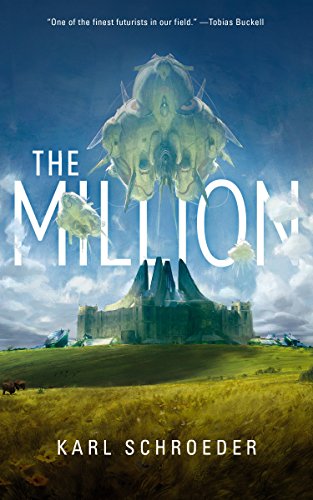
This review was first published by Booklist on July 18, 2018.
Schroeder (Lockstep, 2014) presents an engrossing and unique vision of the future. Most humans have moved off world, and the population of Earth is kept at one million. The Million is made up of families who are custodians of the land and resources, responsible for preserving historic skills and culture, and they’re all incredibly wealthy. Meanwhile, 10 billion people lay in cryogenic hibernation underground, waking for one month every 30 years to overrun the planet. Gavin is a young man who doesn’t belong: he is a visitor secretly adopted by one of the Million. When a rival dies, Gavin takes his place in the Academy, a training school for the elite police force charged with tracking down outcasts like him. What he discovers there is a conspiracy that could tear apart the very fabric of society. Schroeder develops a rich setting for such a short book, slightly strained but elegantly rendered, and it makes the juicy intrigue plausible. His characters are believable and the stakes are high. It’s an exciting start to what should be an addicting series.
This title has been recommended for young adult readers:
YA/General Interest: With young protagonists in a school setting dealing with the machinations of adults in authority, The Million ticks all the right boxes for older teen sf fans.
I published a post a couple of weeks ago about neutrality and why I don’t think it’s possible for libraries (or any organization, for that matter) to be neutral in a society riven with historic and structural inequality. I cited posts by Dr. Donna Lanclos and Dawn Finch. I concluded that I would prefer to use the terms nonjudgmental and unbiased.
This was the week before the American Library Association’s Office of Intellectual Freedom updated their interpretation of Article VI of the Library Bill of Rights (pertaining to meeting rooms) to explicitly include “hate speech” and “hate groups” alongside religious and political groups, charities, non-profits, and sports organizations as civic groups that must be allowed to use library meeting spaces, and how these groups are allowed to express themselves. Reaction to this change was swift and spawned the #NoHateALA hashtag.
Ever since posting my review of Kill the Farm Boy, I’ve been thinking anew about The Princess Bride. I don’t think I understood until recently just how much it influenced my sense of storytelling.
I first saw the movie when I was in junior high. I was beginning to form an abiding interest in the craft and techniques of storytelling but I wasn’t consciously aware of it at the time. It would be some years yet before this interest broke the surface of my subconscious and explicitly revealed itself. There are several movies and books from this period of my life which influenced my understanding of the subject without me realizing it.
Like most people of my generation, I fell in love with The Princess Bride the first time I saw it. It was sarcastic and funny with beautiful young leads—I was young and sarcastic and wanted to be funny and beautiful. It was romantic and I was deeply invested in the ideal of being a hopeless romantic.
Or, everyone said the movie was romantic. It talks about True Love a lot and it has the shape of a love story. But I never really bought that part of it.
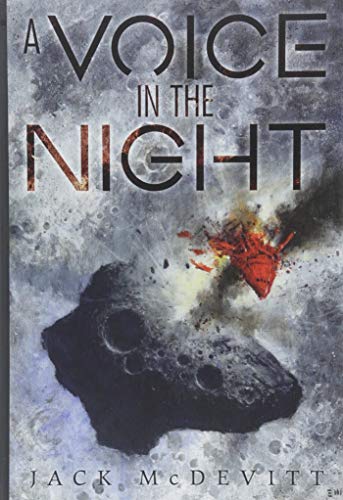
A Voice in the Night by Jack McDevitt Subterranean, 2018
This review was first published by Booklist on July 5, 2018.
A Voice in the Night brings together 24 short stories by McDevitt (The Long Sunset, 2018)—tales of space exploration and artificial intelligence, even a couple of alternate-history yarns. Many highlight McDevitt’s concerns about the future of space travel and the unlikelihood of encountering other intelligent life in the universe, as well as worries about the future of our planet. Most of the stories in this collection were published in the past two decades, with a handful from the previous millennium, so it’s not a complete retrospective. Two stories are award-worthy: “Good Intentions” was a Nebula nominee in 1998, and “Ships in the Night” was an International SF winner in 1993. Of particular interest to McDevitt’s readers are two stories from his well-known Academy series, detailing Priscilla Hutchins’ qualification flight when she first became a starship pilot, in addition to several other stories set in the Academy universe. McDevitt’s fans will welcome this collection.
This review was first published by Booklist on July 5, 2018.
Hurley’s collection revisits the world of the Bel Dame Apocrypha (beginning with God’s War, 2011) with five stories featuring intergalactic bounty hunter Nyxnissa so Dasheem (aka Nyx) and her crew on some of their dangerous jobs. The plots are taut, thrilling, gritty, violent, profane, magical—everything Hurley’s readers expect. New readers will not feel lost in this world—Hurley has created one of the most engrossing environments in modern sf—but fans will delight in learning how Nix meets Khos and the first time she hires Anneke. Though there is not much personal growth, all of the characters are well realized, even in the short story format, and each story covers familiar interpersonal conflicts and emotional highs and lows. These stories were previously published online, but fans of sf adventure stories with lots of political intrigue will welcome them in print.
I’ve written before about my misgivings regarding the ideal of neutrality in public libraries. I recently read an excellent post by Dr. Donna Lanclos titled, “Maybe We Shouldn’t Talk About Diversity Anymore.” There’s a quote in this piece which echoes the argument I’ve made about why neutrality is a problematic concept:
What about notions of ‘neutrality’ and ‘nice’ that talk about the importance of ‘all voices’ when we really should be protecting voices that historically have no platform. Let’s end false equivalencies, and recognize that people who have traditionally had power and influence (especially white men) don’t ever really lose their opportunity to participate just because we make sure that people and especially women of color get to take up space and have their say.”
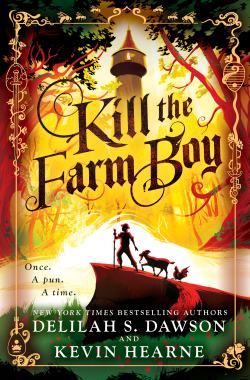
Kill the Farm Boy by Delilah S. Dawson and Kevin Hearne Del Ray, 2018
Kill the Farm Boy is a delight. It’s funny, unexpected, clever. It’s a quick read without sacrificing any substance. The characters are wonderful—interesting, infuriating, and sympathetic by turns—the world is well-rendered and the plot well-paced.
Did I mention it’s funny? Like, really funny. I have high hopes for the series this book sets up.
Fair warning: you better love puns.
I read an advance reader copy of the novel and it came with a summary of the planned marketing and promotional strategy. The marketing for this book emphasizes a comparison with the work of Terry Pratchett. This offers a good way to explore what Kill the Farm Boy is really about.