Book Review: Astounding: John W. Campbell, Isaac Asimov, Robert A. Heinlein, L. Ron Hubbard, and the Golden Age of Science Fiction by Alec Nevala-Lee

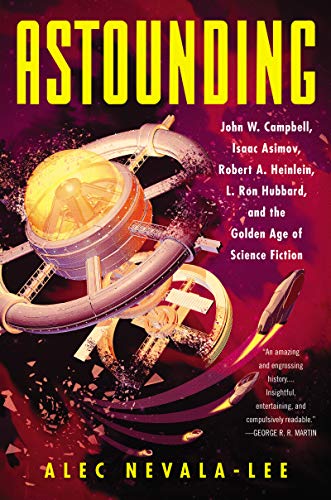
Cover of the book Astounding: John W. Campbell, Isaac Asimov, Robert A. Heinlein, L. Ron Hubbard, and the Golden Age of Science Fiction by Alec Nevala-Lee
Astounding: John W. Campbell, Isaac Asimov, Robert A. Heinlein, L. Ron Hubbard, and the Golden Age of Science Fiction
by Alec Nevala-Lee
HarperCollins/Dey Street, 2018

This review was first published by Booklist on September 15, 2018.

Nevala-Lee (Eternal Empire, 2013) presents a necessary addition to the history of science fiction: a critical look at the life and work of John W. Campbell, legendary editor of Astounding magazine and the central architect of science fiction’s golden age. This period, and the men most central to it, defined the path that still dominates the genre today. Part biography, part history, Astounding covers Campbell’s relationships with his most important writers (Asimov, Heinlein, and Hubbard); their tumultuous personal lives; the role their wives played in their careers; and the effect WWII and the atomic bomb had on the genre. Campbell and others truly believed science fiction could save the world. Nevala-Lee delves into the development of dianetics and Campbell’s split with Hubbard over Scientology. He also addresses the many biases, prejudices, and personal failings of these eminent men. At times, it feels like Nevala-Lee attempts to accomplish too much, and the mix of history with biography isn’t always comfortable, but it’s all necessary to understand how science fiction became what it is today.

The Challenge of Fairness

I struggle with the idea of fairness. Fairness is important to me. It bothers me, deeply, when I see things that are unfair. As a kid, I hated it when people would say, “The world isn’t always fair!” It was always just a transparent excuse for people treat others unfairly. Just because the world isn’t fair doesn’t mean we shouldn’t be.

Most libraries have a Patron Code of Conduct: a document laying out behavioral and usage expectations for people who use the library. Fairness is essential when it comes to these codes of conduct and especially when it comes to disciplinary actions in response to infractions.

Fairness requires us to apply our codes of conduct equally to all patrons. That seems obvious, right?

Maybe not.

Continue reading “The Challenge of Fairness”

Book Review: Lost Mars: Stories from the Golden Age of the Red Planet edited by Mike Ashley

Cover of the book Lost Mars: Stories from the Golden Age of the Red Planet edited by Mike Ashley
Lost Mars: Stories from the Golden Age of the Red Planet
edited by Mike Ashley
Univ. of Chicago/British Library, 2018

This review was first published by Booklist on August 20, 2018.

There has been a craze lately for retro and golden-age science fiction, and Lost Mars fits right into that trend, presenting a collection of 10 classic short stories about Mars written between 1887 and 1963. It features works by H. G. Wells, Ray Bradbury, and J. G. Ballard as well as authors less well known to modern audiences. These stories are of the highest quality and illustrate how our evolving understanding of the Red Planet changed the way we wrote about it and how Mars came to occupy a prominent position in our hopes, dreams, and fears as the modern age dawned and grew. Editor Ashley (The Mammoth Book of Time Travel SF, 2013) offers a brief and thoroughly researched introduction which provides background information about both the major Martian discoveries of the nineteenth, twentieth, and twenty-first centuries and the history of Martian science fiction from H. G. Wells through Andy Weir. It serves as a fascinating overview of the history of Mars in science fiction, from the birth of the genre through the beginning of the space age.

Book Review: Resistant by Rachael Sparks

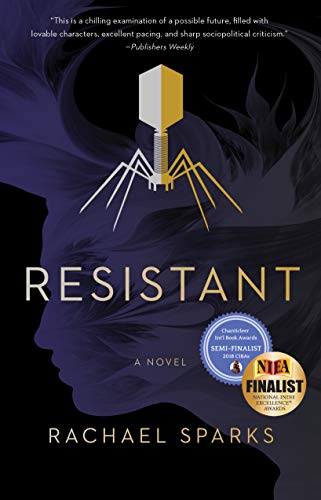
Cover of the book Resistant by Rachael Sparks
Resistant
by Rachael Sparks
SparkPress, 2018

This review was first published by Booklist on August 20, 2018.

In the near future, antibiotic-resistant bacteria have decimated the population. One young woman may hold the cure, and, aided by the Resistance, she is on the run from nefarious government agents. Besieged by betrayals, she must figure out whom to trust and how to save mankind. Sparks’ debut is a thrill ride for readers of biological thrillers like those of Robin Cook. The strong pacing and characterization contribute to an easily believable world with just the right amount of technology to satisfy more traditional sf readers. There is even a dash of romance. Despite the occasional awkward transition and slightly heavy-handed exposition, Resistant is a potent combination of elements, making this a novel that’s sure to appeal to a wide audience.

Movie Review: Solo: A Star Wars Story

Solo: A Star Wars Story directed by Ron Howard
Solo: A Star Wars Story
Directed by Ron Howard
Written by Jonathan & Lawrence Kasdan
Produced by Lucasfilm, Ltd.
Distributed by Walt Disney Studios, 2018

What I find most interesting about Solo: A Star Wars Story is that it doesn’t really feel like a Star Wars movie. That’s mostly a good thing.

What I mean is: it doesn’t feel important. It’s the only Star Wars movie so far that isn’t significant. In the original trilogy, Lucas explicitly sought to create a modern myth, a la Joseph Campbell. There’s an inherent sense of weight to it. The new trilogy sought to bring the Star Wars universe back to relevance and so it has a sense of mission, as well as a similar sense of modern myth. Rogue One tells a tale of emotional, moral, and narrative consequence.

Solo doesn’t have any of that. It’s not important to the main trilogies and it doesn’t take itself all that seriously. Which makes it one of the most fun Star Wars movies I’ve seen. It’s pure entertainment. It’s refreshing.

Continue reading “Movie Review: Solo: A Star Wars Story

Book Review: Dispatches from Planet 3: 32 (Brief) Tales on the Solar System, the Milky Way, and Beyond by Marcia Bartusiak

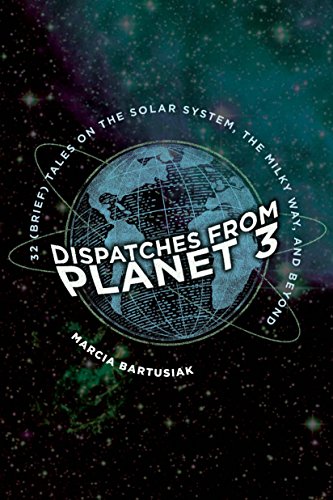
Cover of the book Dispatches from Planet 3: 32 (Brief) Tales on the Solar System, the Milky Way, and Beyond by Marcia Bartusiak
Dispatches from Planet 3: 32 (Brief) Tales on the Solar System, the Milky Way, and Beyond
by Marcia Bartusiak
Yale, 2018

This review was first published by Booklist on August 13, 2018.

These 32 short essays cover major events in the history of astronomy and cosmology, ranging from the demotion of Pluto to the status of dwarf planet, the evolution of galaxies, the detection of gravity waves and neutrinos, and the role of time in the Big Bang. Bartusiak’s (The Day We Found the Universe, 2009) goal is to provide historical context for many recent discoveries and a summary of how we got to where we are now in the science of space, offered in easy-to-read, bite-size morsels. Many of these essays cover events from the late 1800s through the mid-1900s, the period when modern cosmology was born, but the collection isn’t arranged chronologically. Rather, the essays are grouped, small to large, by topic, starting from the solar system and working out to the larger universe. Of particular value, several essays focus on women who did significant work, but who historically haven’t gotten credit. This is an informative and rewarding read for anyone interested in our understanding of the universe. Recommended for fans of Amanda Gefter’s Trespassing on Einstein’s Lawn (2014).

Book Review: Exit Strategy by Martha Wells

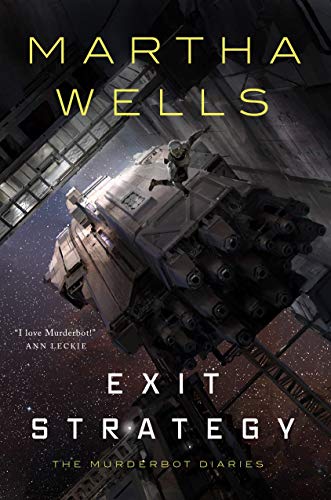
Cover of the book Exit Strategy by Martha Wells
Exit Strategy
by Martha Wells
Tor, 2018

This review was first published by Booklist in August, 2018.

After finding evidence proving that the GrayCris Corporation engaged in illegal activities, Murderbot heads out to hand the case over to Dr. Mensah, its former owner. But Dr. Mensah has disappeared, and Murderbot must track her down—straight into the heart of enemy territory. Saving its mentor and taking down GrayCris are just the beginning of its challenges—Murderbot also has to figure out who it is, where it fits in society, and just how it is supposed to relate to all these people. The fourth installment of Wells’ Murderbot Diaries (after Rogue Protocol, 2018) will satisfy readers’ hopes for this series finale. It follows the same basic structural formula as its predecessors, so it has all the action fans expect. Exit Strategy tones down the humor a bit but adds depth to Murderbot’s introspection as it wrestles with questions of identity that it has been avoiding, and the story leaves it to decide its own future. Everything comes full circle while remaining appropriately open ended. Wells gives us a worthy conclusion to one of the best series in recent memory.

What If…?

I wanted to be a cosmologist when I grew up.

In third grade, I wrote an essay about it for class. I went through my whole childhood assuming that would be the path I followed, right up until I started high school and discovered theater. I don’t regret turning away from cosmology to follow the theater path, just as I don’t regret leaving theater to become a librarian, but some days I find myself melancholy over the loss of what could have been.

Continue reading “What If…?”

Free Speech & Hate Groups

Or: OK, I Lied—My Previous Post Wasn’t the Last I Had to Say on This Subject. Honestly, I Won’t Ever Run Out of Things to Say about This Issue.

It’s illuminating to peruse the history of judicial interpretations of the First Amendment of the Constitution of the United States of America. Time and time again, it’s noted that the goal of the freedom of expression is to enable and promote the free exchange of ideas.

The free exchange of ideas is the fundamental purpose of public libraries.

The freedom of expression requires us to engage with the presence of hate speech and the various expressions of hate groups in our communities. As we debate the proper approach to and place of hate in society—and more specifically within public libraries—we must at least acknowledge that hate groups don’t care about participating in the free exchange of ideas. If we believe we must allow hate groups and hate speech in libraries because we believe that we should provide access to all ideas, and a platform for all members of our community, it should matter to us that hate groups don’t care about any of that.

Hate groups have no desire to engage in discussion or debate. That’s not why they speak their hate.

They speak to cause harm.

Continue reading “Free Speech & Hate Groups”

Theory vs. Practice

Or: My Last Thoughts on the Controversial Update to the Interpretation of the Meeting Room Policy of the Library Bill of Rights

I’m happiest when exploring the realm of ideas, big picture theory. As a kid, I would spend hours sitting in my room thinking about the nature of reality and existence, our minds and souls and bodies, perception, the Universe and time. As an undergraduate in college, I took enough philosophy classes to qualify for a minor in philosophy. A good intellectual debate is one of my favorite things.

I love delving into theory. But there’s one thing about this world which I know to be true:

Nothing ever works in practice the way it works in theory. Reality never matches the model.

Continue reading “Theory vs. Practice”