With the inexorable rise of ebooks, there have been a lot of people expounding the continuing benefits of print books. Most of them tend to cite similar things:
The physical heft of print books.
The smell of print books.
The permanence of print.
The retention of knowledge when reading print books.
Etc.
People also approach the issue from the perspective of the benefits of ebooks.
We’ve all read these blog posts and articles, we know how they go. These are all legitimate and important considerations.
Here’s an article, though, that mentions a couple benefits of print that I’ve not seen cited before—and I think these reasons are some of the best for continuing to allow print books to play an important role in all our lives:
Sometimes it amazes me that it took so long for me to figure out that I could make my living working in libraries.
My mom loves to tell the story of when I was little and I proclaimed that when I grew up I wanted to live in a library. From my earliest memories, my concept of heaven has been a giant library. I went through a phase in junior high were I tried to sketch out my ideal home and the centerpiece of the house was a multistory library (also, a huge terrarium for a pet three-toed tree sloth… I was a strange young man.) During the years I lived in Chicago, I always said that if the apocalypse came, I’d barricade myself in Harold Washington Library and protect the books.
I’ve always felt at home in a library. Some of my fondest memories from childhood are when my mom worked in the history library on the local campus and I’d get to spend time wandering around in the stacks. Continue reading “My Path to Libraries”→
When I tell people that I’m a Digital User Specialist at the Kansas City Public Library, the most common response I get is: “What’s that?” My fumbling attempts to explain my responsibilities are typically followed by the question, “So… what do you actually do?”
Explaining what I do is a challenge—partly because what I do is new enough that I have freedom to decide for myself the best ways to do it and I can create specific tasks as I go; and partly because my job is as much about observing and learning and thinking and conceptualizing and ideating as it is about day-to-day to-do lists (not that there aren’t plenty of those).
I was a voracious reader on my own but I hated reading for school. It was never any fun when it was for school. I understand that reading is essential for childhood learning in almost every respect—but this is not the way to encourage kids to want to read.
Ironically, I never read any of the assigned books for my classes in junior & high school—but I’ve read every one of those books on my own just for fun (and because I think it’s important to be well read) since then. The mere act of assigning the book automatically made me not want to read it.
Over the years, I’ve spoken about this phenomenon with many people—friends, coworkers, classmates—and I’ve been struck by how many people had the exact same experience in school. Moreover—it tends to be the most well-read and best educated people who felt this most acutely.
When the people who love reading the most hate reading for school… that should tell us something.
I think everyone who has any role in the design of user interaction environments, no matter how peripheral or glancing (and yes – book displays and public service desks count!) should read this article.
His critiques are spot-on and his conclusion is important. Such considerations may seem overwrought in the context of public service desk or book display design, but the ethical responsibility to help is appropriate for all—and especially for libraries.
As I mentioned in a post last week, I have a lot of significant anniversaries in the first half of July. I want to talk some about how I got to where I am today. But first, I want to share this blog post:
This is one of the wisest and most important things I’ve read. It resonates deeply with me. And there’s a lot of history which explains why I find this post is so meaningful. Continue reading “The Dangers of the Comfort Zone”→
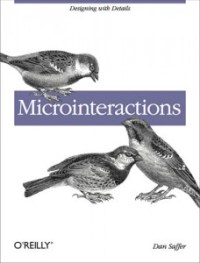
Microinteractions: Designing with Details by Dan Saffer, published by O’Reilly Media, 2013.I’ve been hearing about microinteraction design rather a lot in the last couple of weeks. This morning, a coworker sent me a link to an article on Fast Company about Dan Saffer’s book, Microinteractions: Designing with Details.
(It’s worth reading not just for the article but for the comments, as well – they’re pretty amusing!)
I really like the philosophy of microinteraction design. It appeals to what I understand about neurology – that we’re evolved to be paleolithic hunter-gatherers and our brains are wired to take in all the little details of our surroundings (animal sign for food and danger, edible plant sign, water sign, weather sign). Our fundamental functioning of mind is based on being hyperaware of the details around us, the visceral input that informs all of our interactions with the world. It’s the details that wake up our full attention and spur our brains to engage at their fullest capacity. It’s the details that make things really real for us. Microinteractions fulfill a similar role in a digital environment as visceral input in the analog world.
In particular, I like microinteraction design as an alternative to skeuomorphism – which does have legitimate uses (particularly for people who aren’t entirely comfortable in digital environments) but tends to be inelegant, clunky, and overly relied upon as a crutch for bad designers.
As my coworker summed up microinteraction design:
Indeed, details are everything – people pay attention to their comprehensive experiences, whether it’s IRL on online. Sites that are enjoyable to navigate/explore are products of thoughtful planning and design; since users have become much more discerning about site structure/features, more sophisticated (but not overly complicated) design approaches are needed.
I love this design philosophy and I’m eager to see what we can do with microinteractions.
I feel a bit guilty that I’ve allowed this blog to languish lately. Aside from a spate of posts the other week, my frequency has dropped noticeably over the past couple of months. It’s summer, so when I’m home I want to be outside and not sitting in front of my computer writing. And we’ve been really busy here in the Kansas City Public Library’s Digital Branch so I haven’t had the kind of time I normally do to write.
We’ve had our Summer Reading Program going on; we’re also setting up for a major Big Read program this fall and we’re planning to make the online components more robust than we’ve ever done.
We’re getting close to launching our revamped dedicated local history website, The Civil War on the Western Border, which has been in development for some time now. It’s going to offer some features that are truly unique for history websites.
We’ve begun the first steps toward planning a complete redesign & upgrade of the Library’s website and we’ve made some initial incremental changes already.
It’s exciting times!
Today is the 5th anniversary of my first date with Julie – next Tuesday is our 4th wedding anniversary. Yesterday was the 2nd anniversary of me starting my employment at KCPL. July 1st is the day we left Chicago and arrived in KC to stay.
With all these big milestone anniversaries, I’m thinking a lot about all the decisions I made, and actions I took, that have brought me to where I am now. So I’m working on a couple of personal reflection posts to go up in the next week or two.
As a professional librarian, I’m obsessed with the phenomenon of serendipitous discovery. Some of the most rewarding learning experiences of my life came to me by chance; I discovered some of my favorite books and authors simply by browsing the shelves at the library and allowing interesting things to catch my eye. I’m more grateful for these unlooked-for experiences than I can say.
One of the primary functions of libraries – and librarians – especially in our current Information Age, is to sort through the ocean of information available to us and find the truly worthwhile bits. We talk about “tsunamis” of information, “deluges” of information, and we’re acutely aware of how easily people can get lost and drown in it all.
I recently had an experience that made all this very real to me.