Book Review: Meet Me in the Future by Kameron Hurley

Cover of the book Meet Me in the Future by Kameron Hurley
Meet Me in the Future
by Kameron Hurley
Tachyon, 2019

This review was first published by Booklist on June 1, 2019.

**STARRED REVIEW** In her introduction, Hurley (The Light Brigade, 2019) admits that short stories aren’t her typical fare: her heart belongs to novels. And yet, she has produced one of the best story collections of the past few years. Hurley imagines brutal worlds, and her work is typically violent and vulgar. But as these stories make clear, her visions offer much more than shock value: these tales are emotionally powerful, lyrical, occasionally hopeful, and flirt with the profound. She creates worlds and characters as full and fascinating in a dozen pages as any she offers in her longer works. They throw into stark relief the core themes of her larger body of work: physical and linguistic expressions of gender or bodies fraught with illness (“Elephants and Corpses,” “Tumbledown,” “The Plague Givers”); war and the cycle of violence (“The Red Secretary,” “Garda,” “The War of Heroes”); storytelling as a medium for both social control and individual freedom (“Sinners on Solid Ground,” “The Corpse Archives”). What makes Hurley’s stories unique is her focus on what comes after: after war, after plague, after the collapse of civilization. These are stories that pack a punch. Highly recommended for existing fans and as an introduction for new readers.

Book Review: Reentry by Peter Cawdron

Cover of the book Reentry by Peter Cawdron
Reentry
by Peter Cawdron
HMH/John Joseph Adams, 2019

This review was first published by Booklist on May 17, 2019.

After defeating the artificial intelligence on Mars, Liz Anderson and two other survivors arrive back on Earth, but not to the welcome they expect. Earth is in turmoil after the devastation of nuclear war, and paranoia and hatred of AIs run rampant. The astronauts return with the remnants of the Martian AI, which contains the uploaded consciousness of Liz’s dead lover. Or does it? It turns out the AIs aren’t done with her yet, and all is not as it seems. Targeted by the U.S. government and aided by AI sympathizers, Liz must figure out whom to trust. In Cawdron’s follow-up to Retrograde (2016), he develops his ideas about artificial intelligence and the nature of life in complex and interesting ways. The political ramifications that drive the action are entirely believable. Reentry is a worthy sequel. Though it lacks the novelty of its predecessor, this series entry develops this world more broadly and leaves open the possibility of future stories. Fans will be satisfied.

Book Review: Octavia Gone by Jack McDevitt

Cover of the book Octavia Gone by Jack McDevitt
Octavia Gone
by Jack McDevitt
Saga, 2019

This review was first published by Booklist on May 17, 2019.

Octavia Gone, the eighth entry in McDevitt’s Alex Benedict series (after Coming Home, 2014), brings back long-missing character Gabe, while Alex and crew tackle the tandem mysteries of a disappeared research station and a possibly alien artifact. What the crew discovers entails a moral conundrum that forces them to make difficult choices to find a resolution. As always, McDevitt’s story is well-structured and paced. His characters are relatable and it’s interesting to see how they react to Gabe’s reappearance. One of McDevitt’s hallmarks is his focus on external conflicts—solving the mystery and navigating its implications—but there’s little conflict between the characters; people in McDevitt’s worlds are reasonable and resolve their interpersonal issues without much ado. While the two mysteries tie together in the end, for much of the book they seem oddly unrelated. This book offers what McDevitt’s fans are looking for, but new readers will want to start with earlier books in the series.

Book Review: Heroes of the Space Age: Incredible Stories of the Famous and Forgotten Men and Women Who Took Humanity to the Stars by Rod Pyle

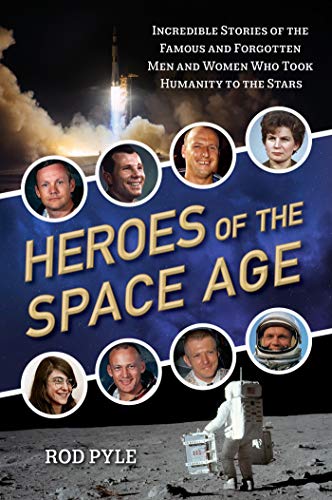
Cover of the book Heroes of the Space Age: Incredible Stories of the Famous and Forgotten Men and Women Who Took Humanity to the Stars by Rod Pyle
Heroes of the Space Age: Incredible Stories of the Famous and Forgotten Men and Women Who Took Humanity to the Stars
by Rod Pyle
Prometheus, 2019

This review was first published by Booklist on May 3, 2019.

Heroes of the Space Age offers profiles of eight individuals who played significant roles in the early days of the Space Age, from the late 1950s to the mid-1970s, including the first men and women in space (Yuri Gagarin, John Glenn, and Valentina Tereshkova), the first men on the moon (Neil Armstrong and Buzz Aldrin), and the first man to occupy a space station (Pete Conrad). Significantly, Pyle (Interplanetary Robots, 2019) includes people in pivotal roles on the ground: Gene Krantz, NASA flight controller during the first moon landing, and Margaret Hamilton, who designed the computer software for the Apollo missions. The author notes he sought to include diversity in these profiles, though the space race at that time was largely homogeneous. Each biography is brief but complete, though of greatest interest are the accounts of the work these individuals did as part of the space program. This is not a comprehensive collection of the hundreds of individuals involved but it’s a solid history of the earliest days of our exploration of space.

Book Review: Deep Past by Eugene Linden

Cover of the book Deep Past by Eugene Linden
Deep Past
by Eugene Linden
RosettaBooks, 2019

This review was first published by Booklist on April 19, 2019.

Linden’s first novel combines a story about the practices of science with a political thriller. An archaeological dig in Kazakhstan uncovers a mysterious ancient find with potentially revolutionary implications. When the find is threatened by larger geopolitical forces, Claire Knowland must resort to unorthodox methods to save it. But this puts her in the sights of malevolent powers and threatens to undermine scientific acceptance of the discovery. Deep Past will remind readers of Golden Age science fiction in that the story is dedicated to the exploration of a really Big Idea. In this case, the idea is about evolution and animal intelligence rather than technology. Also like Golden Age science fiction, the characters and plot are clearly secondary to the Big Idea. The characters are varied and interesting but lacking nuance, and the plot has some good twists and tensions, if it is somewhat ham-handed at times. The story is good enough to be entertaining but it’s also just a good excuse to explore a radical scientific idea about animal intelligence.

Book Review: Perihelion Summer by Greg Egan

Cover of the book Perihelion Summer by Greg Egan
Perihelion Summer
by Greg Egan
Tor, 2019

This review was first published by Booklist on March 15, 2019.

Once again, Egan (Phoresis, 2018) demonstrates his mastery of short-form science fiction. In Perihelion Summer, he takes on climate change from a unique angle—a micro-black hole passes close to Earth, changing its orbit and making the seasons more extreme and deadly, with swaths of the planet rendered uninhabitable. A group who built a self-sustaining aquaculture rig in the Indian Ocean to ride out the black hole now find themselves needing to navigate dangerous seas in search of survivable temperatures. Egan packs quite a lot into such a short book: science and engineering, family relationships and personal conflicts, global politics and danger. He presents a human tapestry in a time of disaster through evocative highlights of how people adapt to sudden crisis. This is a warning for how bad things could get if climate change is left unchecked. It’s a cautionary tale of the need for us to be prepared. But it’s also a beacon of hope—a story of survival at great cost. Difficult and painful as it may be, we find a way.

Book Review: The Science Fiction Fanzine Reader: Focal Points 1930–1960 edited by Luis Ortiz

Cover of the book The Science Fiction Fanzine Reader: Focal Points 1930–1960 edited by Luis Ortiz
The Science Fiction Fanzine Reader: Focal Points 1930–1960
edited by Luis Ortiz
IPG/Nonstop, 2019

This review was first published by Booklist on March 15, 2019.

The Science Fiction Fanzine Reader offers a fascinating look into the culture of early science fiction fandom during its first three decades. Given the cheap and ephemeral nature of these fanzines, this book is the culmination of a remarkable research project by Ortiz (Emshwiller, 2007). He collects dozens of articles, editorials, letters, and commentary written by sf fans between 1930 and 1960, as well as a handful of pieces where fans reflect back on their early days in fandom. It’s an engrossing glimpse into the mindset of sf readers in the middle of the twentieth century. This isn’t a straight history—readers need to have a solid knowledge of the history of science fiction and fandom in order to get the most out of it. The selections don’t seem to be in any order—they’re not grouped by theme or chronologically, which obscures broader patterns within the history of fanzines. Still, this book is for committed historians of the sf genre.

Book Review: We Are Mayhem by Michael Moreci

Cover of the book We Are Mayhem by Michael Moreci
We Are Mayhem
by Michael Moreci
St. Martin’s, 2019

This review was first published by Booklist on March 1, 2019.

Moreci’s second novel in his Black Star Renegades series (Black Star Renegades, 2018) is even more compelling than its predecessor: action packed and funny, with more emotional resonance. We Are Mayhem deepens established characters’ relationships and explores how they inhabit their world. The narrative follows two alternating story lines—Cade, searching for answers to help him control the Rokura, and Kira, leading the rebellion against Praxis. Each chapter ends with a cliff-hanger, and there are several surprise reveals and an unexpected ending. Though occasionally the novelty of Moreci’s characters and ideas outpace his unsophisticated writing style, readers who are hooked will be eager for the next installment.

Book Review: Titanshade by Dan Stout

Cover of the book Titanshade by Dan Stout
Titanshade
by Dan Stout
DAW, 2019

This review was first published by Booklist on March 1, 2019.

**STARRED REVIEW** Titanshade is a city running out of oil, and there’s a scramble to find alternative energy sources. When a delegate central to delicate negotiations is brutally murdered, it threatens to upend the future of the city. But no one knows who wanted the delegate dead or why, and a disgraced cop must descend into a complex underbelly of crime and political machinations to uncover the truth. What he discovers could cost him what he holds most dear. Titanshade is entirely unique: it’s a gritty noir murder mystery on an alien world with multiple species, a strange form of sorcery, a powerful religion, and large-scale political intrigue. And it’s set in the 1970s, with pay phones, 8-track tapes, racial tensions, and arguments about disco music. What’s amazing is how good it is at being all of these: the genuinely compelling mystery lives in a hugely original sf world and an immersive historical milieu. Moreover, debut novelist Stout is smart enough to let his characters live in this world without trying too hard to show it off. The setting just is, without effort, and that makes it eminently believable. This book should appeal equally to both sf fans and noir aficionados.

Book Review: Terminal Uprising by Jim C. Hines

Cover of the book Terminal Uprising by Jim C. Hines
Terminal Uprising
by Jim C. Hines
DAW, 2019

This review was first published by Booklist on January 18, 2019.

Terminal Uprising cements the reputation of the Janitors of the Post-Apocalypse as an exciting and rewarding series. The second entry (after Terminal Alliance, 2017) picks up four months after the end of the first. This time, Mops and crew are headed to Earth, the world of feral humans, and they’re accompanied by an unexpected ally. What they discover upends much of what they thought they knew about humanity’s downfall and could tip the balance in the war between Krakau and Prodryans. As always, their expertise in the custodial arts serves them well in unexpected ways. (Even better: librarians help save the day.) This book is plenty funny but less overtly jokey than the first one. The story is more interesting, and the character development is more multifaceted. Hines has grown confident in this world, and he continues to expand it in fascinating directions. The narrative takes a bit to establish momentum, but the latter half is quick and exciting. Overall, a strong edition to an excellent series that will appeal to fans of Becky Chambers.

This title has been recommended for young adult readers:

YA/General Interest: Humor and Hitchhiker’s Guide sensibilities make this series a good fit for sf-loving teens who aren’t put off by salty language.