Inherent Bias in Classification Systems

December 10th is Dewey Decimal System Day. Maybe it’s only librarians who care much about it but to us it’s a big deal.

The entire history of our profession has been a quest to organize information. Sometimes organizational schemas were focused on preserving resources, on merely keeping a list of a collection’s holding, and sometimes systems were intended to restrict access. Indeed, for most of our history, knowledge institutions were exclusive and exclusionary.

But beginning with the birth of public libraries in the 1800s, we conceived the idea that knowledge should be accessible for the betterment of all people. The challenge was—and continues to be—to find ways to accomplish this goal through practical application in real-world situations, in day-to-day activities.

Melvil Dewey’s system was a massive paradigm shift. It seems like such an esoteric thing to celebrate but realize this: before Dewey’s organizational scheme, there existed no universal method for organizing collections of materials, and too many systems were obscure and overly complicated, to the point where people were often discouraged from attempting to access them.

Dewey created a system that anyone could understand and use. For the first time, people could walk into a library and find what they wanted on the shelf, or explore the catalog, without the mediation of a specialist. In a real sense, the Dewey system effectively transferred our collections of knowledge out of the hands of specialists and into the hands of the general populace. *

Still, for all my appreciation and admiration of Dewey’s achievement, when a coworker asked if I wanted to participate in Dewey Day activities at my library, my response was this:

“I have no interest in celebrating the Dewey system. It’s an archaic monument to Western superiority and colonial oppression which obscures the diversity of human cultures and silences diverse voices.”

Continue reading “Inherent Bias in Classification Systems” →

Poetry and Nonsense

I was talking to my parents recently about some of the poetry I’ve written in the past few years. I mentioned how I’d developed a fascination with ways to integrate technology into poetic experimentation. I explained how much I enjoy Google search poems. I told them how I created a method of generating something akin to found poetry, using my smartphone’s auto-suggestion typing feature.

My mom said she’d like to read my tech-based poems, so I sent her links to my first auto-suggestion poem and a Google search poem I built (both written for National Poetry Writing Month in 2016).

My mom responded to these poems with this: “Is playing with words poetry in and of itself?”

Continue reading “Poetry and Nonsense” →

How Can Libraries Compete with Amazon?

I’m so bored by this question. Let’s talk instead about some things Amazon can’t do:

  • Amazon can’t be part of a community.
  • Amazon can’t build meaningful, multifaceted relationships with people at a local level.
  • Amazon can’t provide communal space.
  • Amazon can’t provide boots-on-ground, in-the-trenches, front-line community services.
  • Amazon can’t provide anything beyond purely commercial transactions.
  • Amazon can’t be assumed to care about the common good.
  • Amazon can’t build trust with people.

Libraries do all these things. Libraries do so much more than these things. All without ever advertising to you, without leveraging your needs for commercial gain.

Amazon values monetization. Libraries value people.

Can libraries compete with Amazon? This isn’t a legitimate question. If you think Amazon is competition for libraries, then you fundamentally don’t understand what libraries do.

The truth is this:

Amazon can’t compete with us.

Better Business through Sci-Fi? Better Futures through Storytelling

A coworker recently shared the following article with me. She knows I love SF and that I’m perennially fascinated by all things storytelling.

Better Business through Sci-Fi by Nick Romeo
(published by The New Yorker, July 30, 2017)

I admit, I do find this idea fascinating: using storytelling techniques to envision new products and services, craft new vision and mission statements, new marketing campaigns, new strategic initiatives. I’d be interested to see what, if anything, comes of it.

Continue reading “Better Business through Sci-Fi? Better Futures through Storytelling” →

My Twitter Year

One of my goals this year is to participate more in professional conversations and debates. For me, this means getting more active on Twitter. That’s where I keep track of most of my professional connections.

This past week saw my first forays in that direction.


There’s a quote from Donny Miller that has become ubiquitous among information professionals:

“In the age of information, ignorance is a choice.”

Continue reading “My Twitter Year” →

Hate Speech in Libraries

There have been several reports over the last few weeks identifying a rise in incidents of hate speech, racist graffiti and slogans, and acts of violence toward members of various minority groups throughout the country. Several libraries have been targeted—books and buildings have been defaced with swastikas, racist, sexist, homo- and transphobic epithets, explicit threats of violence toward minority groups, etc.

Libraries are targets because we stand at the vanguard of promoting inclusion and diversity. We seek to empower the disempowered, to give voice and provide access to all individuals and groups within our community. We hold as a core value that no one be excluded from the tools and services we offer, that no one be silenced or impeded from equal participation in our community. Libraries function as a safe space for anyone who needs it.

Libraries pose a great threat to those who seek to exclude all those who are different from them.

Libraries hold a resolute belief in the freedom of speech and expression. This is fundamental to everything we do. How, then, are libraries supposed to handle incidents of hate speech?

Continue reading “Hate Speech in Libraries” →

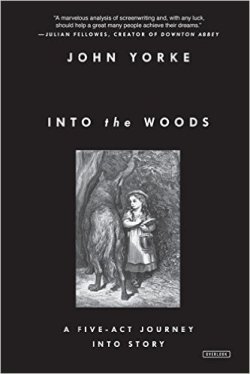
Book Review: Into the Woods: A Five-Act Journey Into Story by John Yorke

Into the Woods: A Five-Act Journey Into Story by John Yorke
The Overlook Press, 2014

Why do stories work the way they do? Why are they structured the way they are?

These questions fascinate me. Storytelling—its nature, how it works, the role it plays in human lives and society—fascinates me. As much as anything, storytelling is what marks human beings as unique among all the animals of Earth. The act of telling stories partakes equally of our capacity for imagination and our need to discern pattern in world around us. We use stories to try and make sense of our experiences and simultaneously celebrate the mysterious and unknowable. It’s both creative and formulaic.

The stories we choose to tell, and the ways we choose to tell them, tell us who we are and how we understand our role in existence.

Continue reading “Book Review: Into the Woods: A Five-Act Journey Into Story by John Yorke” →

Conversations about Libraries, Conversations about Privilege

A couple of years ago, I had a conversation with a gentleman who insisted that public libraries are going to disappear soon. He voiced the standard arguments about how everything is online now, and how ebooks are going to replace print entirely. His conclusion: libraries are irrelevant in the modern digital age.

Like so many people who take this position, this gentleman personally loves libraries and sees their inevitable passing as a loss to society. It makes him sad to think that there won’t be any more neighborhood libraries (even though he freely admits that it’s been years since he last set foot in his local library).

Of course, I spoke up to correct him. The stats make it very clear that libraries are as relevant to their communities as ever. Public library usage has actually increased with the advent of the digital information age, increased yet more during the recent economic crisis, and popular approval ratings are as high as they’ve ever been and holding steady. I shared all these stats with him. I shared multiple calculations of the economic impact of libraries and the ROI for every tax dollar invested—libraries are the single best public investment most communities can make. I talked about how libraries bolster and expand educational opportunities for kids and adults, citizens and immigrants, and the illiterate. I talked about how libraries can function as neutral gathering places during times of community upheaval. I talked about the library’s role in upholding the freedom of information and expression in our society. I talked about our computer labs and maker spaces and coding sessions and 3D printers and recording studios, our creative writing groups, our book groups, and our art spaces. I talked about our public programming and community discussion forums.

It was so clear to me that this gentleman would be happy to know that libraries are doing very well, adapting more-or-less adeptly to changing circumstances as they’ve always done, and they remain well-used and beloved by their communities.

That’s not what happened.

Continue reading “Conversations about Libraries, Conversations about Privilege” →

Shakespeare’s Language

To commemorate the 400th anniversary of the death of William Shakespeare, the Folger Shakespeare Library is sending 18 original copies of the First Folio on a tour of the United States. First Folio! The Book That Gave Us Shakespeare will exhibit the Folio in each of the 50 states, Washington D.C., and Puerto Rico.

The Kansas City Public Library—my library—is the host for Shakespeare’s First Folio during its Missouri showing in June. We’ve planned a year’s worth of activities and programming around it.

So it’s pretty much all Shakespeare, all the time around here. Being a library, we like to emphasize the influence that Shakespeare’s writing had on the course of literature and language in the English-speaking world.

One fact that lots of people love to cite is that Shakespeare invented over 1,700 words and phrases in the English language. This fact tends to be presented as though he sat down and made them up out of whole cloth (a la Lewis Carroll).

I find this scenario unlikely. I consider it far more likely that Shakespeare was merely the first (or the first that we know of) to write down many words and phrases that were already being used in his era.

Continue reading “Shakespeare’s Language” →